Exposed Foundation? How to Fix Soil Erosion Around Your Slab

The Dilemma
A homeowner recently asked:
My concrete slab has been exposed by 20 years of soil erosion, creating a gap where pests are entering. How do I backfill this to relieve stress on the structure?
The GardenOwl Diagnosis
The Assessment
You walk down the side of your house—probably to check the AC unit or grab the hose—and you notice the house looks like it is visually "floating." The soil has receded from the brick, leaving the rough, ugly concrete footing exposed. Worse, there is a dark gap underneath the slab where the dirt has completely washed away. It looks messy and hurts your curb appeal, but the real problem—a textbook example of The Scour & Void Pattern—is invisible: that gap is a highway for termites, rodents, and water.
The Trap: Why "Just Adding Dirt" Fails
The most common mistake homeowners make here is grabbing a few bags of potting mix or topsoil from the hardware store and tossing it into the hole.
Do not do this.
Topsoil is organic and "fluffy." It holds water like a sponge (which you don't want next to your foundation) and it decomposes/shrinks rapidly. If you fill that void with topsoil, the first heavy rain will turn it into soup, and by next season, the gap will be back. You are essentially feeding the problem.
Furthermore, if you just slope the dirt away from the house without a plan, you run right into the "Fence Trap." Pushing water away from the house and directly against your fence posts will rot the timber or rust the metal at the base. You cannot trade a wet foundation for a rotten fence.
The Solution: The "Pack and Swale" Method
To fix this permanently, we need to treat this area as a structural repair, not a gardening project.
1. The Hard Pack
You need heavy clay fill dirt. This is the stuff usually dug out of deep holes; it’s sticky, dense, and non-organic.
- Clear the debris: Rake out the loose leaves and trash from the gap.
- The Ram: Take the end of a 2x4 piece of lumber and use it as a ramrod. Jam that clay soil into the undercut.
- Pack it tight: You aren't just covering the hole; you are eliminating air pockets. Pound it in until you physically cannot push any more dirt into the void. This seals the entry point for pests and stops water from pooling under the slab.
2. The Grading (The "V" Shape)
Once the void is plugged, you need to fix the grade. You want a slope of at least one inch of drop per foot moving away from the house.
However, because this is a narrow corridor, you can't just slope it all the way to the fence. You need to shape the earth into a shallow swale (a subtle "V" shape).
- Build the soil high against the house foundation.
- Build the soil slightly up against the fence base.
- Create a low point in the absolute center of the path.
This forces water to shed off the house and the fence, collecting in the middle where it can run out to the front or back yard without damaging structures.
3. The Surface: Crushed Stone
Do not try to grow grass here. It is a narrow utility corridor with high traffic and shade. Grass will be patchy, and you will hate mowing around the AC unit.
- The Material: Use 3/4-inch crushed gravel or river rock.
- Why: Stone dissipates the energy of falling rain so it doesn't scour your new dirt away. It keeps the perimeter dry (which termites hate) and looks intentional.
- The Prep: Lay down a heavy-duty landscape fabric over your graded clay to keep the rock from sinking into the mud over time.
If you are dealing with a similar situation in a different climate, like a damp corner in the UK, the approach changes slightly regarding plant choices, but the hardscape principles remain. See how we handled a shady UK garden transformation for inspiration on dealing with low-light dampness.
4. Advanced Drainage (If It's Flat)
If your side yard is dead flat and water doesn't flow lengthwise, gravity won't be enough. You may need to bury a perforated drain pipe in that center swale.
- Bedding: Do not throw the pipe directly on the mud. Bed it in 2 inches of gravel first to give it a spine.
- Silt Trap: If you connect this to a stormwater line, you must install a catch basin with a silt trap. If you don't, sediment will clog your main lines, creating a plumbing nightmare.
For more on why simply dumping dirt into a sinking area often fails, read about why backfilling trenches incorrectly causes sinkholes.
Tools & materials for this repair
Three practical items that can make this repair easier.
Buy locally: Heavy clay fill and angular crushed stone are better sourced locally.

2PM TOOLS 24-Inch Digital Torpedo Level and Protractor | Neodymium Magnets | Bright LCD Display | IP54 Dust/Water Resistant smart level with Carrying Bag
A digital level that displays angle or percent slope while grading.
Why it helps: Confirms the fall away from the slab instead of relying on appearance alone.
View on Amazon
Super Geotextile 4, 6, 8 oz Non Woven Fabric for Landscaping, French Drains, Underlayment, Erosion Control, Construction Projects - 6 oz (4X50)
A heavy separation layer between the compacted clay base and crushed stone.
Why it helps: Keeps the surface stone from sinking into the graded soil.
View on Amazon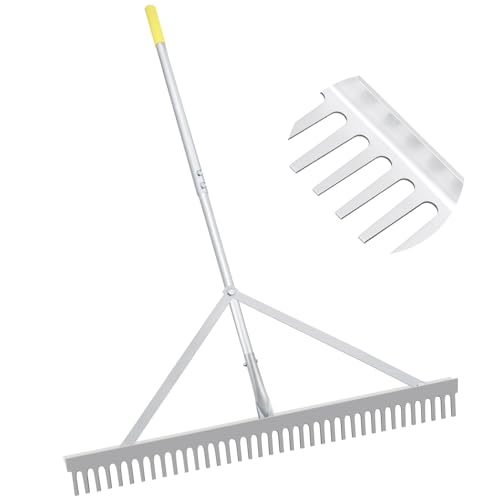
Byhagern Landscape Rake 36'', Aluminum Rakes with Lightweight 69'' Handle, Landscaping Rake Tool for Lawn Care, Beach
A wide landscape rake for shaping the shallow swale and leveling stone.
Why it helps: Makes the subtle V-shaped grade easier to form consistently through the corridor.
View on AmazonAs an Amazon Associate, we earn from qualifying purchases.
Visualizing the Result
Fixing a side yard requires "X-ray vision"—you have to imagine the water flow underground before you move a shovel. If you get the slopes wrong, you end up with a flooded living room or a toppled fence.
This is where GardenDream acts as your safety net. You can upload a photo of your messy side yard, and the AI will analyze the terrain to show you where the hardscape should go. It helps you visualize the "V" swale and the gravel finish before you buy a single bag of rock. It’s a diagnostic tool that prevents expensive grading mistakes.
If you want to spot hidden opportunities (or risks) in your own yard, upload a photo to our Exterior Design App to get an instant diagnosis and visualize the transformation.
Ready to see it on your own yard?
Use GardenDream to visualize ideas on your own photo before you make changes in real life.
Fast results ready in seconds
FAQs
1. Can I use spray foam to fill the gap under the slab?
2. Why shouldn't I use pea gravel for the surface?
3. How do I know if I have clay soil?
See more ideas for yards like this
If this yard problem looks familiar, these guides show broader design directions beyond this one example.
Side Yard Ideas
Narrow-space ideas for access paths, utility screening, drainage-prone corridors, and side-yard destinations.
Backyard Patio Ideas
Patio-led layout ideas for seating zones, gravel extensions, paving choices, and better backyard flow.
Small Backyard Ideas
Space-planning ideas for tight yards, awkward strips, pocket courtyards, and no-lawn layouts.