Yard Drainage Problems
A Forensic Breakdown of Common Hydraulic Failures.
Executive Summary
Water is the primary solvent of property value. Standing water, erosion, and "mud" are not gardening nuisances; they are active threats to structural integrity. This hub catalogs the specific failure modes where poor hydraulic management destroys foundations, rots siding, and liquifies hardscapes. These are not aesthetic choices; they are functional errors that require immediate engineering intervention.
Taxonomy of Failure Patterns
We have categorized systemic drainage failures into the following pathologies. Identify which pattern matches your property.
Category I: Foundation & Envelope Defense
Failures occurring at the interface of the home and the ground.
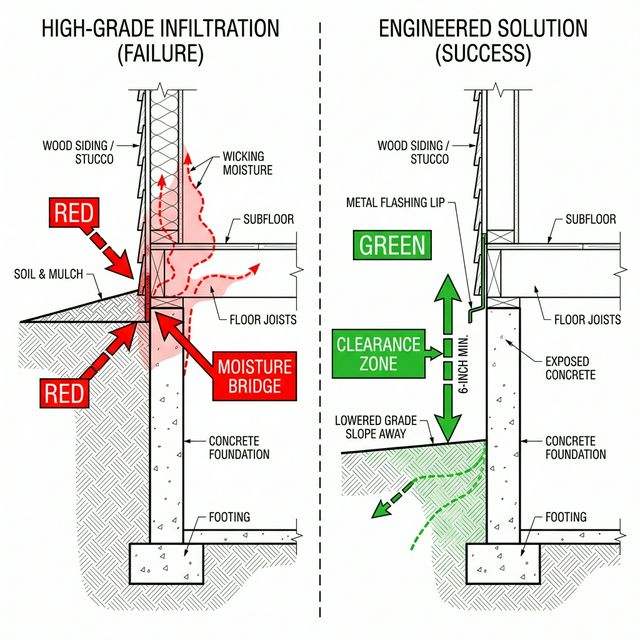
The High-Grade Infiltration Syndrome
Soil, mulch, or gravel piled against the home's siding or weep screed.
- Why it fails: It bridges the moisture gap, wicking water into the sill plate and inviting termites to bypass the concrete foundation.
- The Diagnostic Test: IF wood siding or stucco touches the ground, THEN you have High-Grade Infiltration.
- See the Case Study: "Buried Siding" and Bad Trees
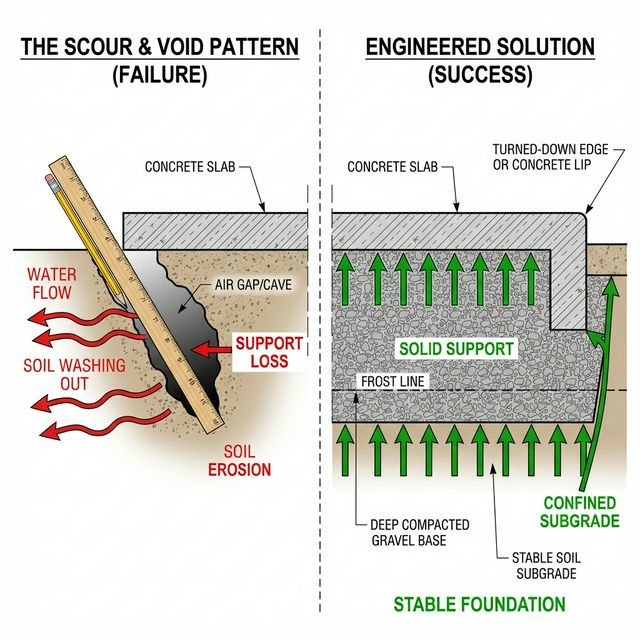
The Scour & Void Pattern
Erosion occurring directly alongside a concrete slab or foundation footing.
- Why it fails: High-velocity runoff removes the load-bearing soil beneath the slab, creating voids that lead to settlement and cracking.
- The Diagnostic Test: IF you can stick a pen into a gap beneath your concrete patio, THEN you have Scour & Void soil migration.
- See the Case Study: Exposed Foundation? How to Fix Soil Erosion Around Your Slab
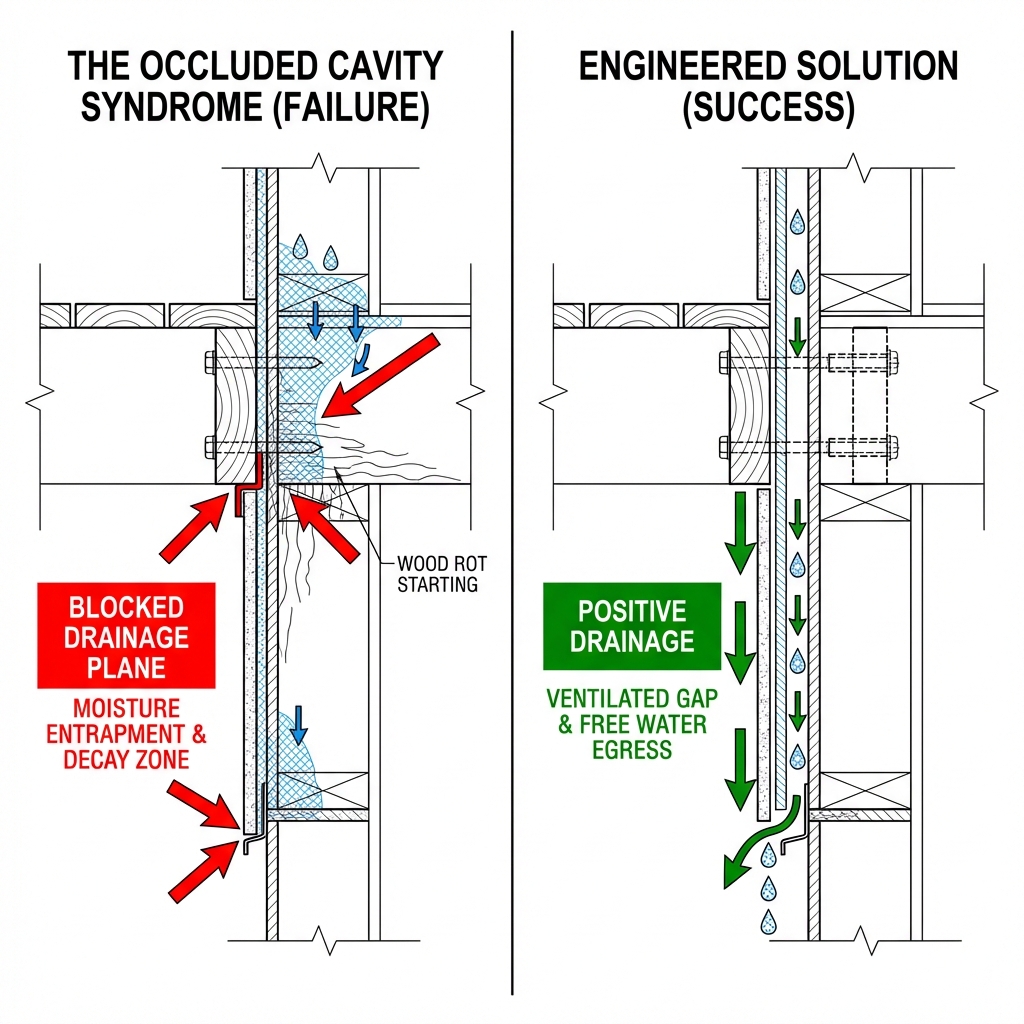
The Occluded Cavity Syndrome
A hydraulic and ventilation failure where hardscaping elements, such as decks or pavers, are installed tightly against the home's drainage plane, obstructing foundation vents or weep holes.
- Why it fails: By choking off essential airflow to crawlspaces or wall cavities, the structure traps interstitial moisture, creating a stagnant environment that accelerates wood rot, mold growth, and subterranean termite activity.
- The Diagnostic Test: IF a proposed patio or deck surface sits level with or above the bottom of foundation vents or masonry weep holes, then the system is in an occluded state., THEN you have The Occluded Cavity Syndrome.
- See the Case Study: The "Ground-Level" Deck Trap
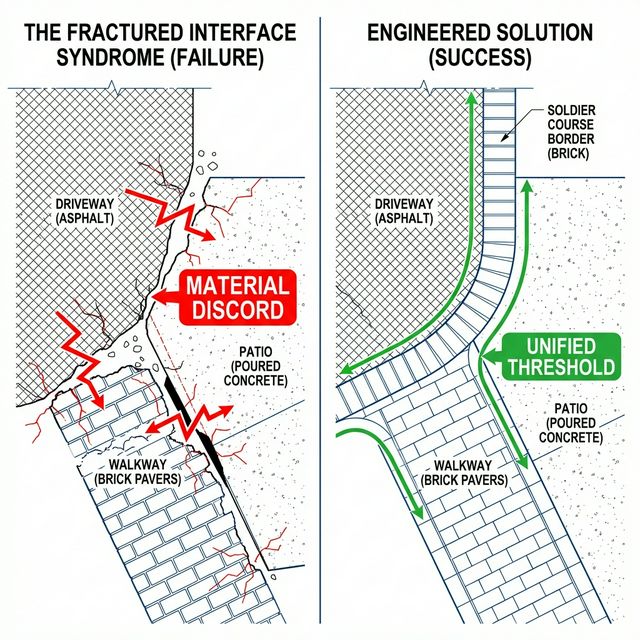
The Fractured Interface Syndrome
A hydraulic failure where the unsealed junction between two dissimilar materials, such as asphalt and a concrete foundation, creates a void that allows water to bypass surface grading.
- Why it fails: The unsealed joint acts as a hydraulic funnel; by bypassing the finished grade, water is directed into the sub-base where it causes foundation saturation, soil migration, and accelerated damage through freeze-thaw cycles.
- The Diagnostic Test: IF there is a visible gap or a recurring line of weeds at the junction of a hardscape surface and a vertical wall, then you have a fractured interface., THEN you have The Fractured Interface Syndrome.
- See the Case Study: Why Poppies Won't Fix Your Driveway Crack
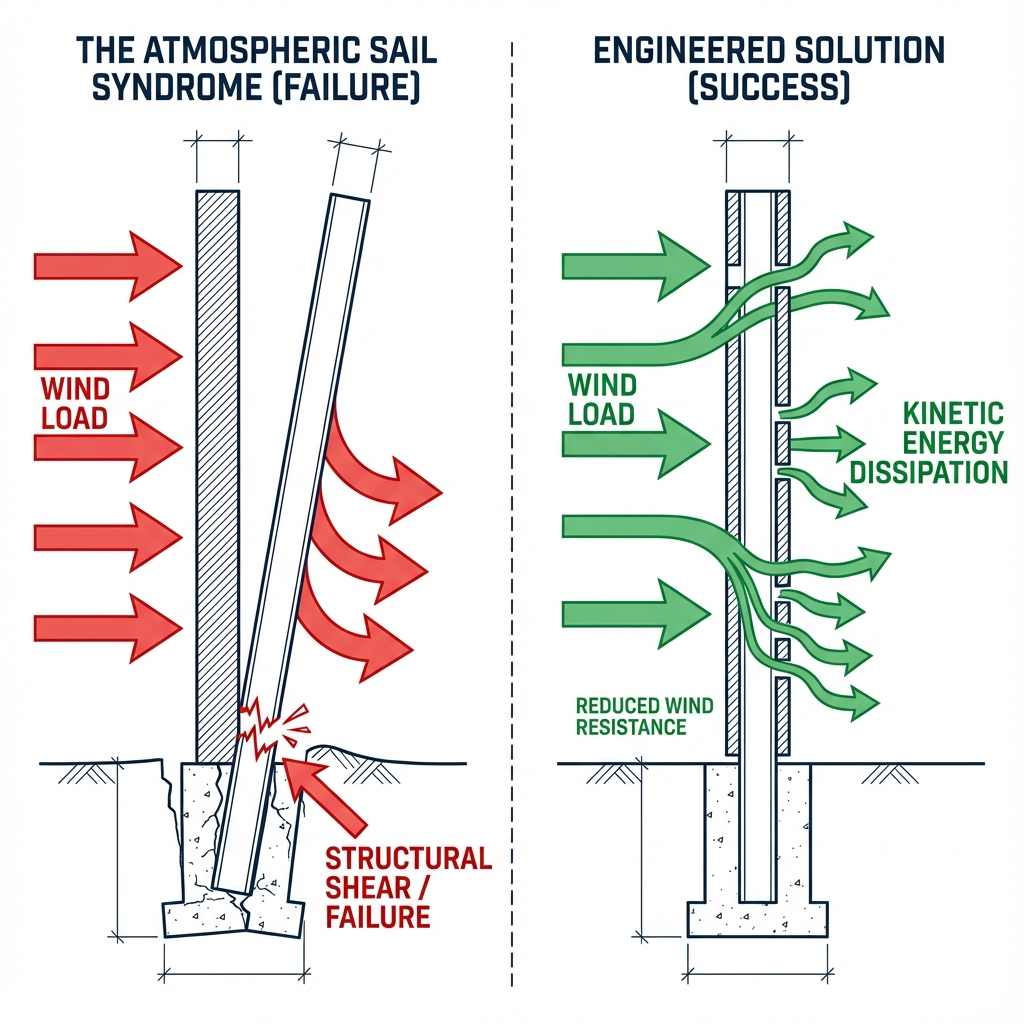
The Atmospheric Sail Syndrome
A structural and hydraulic failure where a permeable architectural gap is bridged with an impermeable fabric or lightweight cover, creating a Venturi effect.
- Why it fails: By obstructing a high-velocity air corridor (the wind tunnel effect) with non-structural materials, the system captures kinetic energy like a sail, transferring intense uplift and lateral loads to the home's fascia or masonry rather than allowing the pressure to dissipate.
- The Diagnostic Test: IF an overhead cover is tensioned between two parallel house wings or a narrow roof gap, then it will exert mechanical shear on its anchors during high-wind events., THEN you have The Atmospheric Sail Syndrome.
- See the Case Study: The "Roof Gap" Trap
The Reverse Gradient Syndrome
A hydraulic and structural failure where a monolithic hardscape surface settles unevenly, creating a negative slope that funnels surface water directly into a building's foundation.
- Why it fails: When soil beneath a slab washes out or compacts unevenly, the rigid concrete acts as a massive funnel, concentrating water against the footings and accelerating soil scour and mortar cracking.
- The Diagnostic Test: If a solid hardscape surface pitches toward your home and water pools against the siding or masonry after rain, Then you have The Reverse Gradient Syndrome.
- See the Case Study: The Concrete Trap: Why Your Sinking Patio is Destroying Your Foundation
Category II: Hardscape & Pavement Physics
Failures in patios, paths, driveways, and utilitarian surfaces.
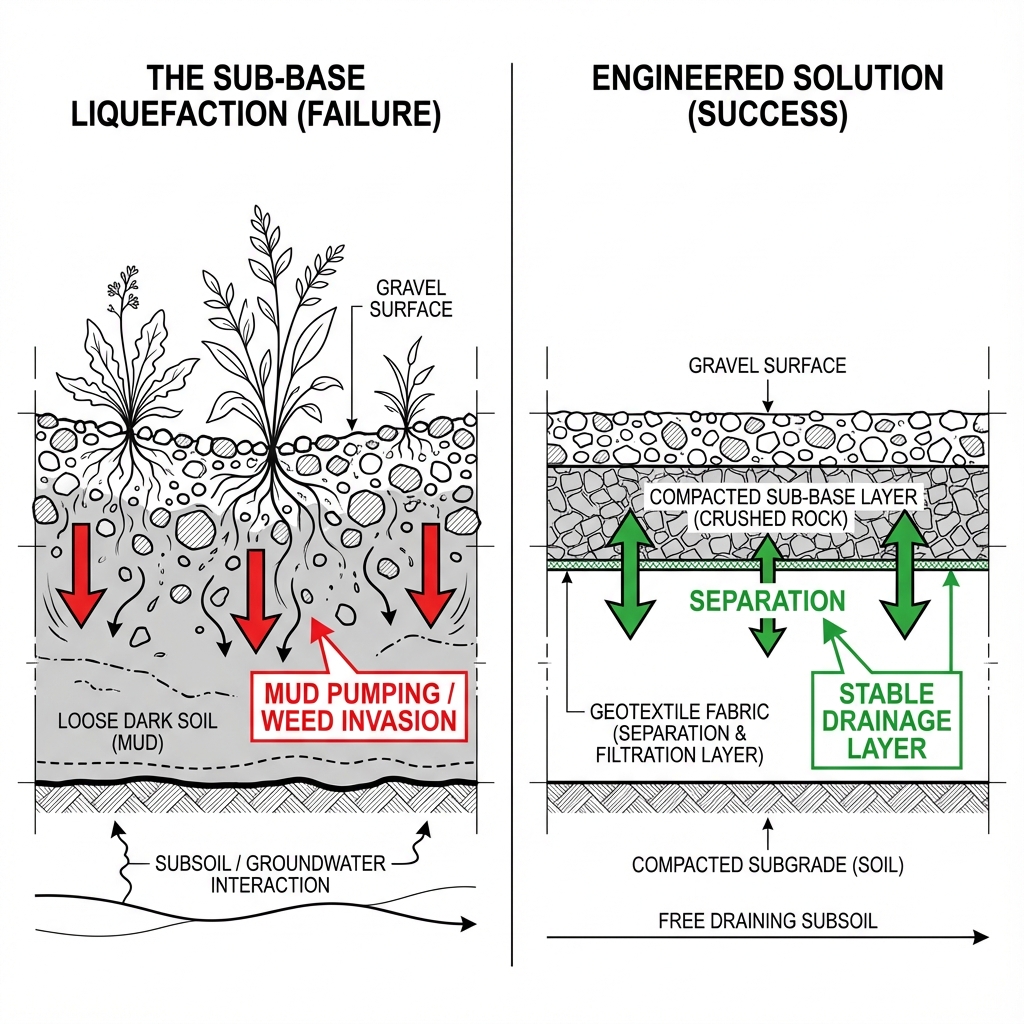
The Sub-Base Liquefaction
Paths or patios installed with "toppings" (gravel/granite) directly over native soil.
- Why it fails: Without a compacted road base, water mixes the surface stone with the subgrade clay, creating a permanent linear mud pit.
- The Diagnostic Test: IF your gravel path sinks when stepped on after rain, THEN Sub-Base Liquefaction is occurring.
- See the Case Study: Don't Skip the Base
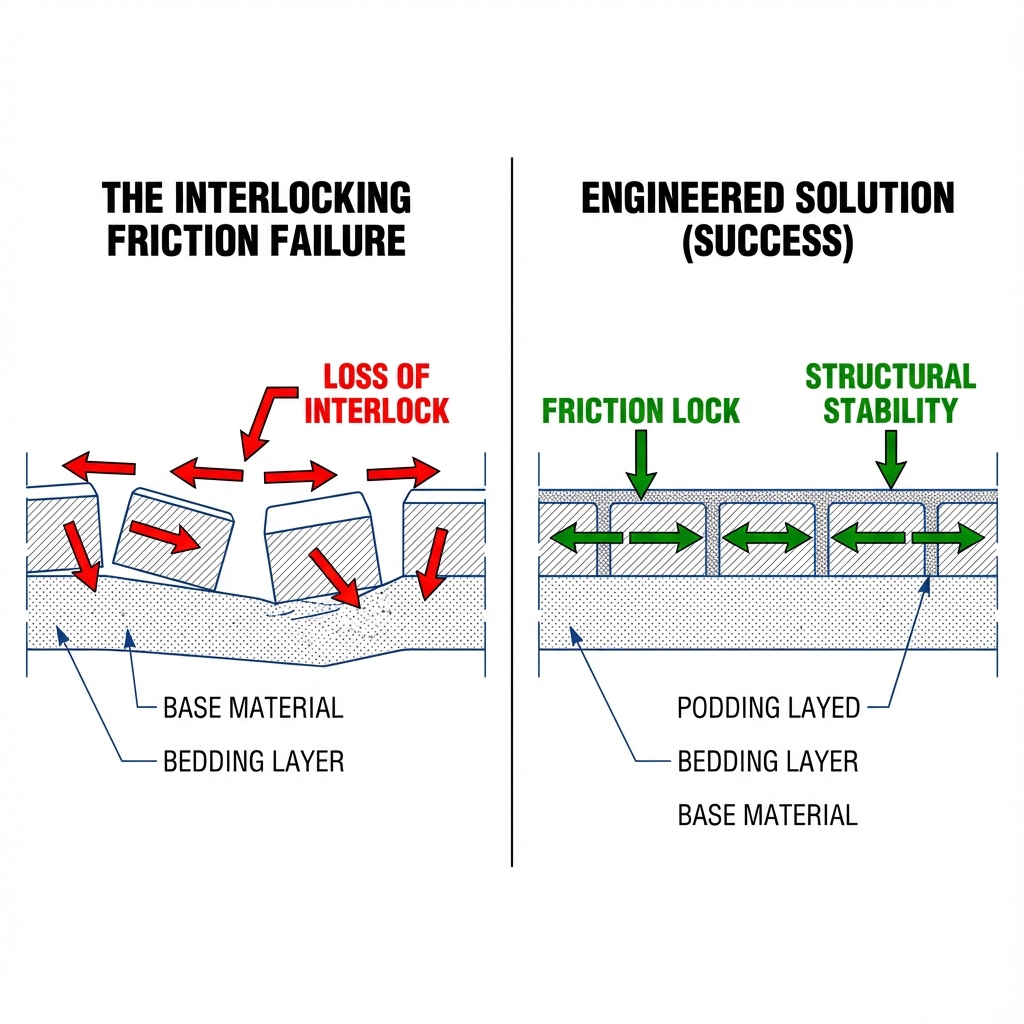
The Interlocking Friction Failure
A structural and hydraulic failure in segmental pavement systems where the jointing material (sand) is washed out or depleted, compromising the mechanical interlock of the units.
- Why it fails: Paver systems rely on lateral friction provided by full-depth joint sand to distribute loads and resist movement; without this lock, the units become susceptible to shifting, water infiltration, and base erosion, leading to total surface destabilization.
- The Diagnostic Test: IF the joints between pavers are empty, washed out, or sunken below the chamfered edge, then the system has lost its structural interlock., THEN you have The Interlocking Friction Failure.
- See the Case Study: New Pavers Look Sloppy?
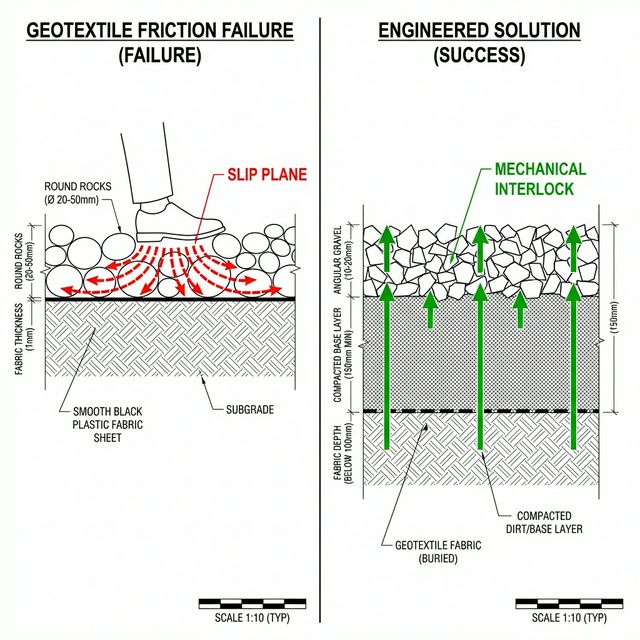
The Geotextile Friction Failure
A mechanical and hydraulic failure occurring when a low-friction, woven plastic barrier is used as a sub-base for aggregate, eliminating the friction required to lock particles in place.
- Why it fails: Woven plastic creates a slick slip-plane that allows gravel to migrate laterally under load, while the fabric’s weave eventually clogs with fine particles, trapping moisture on the surface and fostering weed growth in a layer of 'perched' mud.
- The Diagnostic Test: IF walking on a new aggregate path feels like 'marbles on glass' or the stones shift underfoot despite a flat grade, then a non-permeable, low-friction barrier has been incorrectly established., THEN you have The Geotextile Friction Failure.
- See the Case Study: The "Slip-n-Slide" Gravel Trap
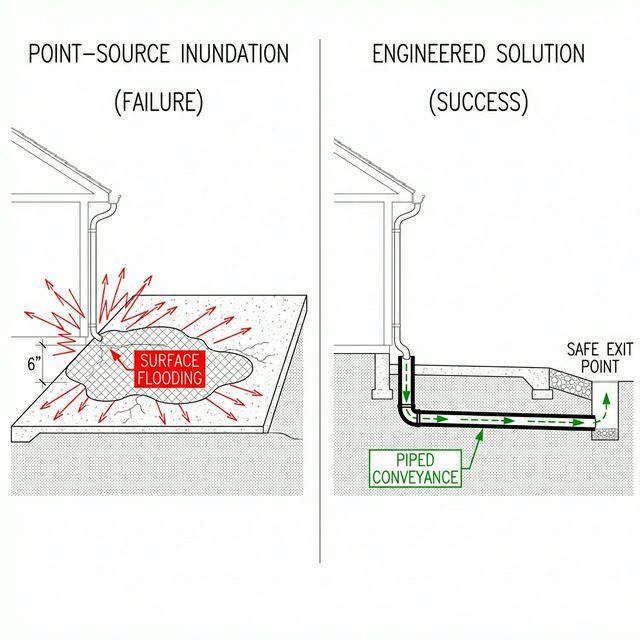
The Point-Source Inundation Syndrome
A hydraulic failure where concentrated runoff from a roof or upper-level hardscape is discharged directly onto a pedestrian or vehicular traffic surface without a dedicated conveyance system.
- Why it fails: By dumping high volumes of water onto a surface not graded for rapid evacuation, the system creates standing water and sheet flow; in cold climates, this leads to a dangerous melt-freeze cycle that creates surface ice and accelerates the mechanical weathering of the concrete.
- The Diagnostic Test: IF a downspout terminates directly onto a driveway or walkway without a transition to a subterranean pipe or trench drain, then you have Point-Source Inundation., THEN you have The Point-Source Inundation Syndrome.
- See the Case Study: Stop Your Driveway From Becoming an Ice Rink
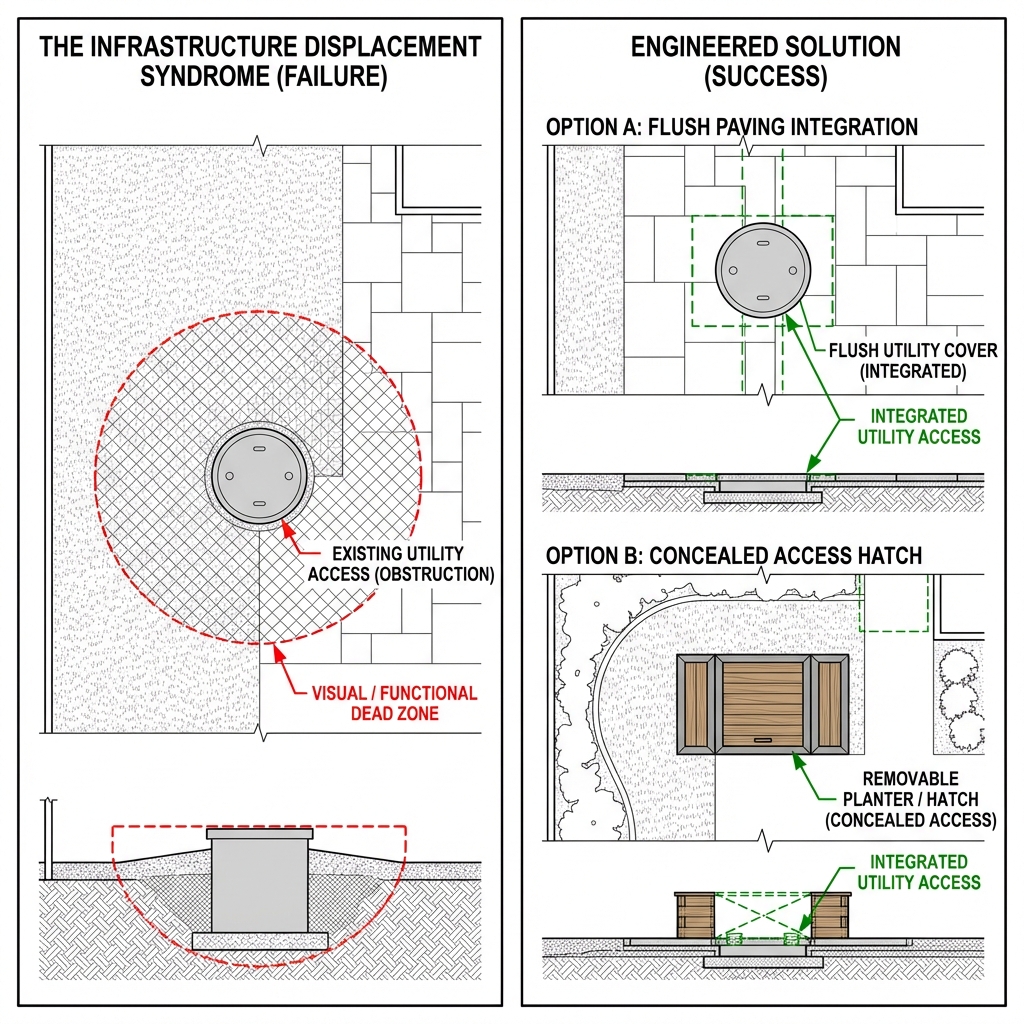
The Infrastructure Displacement Syndrome
A hydraulic and spatial failure where utilitarian conduits, easements, or irregular hardscape offsets create an unmanaged 'dead zone' of exposed soil adjacent to a foundation.
- Why it fails: These leftover strips often bypass the site's primary drainage grading, becoming collection points for surface water and mud that saturate the foundation or risk encasing utilities in concrete if the space is improperly paved.
- The Diagnostic Test: IF a curved walkway or utility easement has left a narrow, crescent-shaped strip of soil against a straight foundation wall, then the property is exhibiting The Infrastructure Displacement Syndrome., THEN you have The Infrastructure Displacement Syndrome.
- See the Case Study: That Awkward Dirt Strip Next to Your Foundation
Category III: Retaining & Boundary Engineering
Failures involving walls, fences, planters, and vertical water management.
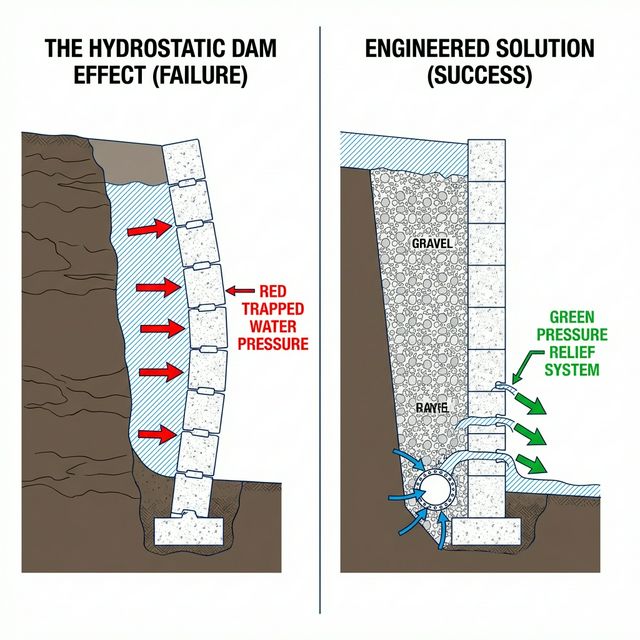
The Hydrostatic Dam Effect
Retaining walls or planters built without weep holes or proper backfill.
- Why it fails: Water pressure builds behind the masonry, exerting force that exceeds the structural rating of the wall, causing bowing and eventual collapse.
- The Diagnostic Test: IF a retaining wall has a visible "belly" or bow in the center, THEN Hydrostatic Pressure has compromised the structure.
- See the Case Study: Rotting Sleepers and "Jail Bar" Fences: How to Fix a Failing Retaining Wall
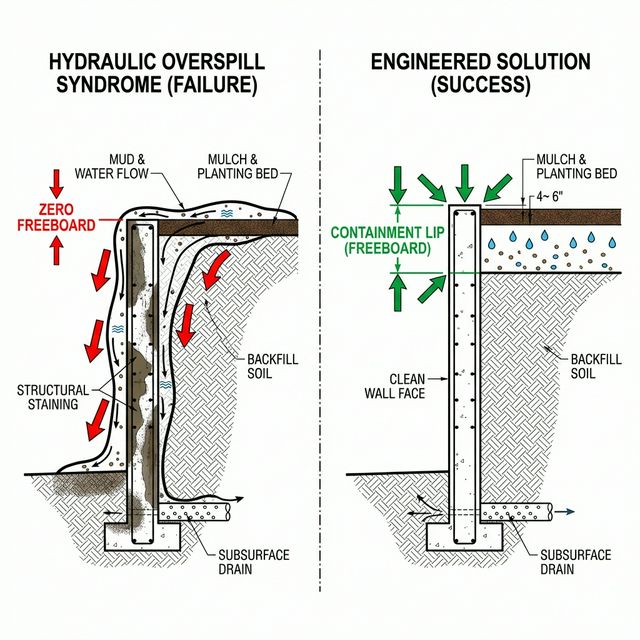
The Hydraulic Overspill Syndrome
A hydraulic failure where a retaining structure lacks sufficient freeboard, allowing surface water and suspended solids to bypass the vertical barrier.
- Why it fails: Without a vertical containment lip (freeboard), the structure fails to arrest the kinetic energy of sheet flow, resulting in 'mud waterfalls' that stain the facade and cause the migration of mulch and topsoil onto lower surfaces.
- The Diagnostic Test: IF the finished grade of the soil or mulch is flush with the top of a retaining wall or garden edging, then the system will experience sediment overspill and facade staining during heavy rain events., THEN you have The Hydraulic Overspill Syndrome.
- See the Case Study: Is My Retaining Wall Tall Enough?
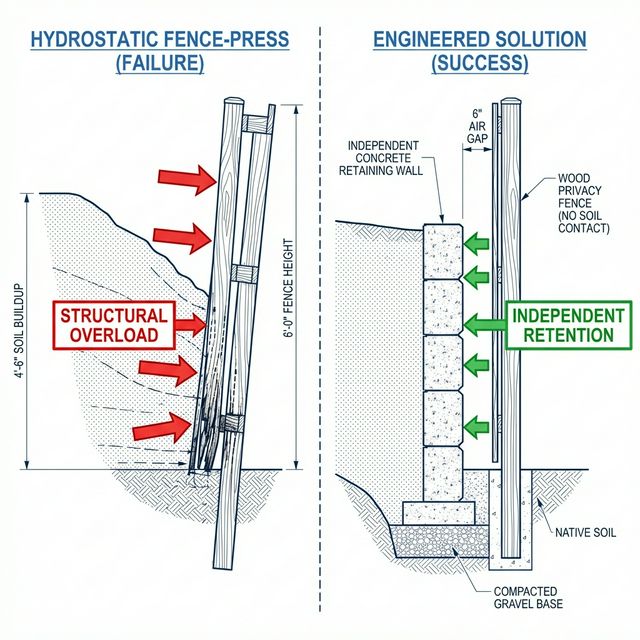
The Hydrostatic Fence-Press Syndrome
A structural and hydraulic failure where a lightweight boundary fence is utilized as a primary retaining wall for soil or mulch in a raised planter.
- Why it fails: Boundary fences are engineered for lateral wind loads, not the 110 lbs per cubic foot of hydrostatic pressure exerted by saturated soil; this results in panel bowing, rail fatigue, and accelerated oxidation of the metal or rot of the timber substrate.
- The Diagnostic Test: IF the soil of a raised planter is in direct contact with a boundary fence rather than an independent back wall, then lateral pressure will eventually compromise the fence's alignment and integrity., THEN you have The Hydrostatic Fence-Press Syndrome.
- See the Case Study: The "Fence-As-Wall" Mistake
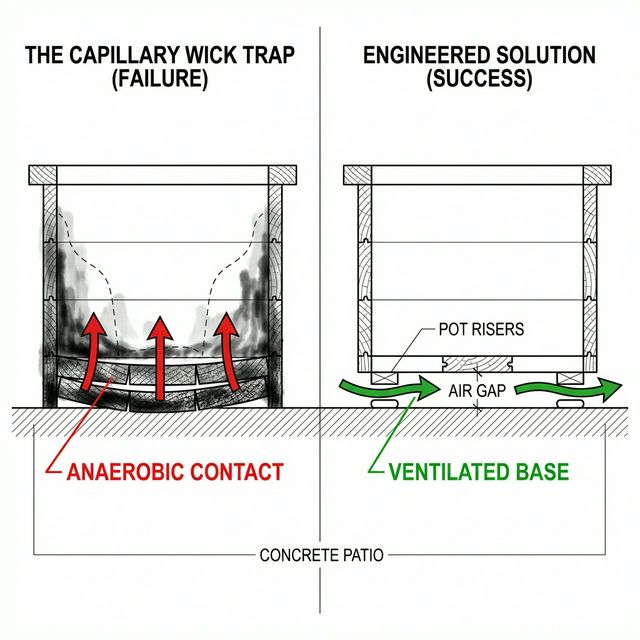
The Capillary Wick Trap
A hydraulic failure where a porous medium (soil or mulch) is used to shim or level a structural frame against an impermeable surface like concrete.
- Why it fails: The organic material acts as a sponge, wicking moisture upward into the timber frame via capillary action while simultaneously blocking the lateral escape of water, leading to rapid rot and anaerobic soil conditions.
- The Diagnostic Test: IF soil or mulch is used to fill the 'daylight' gaps between a wooden planter and a concrete slab, THEN you have The Capillary Wick Trap.
- See the Case Study: Building Raised Beds on an Old Concrete Slab
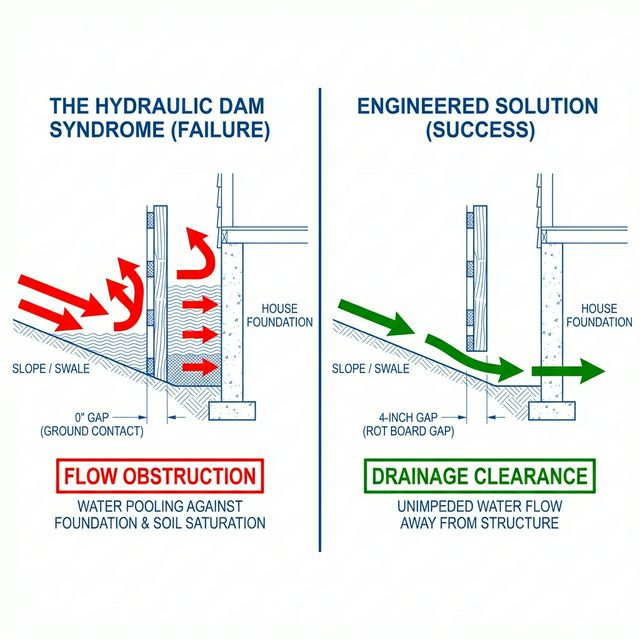
The Hydraulic Dam Syndrome
A hydraulic failure where a linear structure, such as a fence or wall, is installed across a designated drainage swale or easement, obstructing the natural flow of surface water.
- Why it fails: By blocking a managed water conveyance path before the final grade is established, the structure acts as a dam that impounds runoff, forcing water to pool against foundations or flood crawlspaces rather than exiting to the street.
- The Diagnostic Test: IF a fence or hardscape element is installed without a 'rot board' gap or drainage clearance in a side-yard easement before final grading, then it will inevitably capture silt and block the exit path of storm water., THEN you have The Hydraulic Dam Syndrome.
- See the Case Study: Installing a Fence Before the Neighbor's House is Finished?
Category IV: Soil & Biological Hydraulics
Failures related to organic matter, soil percolation, and vegetation.
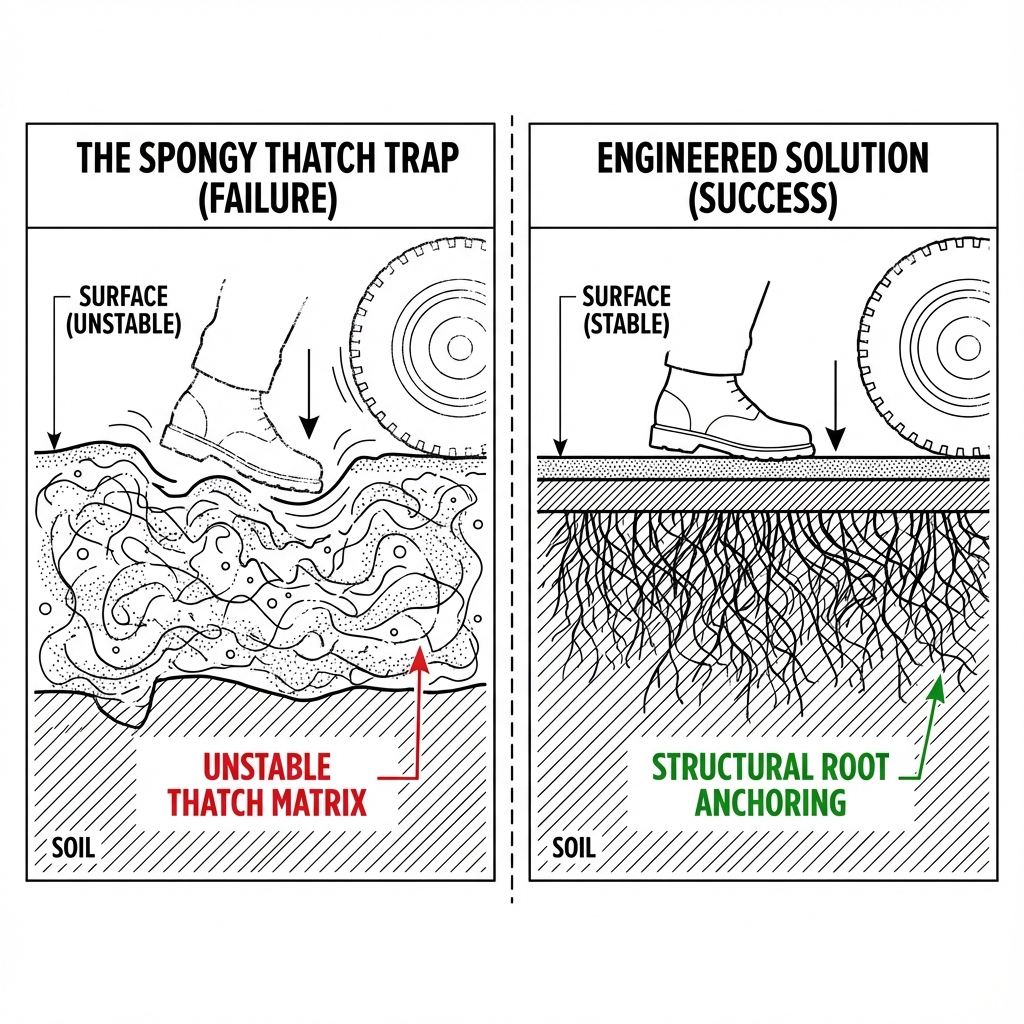
The Spongy Thatch Trap
Lawns (specifically Kikuyu or Zoysia) that have developed a thick organic mat.
- Why it fails: The thatch layer acts as a surface sponge, preventing water from penetrating the soil and causing surface bogging regardless of grading.
- See the Case Study: Fixing the 'Spongy' Lawn
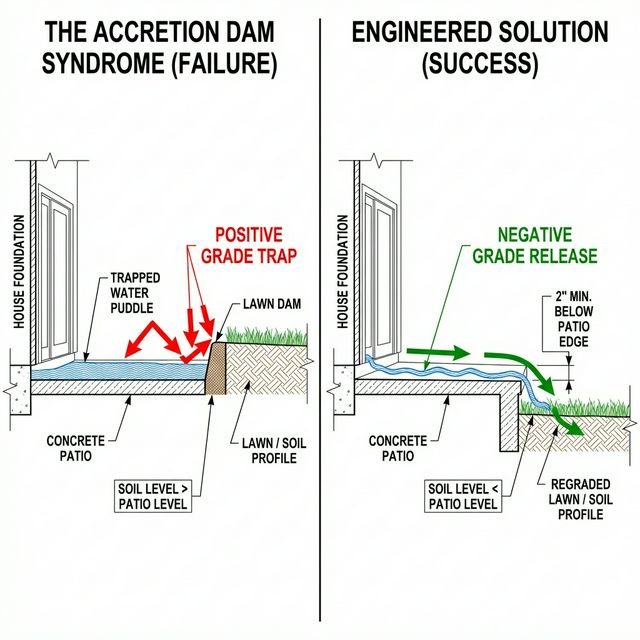
The Accretion Dam Syndrome
A hydraulic failure where the gradual accumulation of organic matter, thatch, and soil raises the lawn's grade above an adjacent hardscape surface.
- Why it fails: Lawns naturally rise over time due to root expansion and decomposition; when this biological grade exceeds the height of the concrete, it creates a 'lawn dam' that prevents surface water from exiting the slab, causing stagnation and masonry staining.
- The Diagnostic Test: IF water remains trapped on a hardscape surface despite no visible structural settling, then the adjacent turf grade has likely risen above the concrete edge., THEN you have The Accretion Dam Syndrome.
- See the Case Study: Sandbags Won't Fix Your Flooded Patio
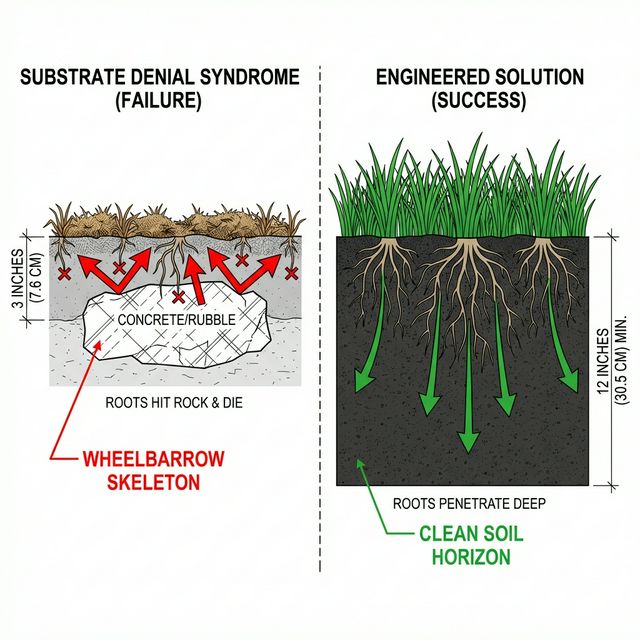
Substrate Denial Syndrome
The attempt to install a biological surface finish, such as turf or planting beds, over an incompatible, non-porous, or rubble-choked sub-base.
- Why it fails: An insufficient soil cap fails to provide necessary thermal insulation or moisture retention; the underlying rock or debris acts as a thermal capacitor, desiccating the root zone and creating anaerobic pockets.
- The Diagnostic Test: IF turf exhibits localized 'crispy' patches or stunted growth that mirrors the footprint of buried debris or former hardscaping, then Substrate Denial Syndrome is present., THEN you have Substrate Denial Syndrome.
- See the Case Study: How Much Rock You Can Leave Under a New Lawn
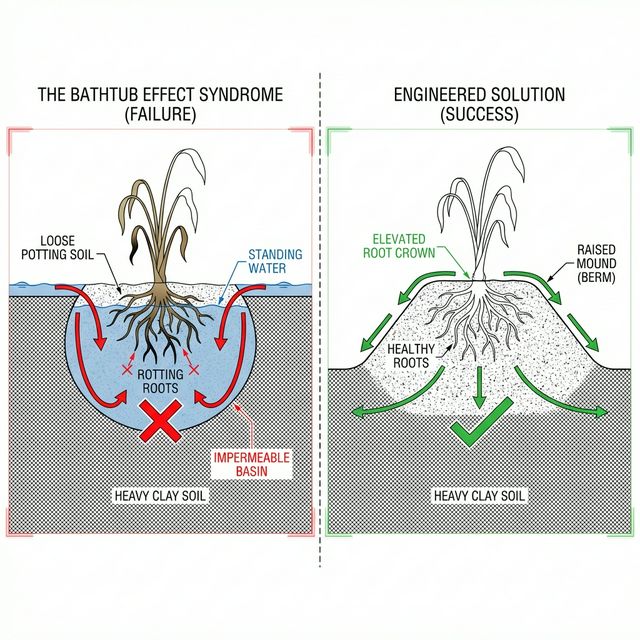
The Bathtub Effect Syndrome
A hydraulic failure where a depression is excavated into an impermeable soil layer (like clay) and backfilled with porous materials, creating a subterranean reservoir.
- Why it fails: Because clay lacks vertical percolation, the excavation acts as a vessel that captures and holds water; this saturates the backfill, creates anaerobic conditions, and leads to the rapid decay of structural elements or organic mulch.
- The Diagnostic Test: IF an excavated pit holds water for more than 24 hours after a rain event, any porous fill placed inside will succumb to this syndrome., THEN you have The Bathtub Effect Syndrome.
- See the Case Study: How to Prep a Muddy Clay Yard for a Playground
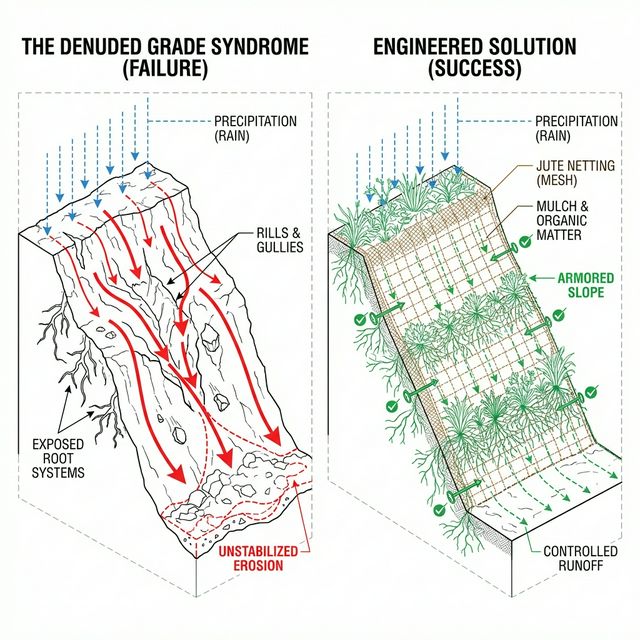
The Denuded Grade Syndrome
The removal of surface vegetation and organic 'skin' from a slope, leaving bare soil vulnerable to hydraulic transport.
- Why it fails: Without a root matrix to provide mechanical stabilization and a 'duff' layer to dissipate raindrop kinetic energy, water gains velocity across the surface, resulting in sheet erosion and the loss of topsoil.
- The Diagnostic Test: IF a slope has been stripped of vegetation and organic debris without being immediately restabilized with a root matrix or interlocking mulch, then the next rain event will result in rilling and sediment transport., THEN you have The Denuded Grade Syndrome.
- See the Case Study: How to Turn a Bare, Eroding Slope Into a Low-Maintenance Woodland Garden
Category V: Subsurface & Systemic Capacity
Failures in the underground conveyance and volume management systems.
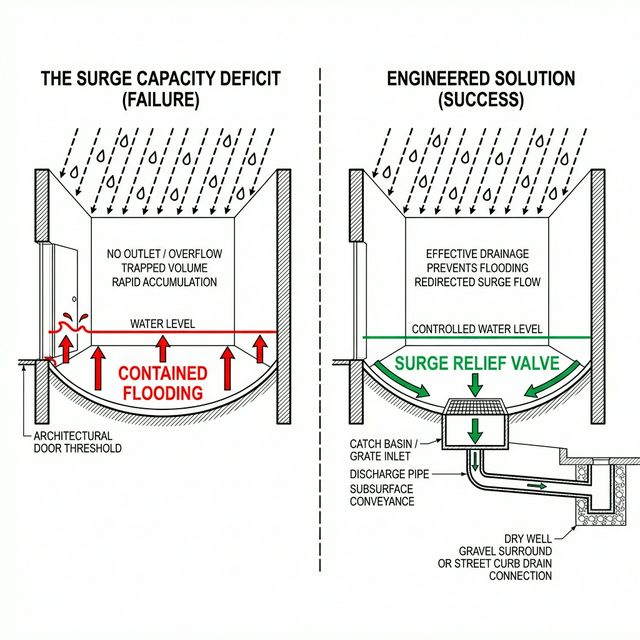
The Surge Capacity Deficit
A hydraulic failure where a site lacks sufficient subterranean void volume or reservoir capacity to buffer high-intensity runoff during peak 'surge' events.
- Why it fails: In enclosed catchments or areas with low-percolation soil, the volume of a storm can exceed the ground’s instantaneous infiltration rate; without a temporary storage vessel like a dry well, water levels rise rapidly and breach architectural thresholds or foundation vents.
- The Diagnostic Test: IF a land-locked hardscape lacks a central drainage intake or surge tank, then localized flooding will occur during rapid-onset storms regardless of the paving's material permeability., THEN you have The Surge Capacity Deficit.
- See the Case Study: The "Useless" Backyard Drain
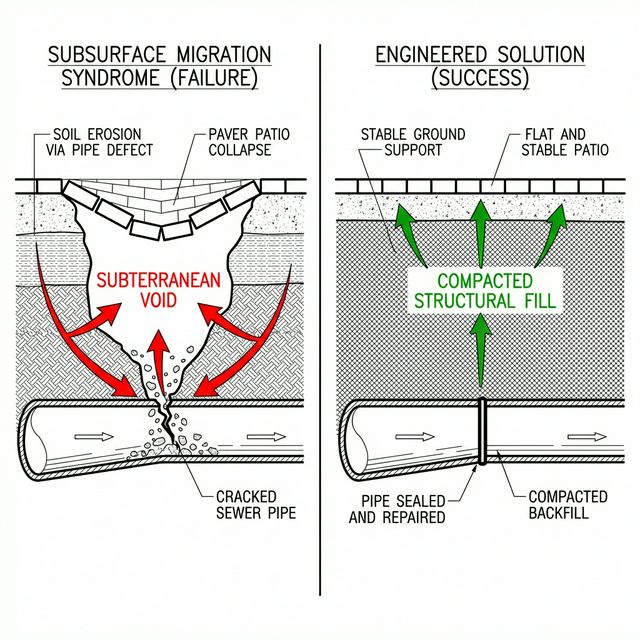
The Subsurface Migration Syndrome
A mechanical and hydraulic failure where soil particles are physically transported into a compromised subsurface conduit, such as a cracked sewer line or separated drain pipe.
- Why it fails: Unlike standard settlement, which is the compression of air pockets in disturbed soil, migration involves the total removal of mass; flowing water acts as a transport medium that carries soil through a pipe breach, creating a structural void that can eventually undermine foundation footings.
- The Diagnostic Test: IF a surface depression reappears rapidly after backfilling and exceeds 12 inches in depth, then the failure is caused by soil migration into a compromised utility line rather than simple substrate settlement., THEN you have The Subsurface Migration Syndrome.
- See the Case Study: The 5-Foot Sinkhole
The Flush-Grade Silt Trap
A hydraulic failure where a surface catch basin is installed flush with or below adjacent un-stabilized soil, allowing sediment to wash directly into the subsurface drainage system.
- Why it fails: It turns a water management tool into a sediment funnel. Instead of capturing clean runoff, the flush grade allows bare mud to flow into the basin, eventually clogging the underground pipes, filling the sump, and causing systemic backup.
- The Diagnostic Test: If bare soil sits flush with or higher than the lip of a catch basin grate, Then you have a Flush-Grade Silt Trap.
- See the Case Study: Why You Should Never Bury a Catch Basin (And How to Stop the Mud)
Material Interface Failures
New failure patterns identified by the GardenDream Engine.
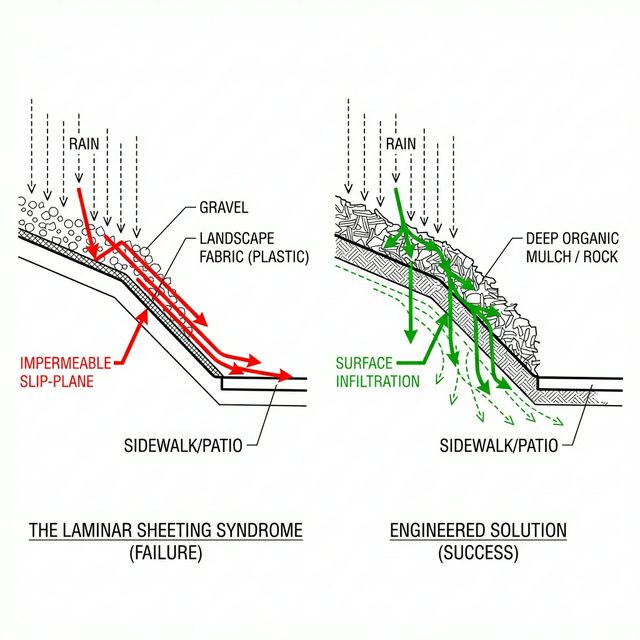
The Laminar Sheeting Syndrome
A hydraulic failure where a permeable mulch layer (rock) is installed over an impermeable or frozen membrane (landscape fabric), preventing percolation and forcing meltwater to sheet laterally onto adjacent hardscapes.
- Why it fails: The landscape fabric reduces surface friction and eliminates infiltration, turning the sub-mulch layer into a water slide that ejects runoff onto the nearest pavement.
- The Diagnostic Test: If you see a dry rock bed immediately adjacent to a heavily iced sidewalk section, Then you have Laminar Sheeting.
- See the Case Study: Why Your 'Low-Maintenance' Rock Garden Turned Your Sidewalk into an Ice Rink
Soil Structure Failures
New failure patterns identified by the GardenDream Engine.
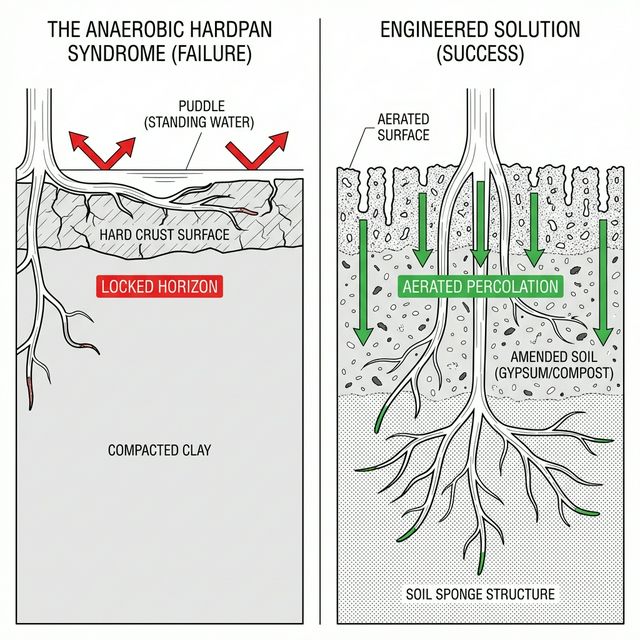
The Anaerobic Hardpan Syndrome
The structural collapse of clay soil porosity due to mechanical compression while wet, resulting in an impermeable, oxygen-deprived brick layer.
- Why it fails: Clay particles are plate-shaped; when compressed under weight and moisture, they align flat against each other, eliminating the pore space required for drainage and root penetration.
- The Diagnostic Test: If water pools in tire tracks for days while adjacent grass is dry, then you have Anaerobic Hardpan.
- See the Case Study: Fixing a Muddy Clay Nightmare: The 'Biological Drilling' Method
[Category V: Subsurface & Systemic Capacity]
New failure patterns identified by the GardenDream Engine.
The Shallow-Trench Crush Syndrome
A mechanical failure where thin-walled drainage conduits are installed without sufficient soil cover in kinetic traffic zones, resulting in structural collapse under vehicular or pedestrian loads.
- Why it fails: Without adequate soil depth to distribute kinetic weight, the point-load of a mower or footstep transfers directly to the brittle plastic housing, shattering the pipe and daylighting the system prematurely.
- The Diagnostic Test: If you see a cracked, exposed plastic pipe protruding from a high-traffic lawn or walkway, Then you have a Shallow-Trench Crush.
- See the Case Study: Stop Crushing Your Drainage Pipes: How to Properly Daylight a Downspout
Topographic & Boundary Failures
New failure patterns identified by the GardenDream Engine.
The Cross-Boundary Sheeting Syndrome
A hydraulic failure where unmanaged surface runoff from an elevated adjacent property sheets directly across a shared boundary into a lower-elevation architectural envelope.
- Why it fails: It assumes arbitrary property lines act as physical hydraulic barriers. Without an intercepting swale or retaining structure, gravity forces the lower home's foundation to act as the retaining wall for the neighbor's entire watershed.
- The Diagnostic Test: If your foundation is the lowest point between two properties and lacks an intercepting channel, Then you have The Cross-Boundary Sheeting Syndrome.
- See the Case Study: How to Stop Neighbor's Runoff from Flooding Your Garage
The "Curb Appeal" Bridge
Curb appeal is not magic; it is the absence of these specific errors. A muddy path is not "rustic," it is poorly engineered. A rotting wall is not "weathered," it is structurally unsound. You cannot decorate over a drainage problem.
"A home with high curb appeal is simply a home where the geometry, drainage, and materials are mathematically coherent."
Initiate Curb Appeal Optimization
You cannot fix what you cannot measure. The human eye misses slope ratios and proportion errors that lead to drainage failures. Upload a photo of your property to run a full diagnostic scan against our engineering database.