Exterior Design Mistakes
A Forensic Breakdown of Common Facade Failures.
The Executive Summary
A home's exterior is an envelope system, not a canvas. Most "ugly" homes are actually suffering from geometric imbalances, drainage failures, or material incompatibilities that degrade the structure's longevity. These are not subjective questions of "bad taste"; they are functional errors in scale, contrast, and continuity that lower property value and usability. We diagnose these issues as pathologies of the built environment.
Taxonomy of Failure Patterns
We have categorized the most common exterior failures into specific syndromes. These patterns represent a fundamental disconnect between architectural DNA and landscape execution.
Category I: Geometric & Massing Failures
Failures related to the physical shape, scale, and proportion of the structure.
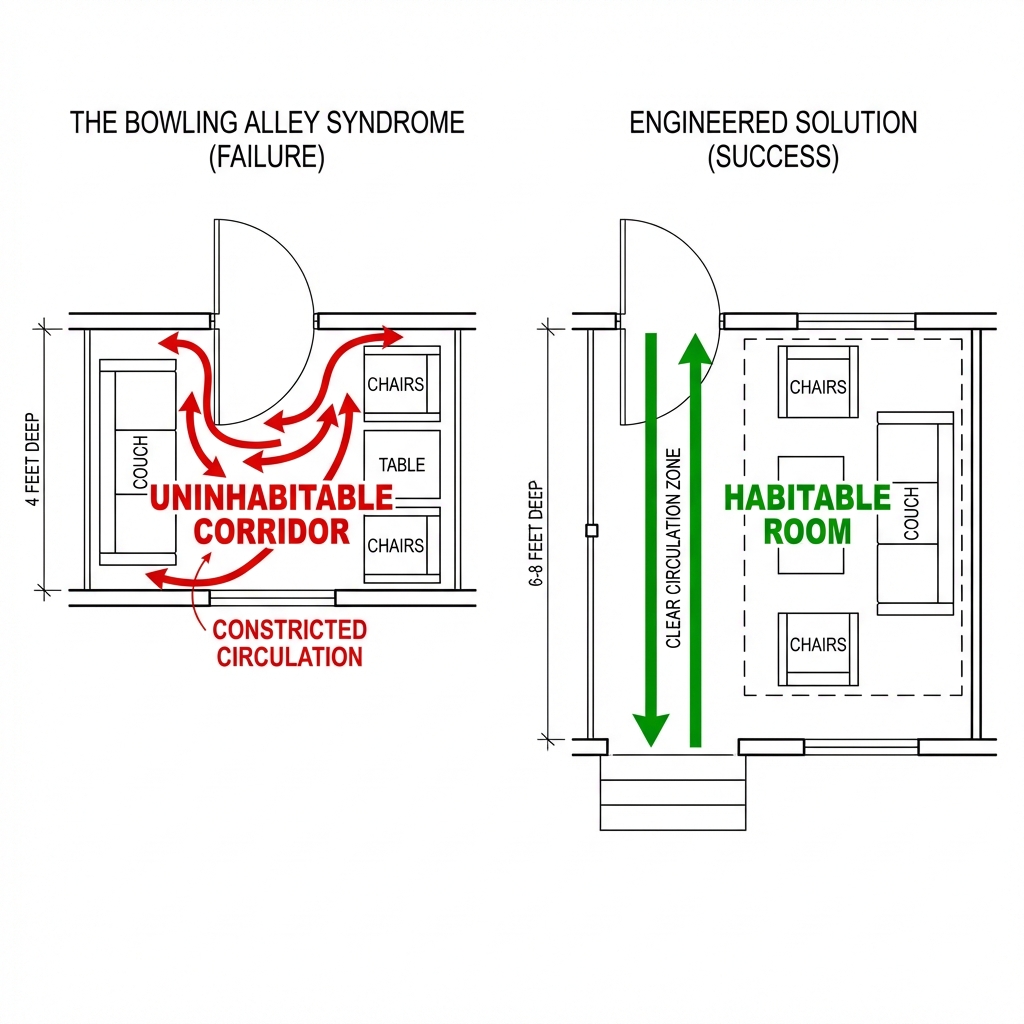
The Bowling Alley Syndrome
Defining a porch or walkway by its length rather than its depth.
- Why it fails: A porch less than 6 feet deep is a hallway, not a room; it creates a "corridor effect" that accelerates movement rather than creating a habitable entry zone.
- The Diagnostic Test: Measure your front porch depth. IF it is less than 6 feet deep, THEN it is a "corridor," not a habitable room.
- See the Case Study: Adding a Front Porch to a Brick Ranch? Avoid the "Bowling Alley" Mistake
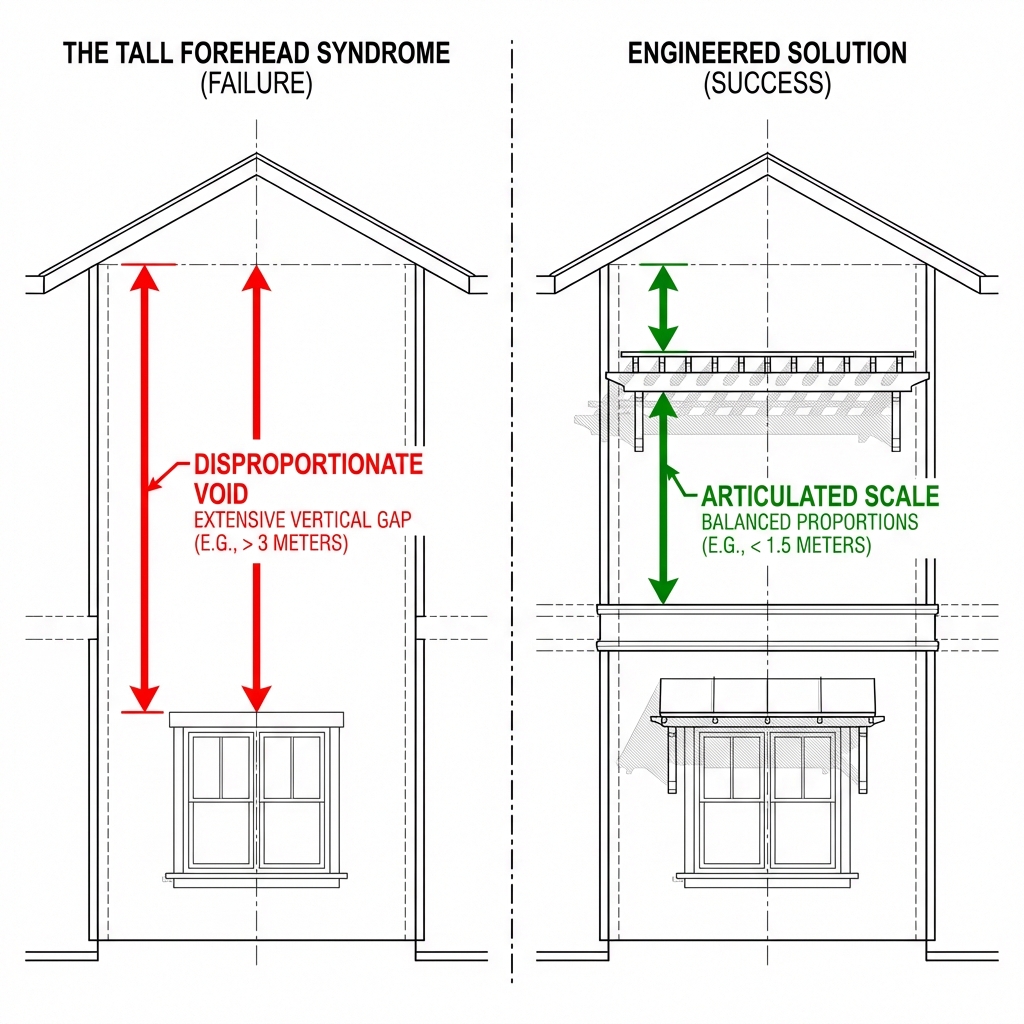
The Tall Forehead Syndrome
A visual failure where a large expanse of unarticulated vertical facade between or above windows creates a disproportionate, 'empty' architectural face.
- Why it fails: It lacks depth, shadow, and horizontal breaks (articulation), causing the eye to fixate on the blank massing rather than the home's intentional features.
- The Diagnostic Test: Look at the space above your garage or windows. IF the blank vertical space is taller/wider than the windows themselves, THEN the proportions are unbalanced.
- See the Case Study: Fixing the 'Tall Forehead'
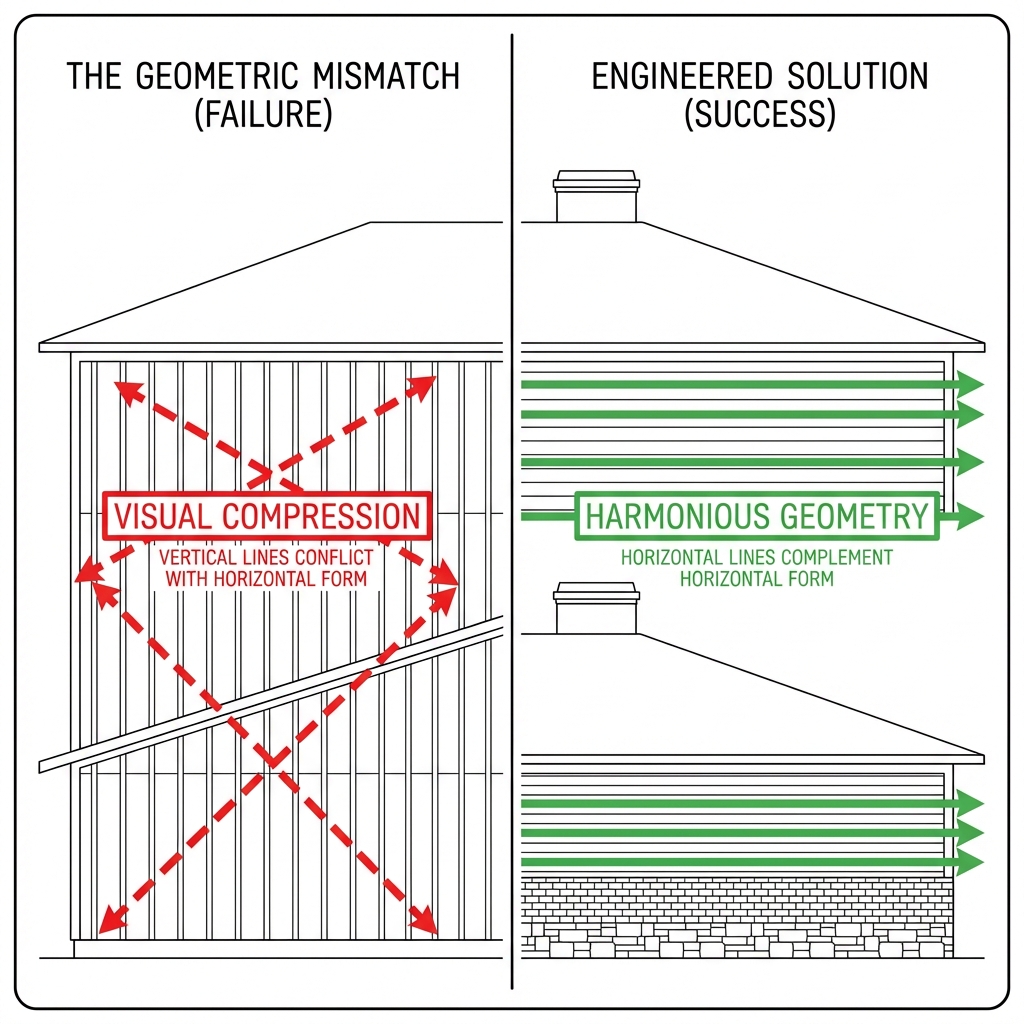
The Geometric Mismatch
The application of vertical architectural elements (steep gables, board-and-batten siding) onto a structure with a horizontal chassis (low-pitch roof, linear footprint).
- Why it fails: The existing roof pitch and massing physically contradict the new aesthetic, creating visual dissonance where the house looks "costumed" rather than renovated.
- The Diagnostic Test: IF you are adding board-and-batten siding to a low-pitch hip roof, THEN the vertical lines will visually crush the horizontal roofline.
- See the Case Study: Don't 'Farmhouse' Your 1950s Ranch: How to Add Texture Without Trending Hard
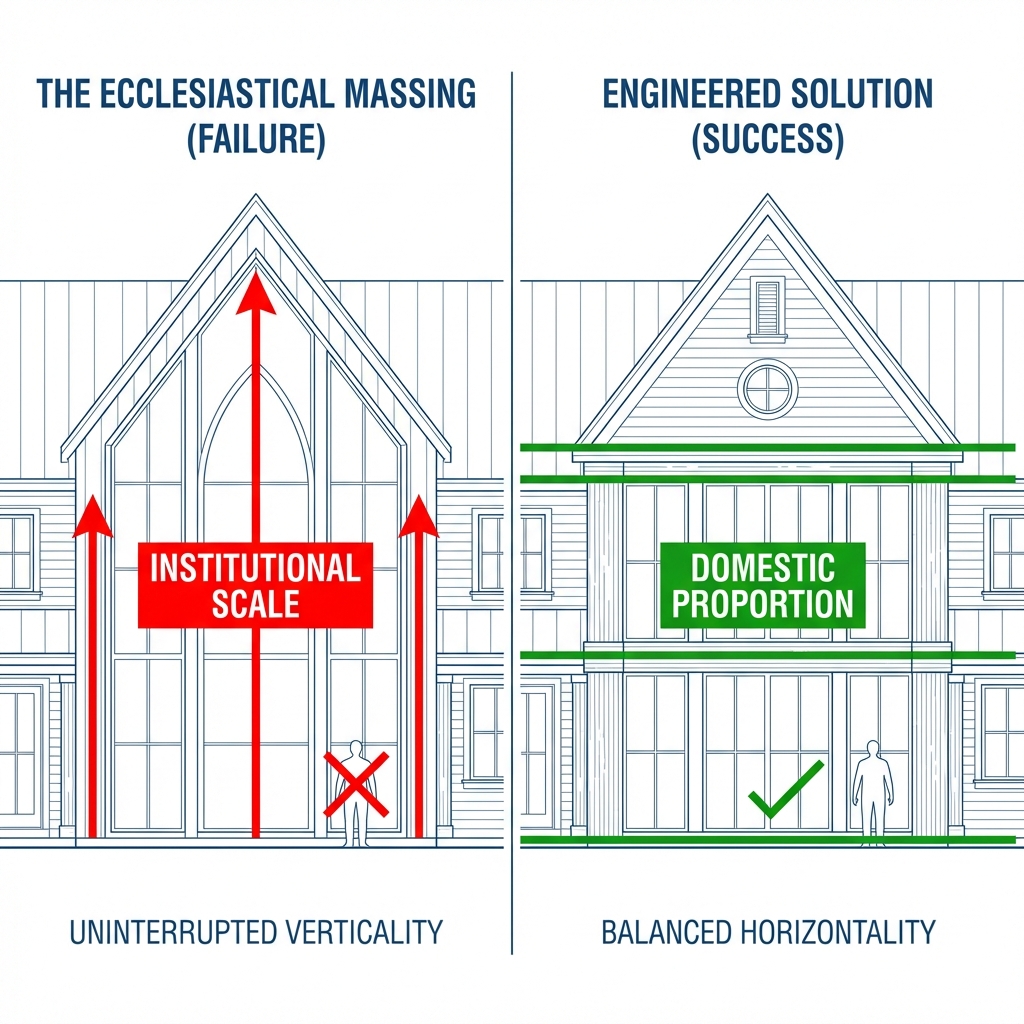
The Ecclesiastical Massing Syndrome
A visual failure where residential glazing and roofline proportions mimic the vertical velocity and scale of religious or institutional architecture.
- Why it fails: By extending glass to the peak of a gable or using rigid, ungrounded symmetry, the structure loses its domestic intimacy and instead draws the eye upward in a way that signals a public lobby or sanctuary rather than a private home.
- The Diagnostic Test: IF a central gable features a bank of windows that follows the roof pitch to a sharp peak without a horizontal wall break, THEN it will be perceived as a church lobby.
- See the Case Study: Why Your Modern Farmhouse Looks Like a Chapel
Category II: Material Envelope Physics
Failures related to moisture, thermal expansion, substrate stability, and adhesion.
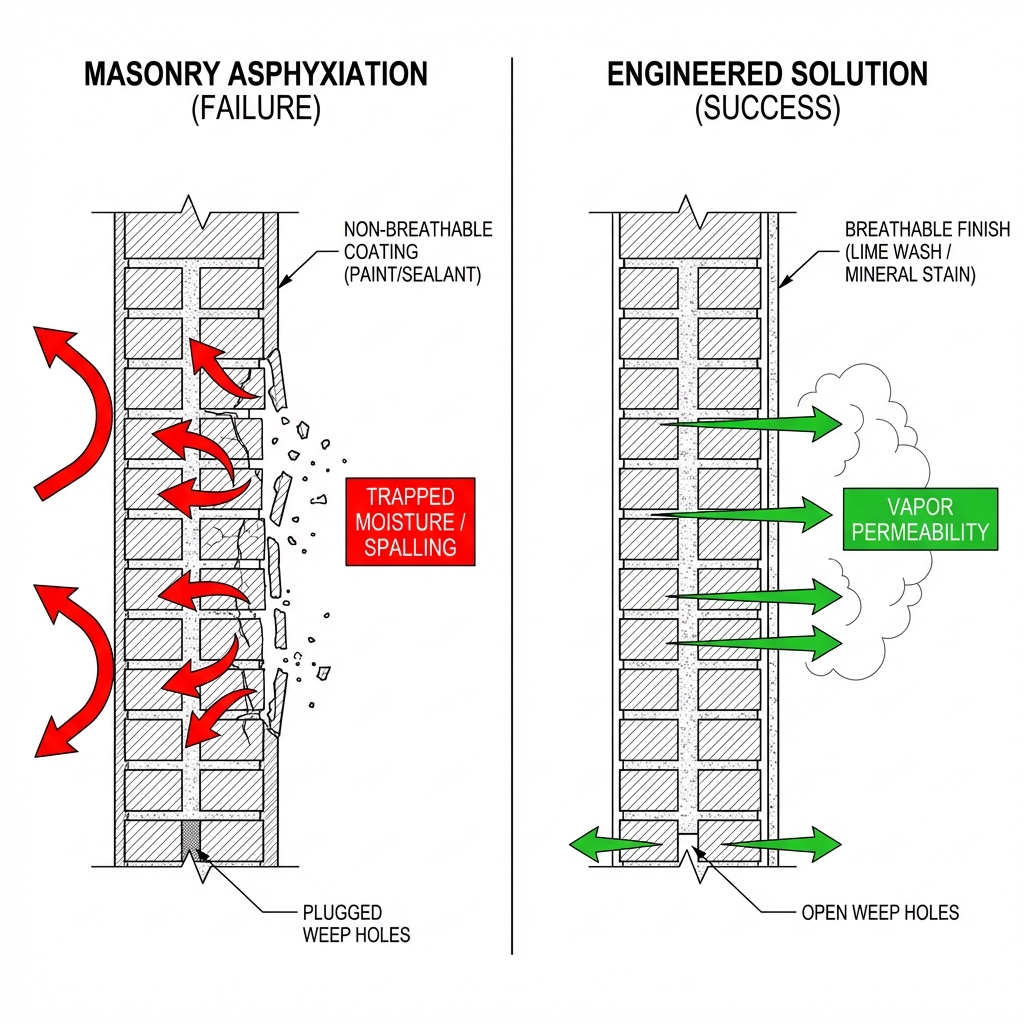
Masonry Asphyxiation
The application of solid paint or heavy mortar bagging over brick without regard for weep holes or moisture gradients.
- Why it fails: It converts a breathable masonry substrate into a sealed surface, trapping moisture behind the face and flattening the architectural texture into a plastic-looking monolith.
- The Diagnostic Test: Inspect the bottom row of your brick. IF the weep holes are filled with mortar or paint, THEN you have sealed the wall assembly.
- See the Case Study: Bagging Your Brick House: The Permanent Mistake You Might Not Need to Make
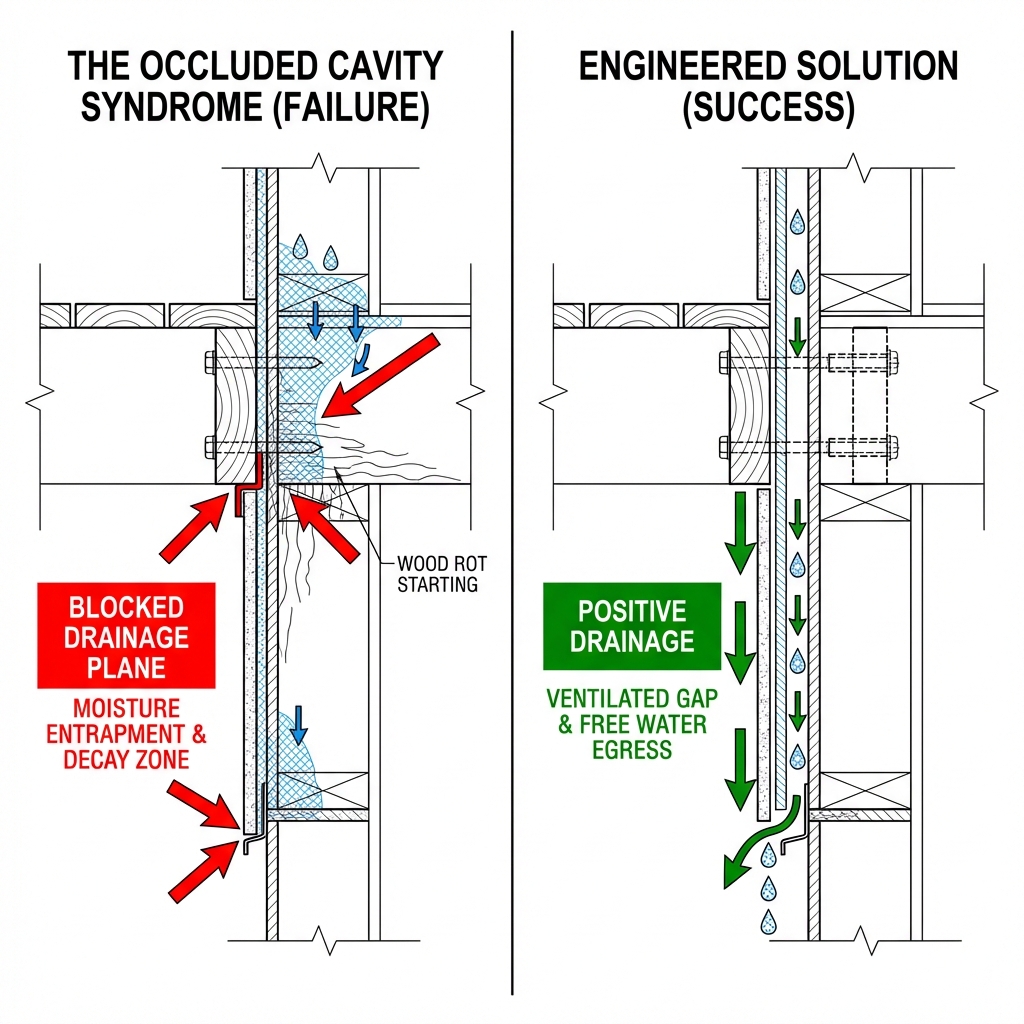
The Occluded Cavity Syndrome
A mechanical failure where hardscaping elements (decks, pavers, or steps) are installed tightly against the home's drainage plane, blocking weep holes and ventilation.
- Why it fails: It prevents the wall assembly from exhausting condensation and creates a capillary bridge that draws moisture into the structure.
- The Diagnostic Test: Check where your deck or patio meets the house. IF you cannot see the bottom edge of your weep screed (or if the deck boards touch the stucco), THEN you have blocked the drainage.
- See the Case Study: The "Stifled Weep" Trap: Why Decking Against Stucco is a House-Killer
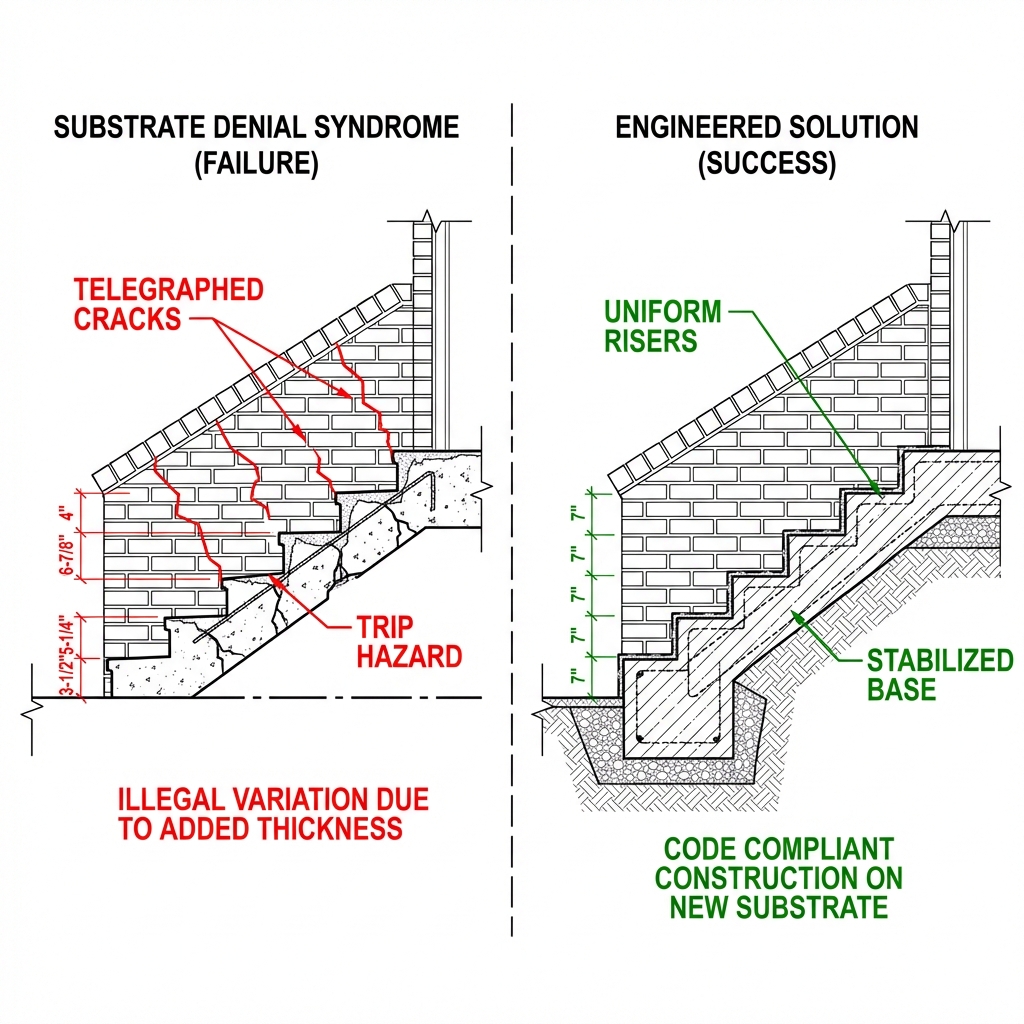
Substrate Denial Syndrome
The attempt to install surface finishes (brick veneer, stone, or pavers) over unstable, moving, or geometrically non-compliant sub-bases.
- Why it fails: New materials 'telegraph' the cracks of the base below because the underlying movement hasn't been stabilized, and adding thickness to stairs creates illegal riser variations that cause trip hazards.
- The Diagnostic Test: Measure your front steps. IF the rise of your steps varies by more than 3/8 inch, or if the underlying masonry is cracked, THEN any new veneer will fail or create a trip hazard.
- See the Case Study: Don't Brick Over Broken Stairs
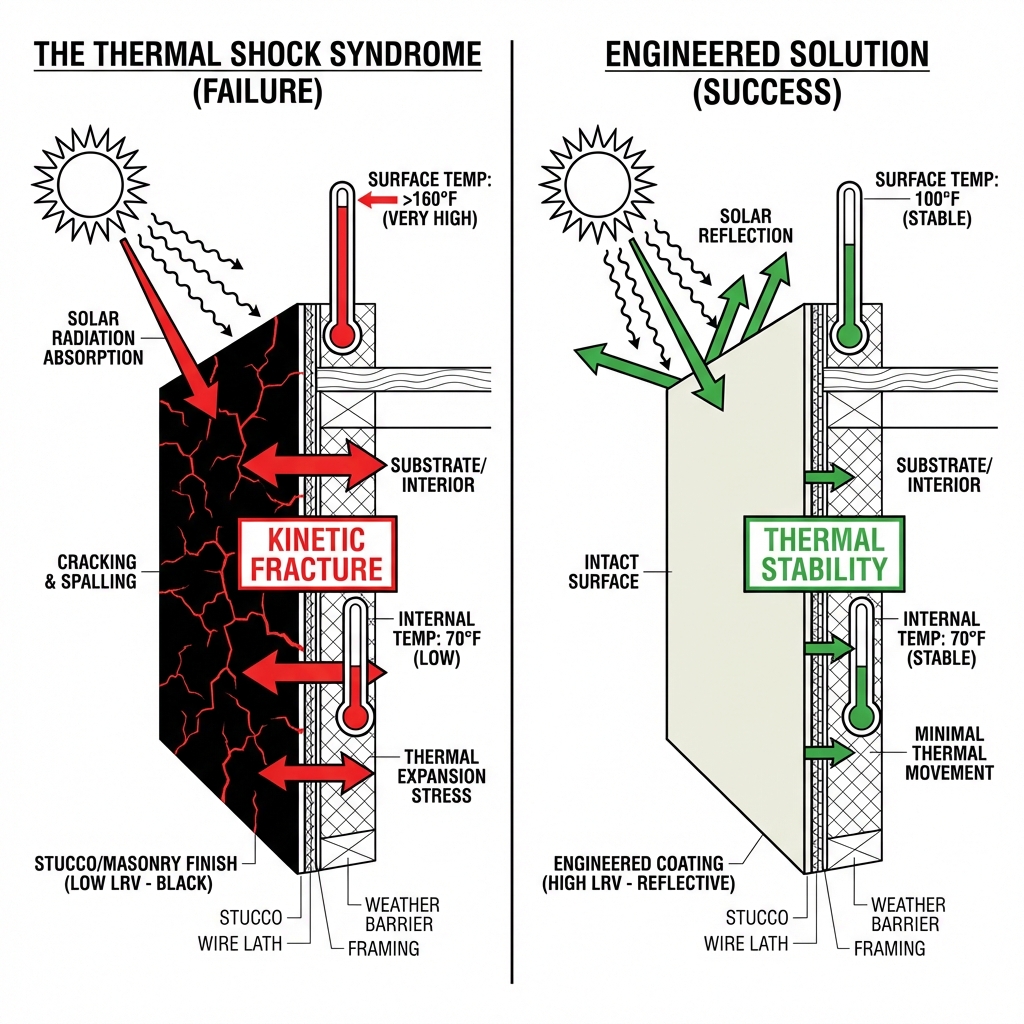
The Thermal Shock Syndrome
A mechanical failure of masonry or stucco finishes caused by rapid expansion and contraction resulting from high solar absorption.
- Why it fails: Dark, low-reflectance pigments act as thermal capacitors, absorbing solar radiation and raising the surface temperature of the substrate significantly higher than its internal core; this thermal gradient creates kinetic stress that causes brittle stucco or mortar to fracture.
- The Diagnostic Test: IF an older, light masonry facade develops spiderweb cracking shortly after being painted black, THEN it is suffering from thermal shock.
- See the Case Study: Thinking of Painting Your Stucco House Black?
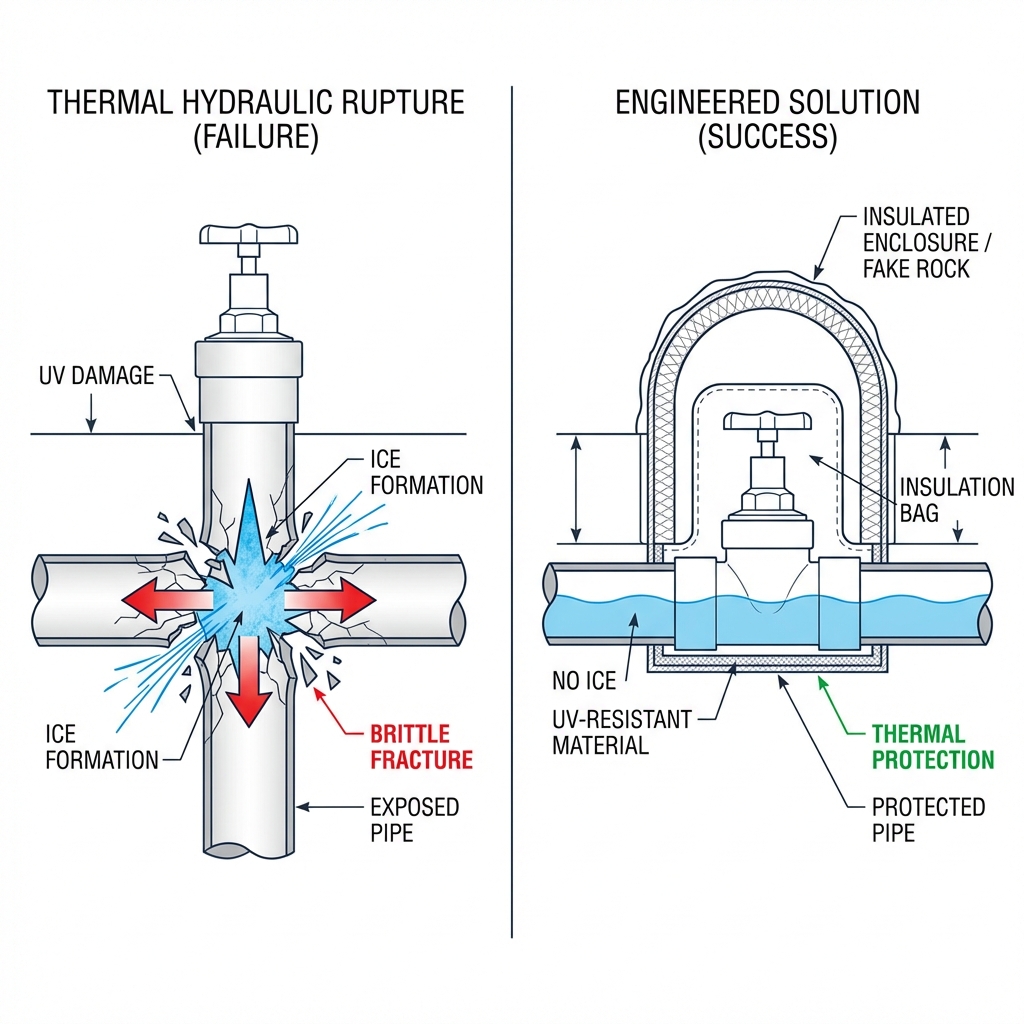
The Thermal Hydraulic Rupture
The catastrophic failure of exposed rigid plumbing components caused by the expansion of freezing water within a UV-degraded housing.
- Why it fails: Rigid polymers (PVC) lose elasticity due to UV radiation and cannot accommodate the 9% volumetric expansion of freezing water, leading to structural fracture.
- The Diagnostic Test: If you see exposed gray or white PVC valves rising above grade without an insulated enclosure, Then you have a system primed for winter failure.
- See the Case Study: Why Your Irrigation Valve Is a Ticking Time Bomb (And How to Freeze-Proof It)
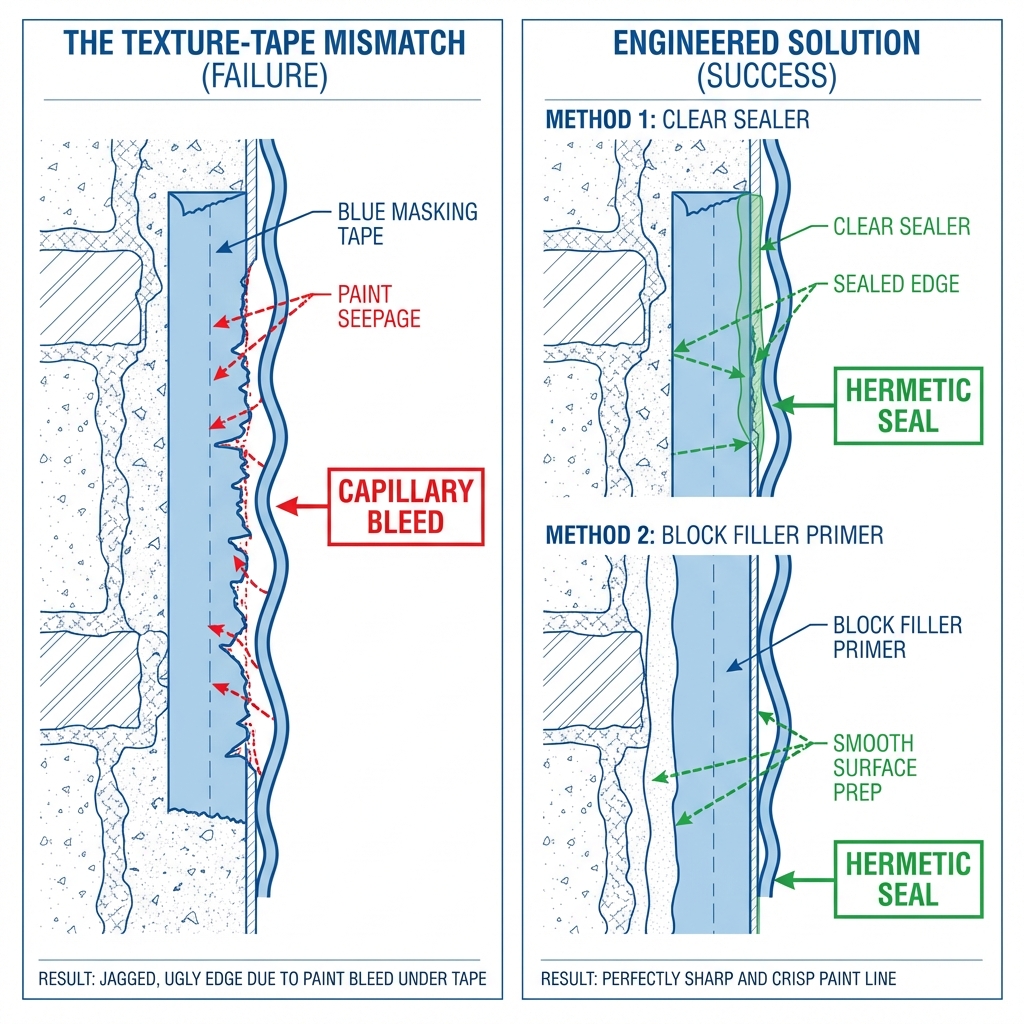
The Texture-Tape Mismatch
Applying flat painter's tape to textured surfaces (brick or concrete) without a sealing agent.
- Why it fails: It ignores the microscopic valleys in masonry. Capillary action pulls wet paint under the tape, creating a jagged, "bleeding" edge that highlights the error through high-contrast visual vibration.
- The Diagnostic Test: Inspect your painted edges. IF the paint line where the floor meets the wall is fuzzy or jagged, THEN the contractor treated your masonry like drywall and failed to account for capillary action.
- See the Case Study: The "Bleeding Edge" Nightmare: Why Your Concrete Paint Job Looks Cheap
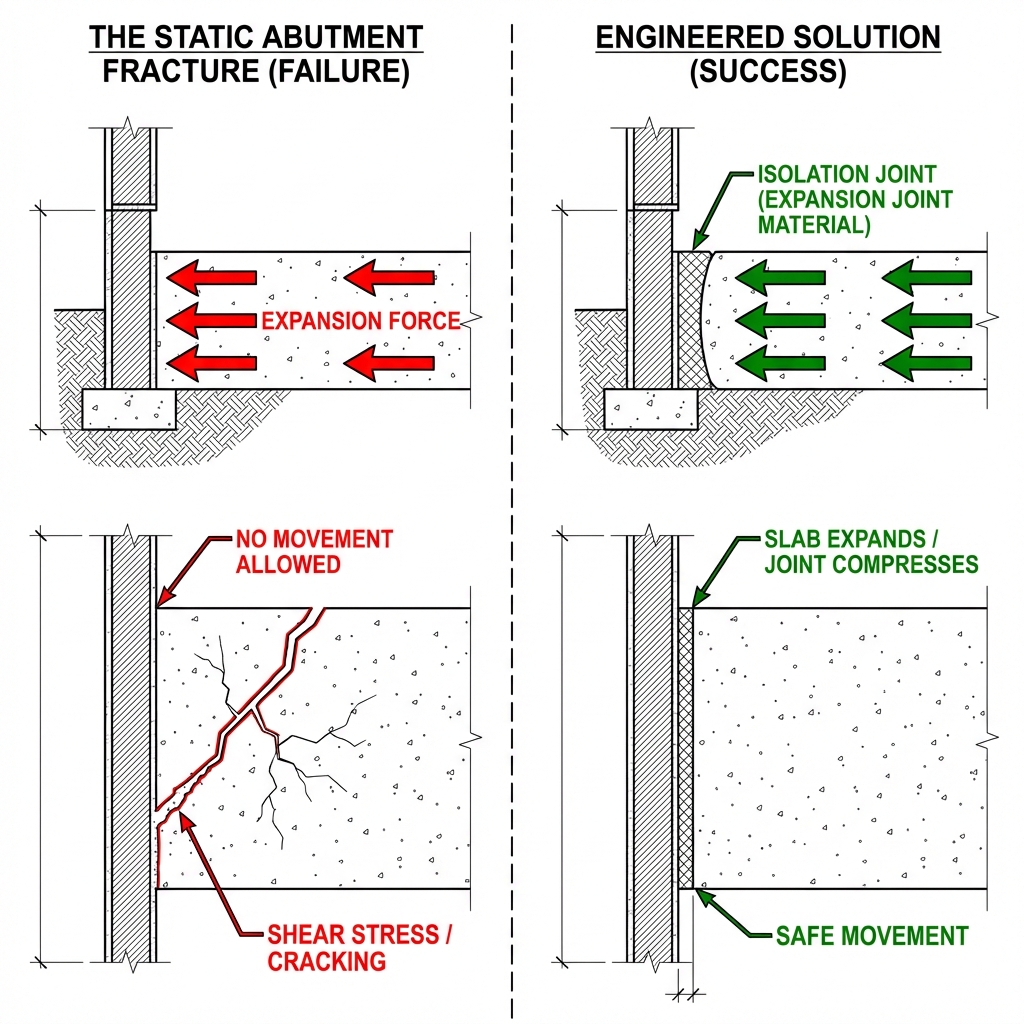
The Static Abutment Fracture
A structural failure where a rigid horizontal slab is poured directly against a vertical foundation without an isolation joint, causing shear cracks during thermal expansion.
- Why it fails: Concrete expands with heat. If it is mechanically locked against an immovable object (like a house foundation) without a compressible buffer, the force of expansion exceeds the tensile strength of the concrete, causing it to snap at the point of highest stress.
- The Diagnostic Test: If you see a triangular or diagonal shear crack at the corner of a slab exactly where it touches a wall, Then you have a Static Abutment Fracture.
- See the Case Study: Why Your Driveway Corner Cracked (And Why Patching It Won't Work)
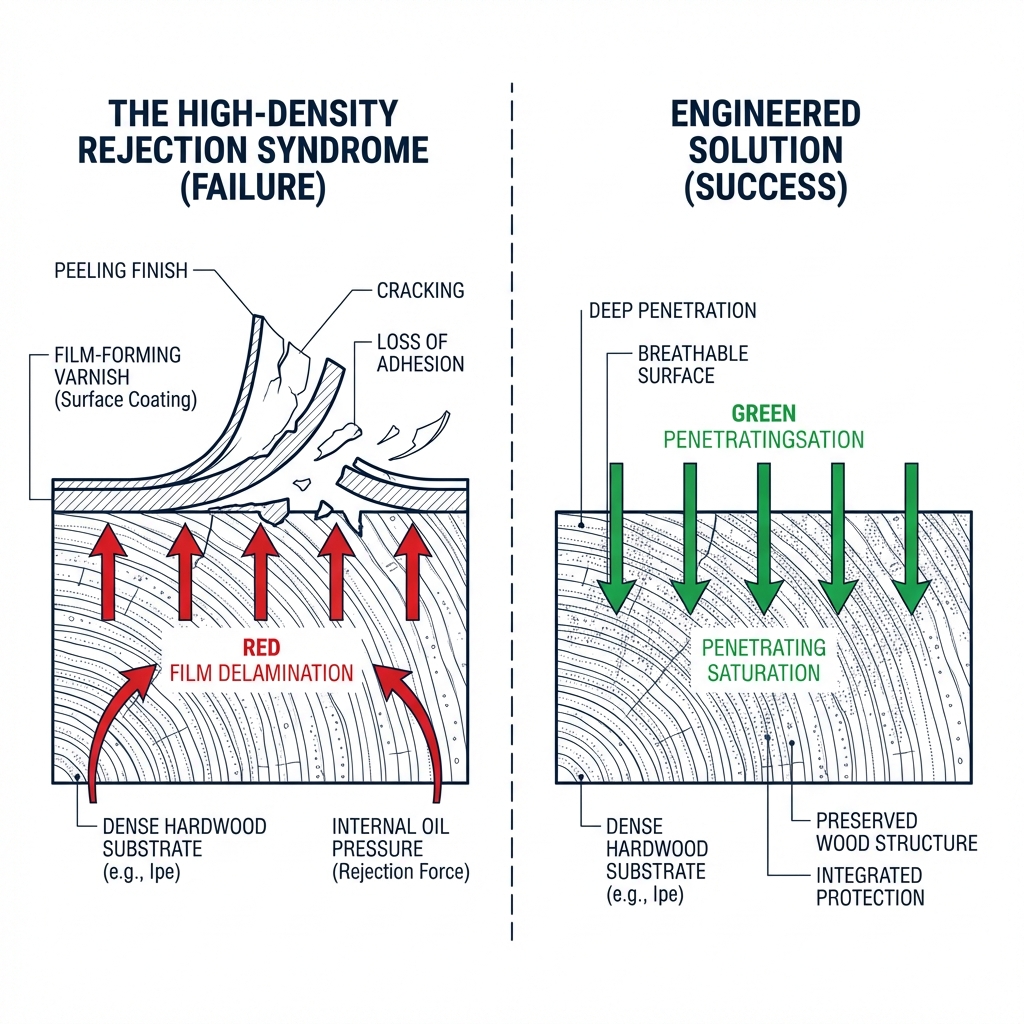
The High-Density Rejection Syndrome
The mechanical failure of film-forming sealers (varnish, acrylics) when applied to high-density hardwoods, resulting in blistering and delamination.
- Why it fails: Dense exotic woods (Spotted Gum, Ipe) lack the porosity to anchor surface coatings, and their high natural oil content pushes film-formers off the surface.
- The Diagnostic Test: If you see a hardwood surface where the clear coat is flaking off like sunburned skin, Then you have High-Density Rejection.
- See the Case Study: Don't Seal That Fence: Why Spotted Gum Needs Oil, Not Varnish
The Veneer Delusion Syndrome
The structural failure resulting from the application of non-load-bearing vertical cladding (thin brick/stone veneer) onto horizontal, high-traffic pedestrian surfaces.
- Why it fails: Thin veneers lack the tensile strength and mass to resist shear forces from foot traffic and freeze-thaw cycles, leading to cracking and delamination.
- The Diagnostic Test: If you see 'brick' flooring that sounds hollow when tapped or has cracks running through the face rather than the joints, Then you have The Veneer Delusion.
- See the Case Study: The Pinterest Trap: Why Thin Brick Veneers Ruin Porches
The Film-Forming Delamination Syndrome
The application of a non-breathable, film-forming paint to an on-grade exterior concrete slab, resulting in blistering and peeling due to hydrostatic pressure.
- Why it fails: Concrete is highly porous. Ground moisture wicks up through the slab via capillary action and becomes trapped beneath the impermeable paint film, physically blowing the coating off the surface during thermal expansion or freeze-thaw cycles.
- The Diagnostic Test: If you see large flakes of paint peeling away from an exterior concrete slab to reveal raw gray concrete underneath, Then you have The Film-Forming Delamination Syndrome.
- See the Case Study: Stop Painting Your Concrete Porch: How to Upgrade an Entryway Slab the Right Way
Category III: Visual & Optical Failures
Failures related to color theory, contrast ratios, and style coherence.
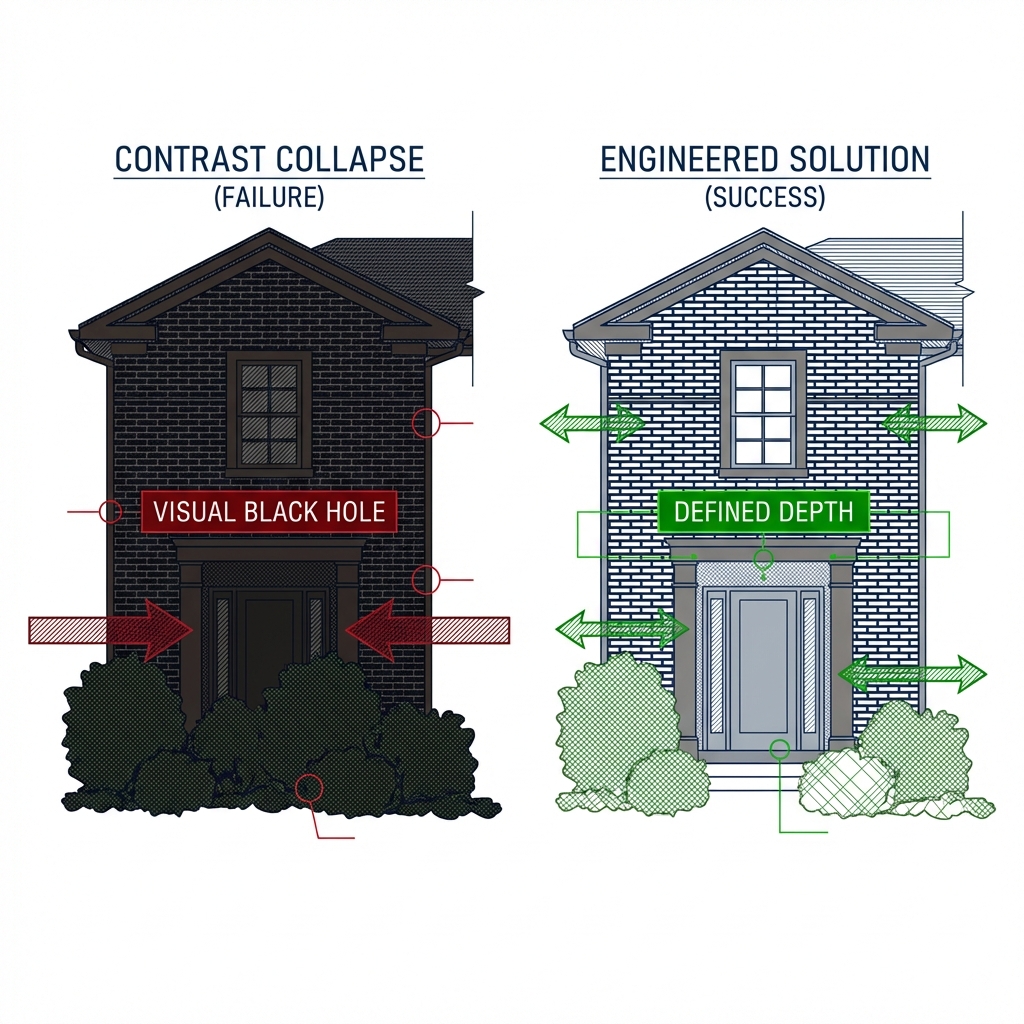
Contrast Collapse
Pairing dark masonry with dark foliage, or stark white paint with high-contrast black trim (the "Zebra" effect).
- Why it fails: Without mid-tone bridges, the facade loses depth perception; elements either disappear into a "black hole" or vibrate visually due to excessive harshness.
- The Diagnostic Test: Take a photo of your house in the evening. IF the entry disappears into a "black hole" or the trim vibrates visually, THEN you lack mid-tone bridges.
- See the Case Study: Dark Brick and Big Trees: How to Fix a Heavy Front Yard Without Painting
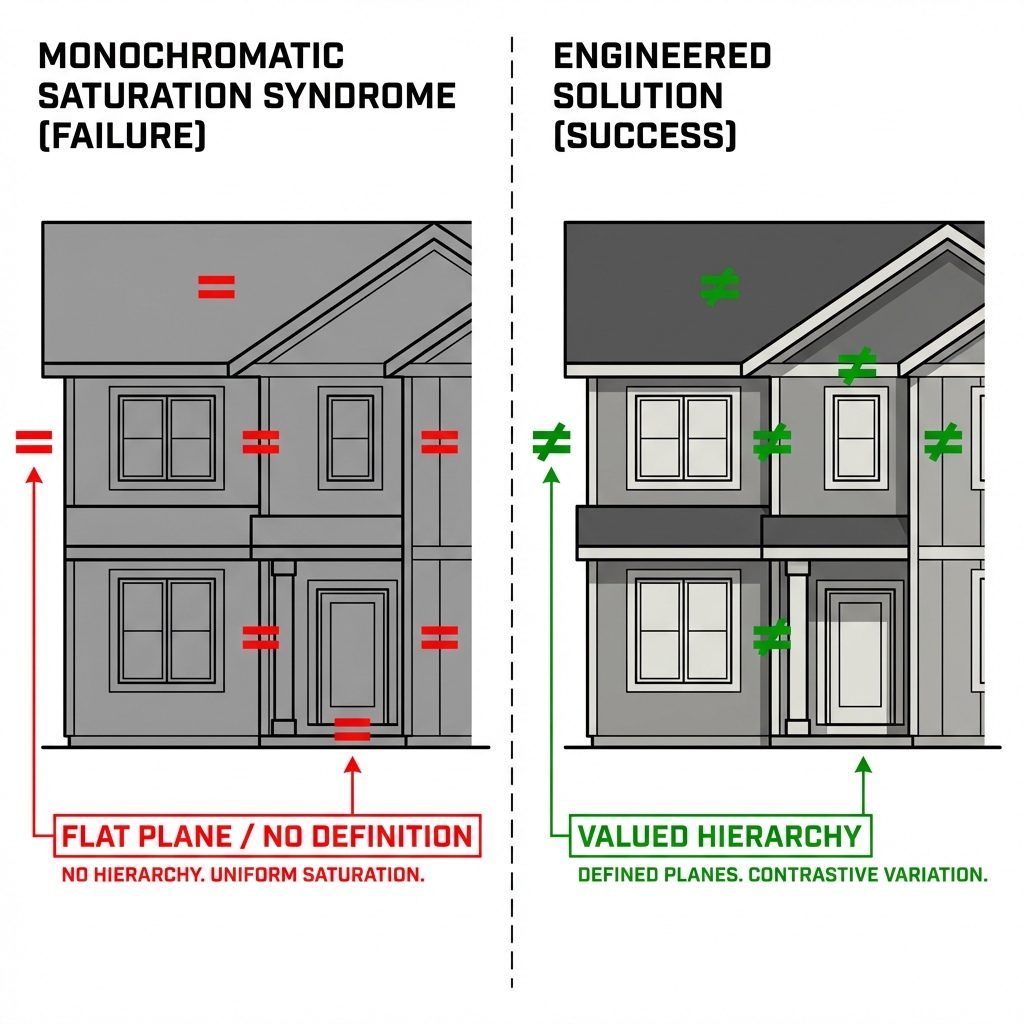
The Monochromatic Saturation Syndrome
A visual failure where the primary facade, trim, and hardscape share nearly identical tonal values, resulting in a loss of architectural depth and definition.
- Why it fails: Without variance in light reflectance values (LRV) or hue, the home’s features bleed into one another; this 'Gray Wash' removes the visual hierarchy necessary to guide the eye to the entrance, making the structure appear cold, flat, and institutional.
- The Diagnostic Test: Take a black-and-white photo of your house. IF the siding, roof, and trim all look like the same shade of gray, THEN you have lost architectural definition.
- See the Case Study: The "Gray Wash" Trap
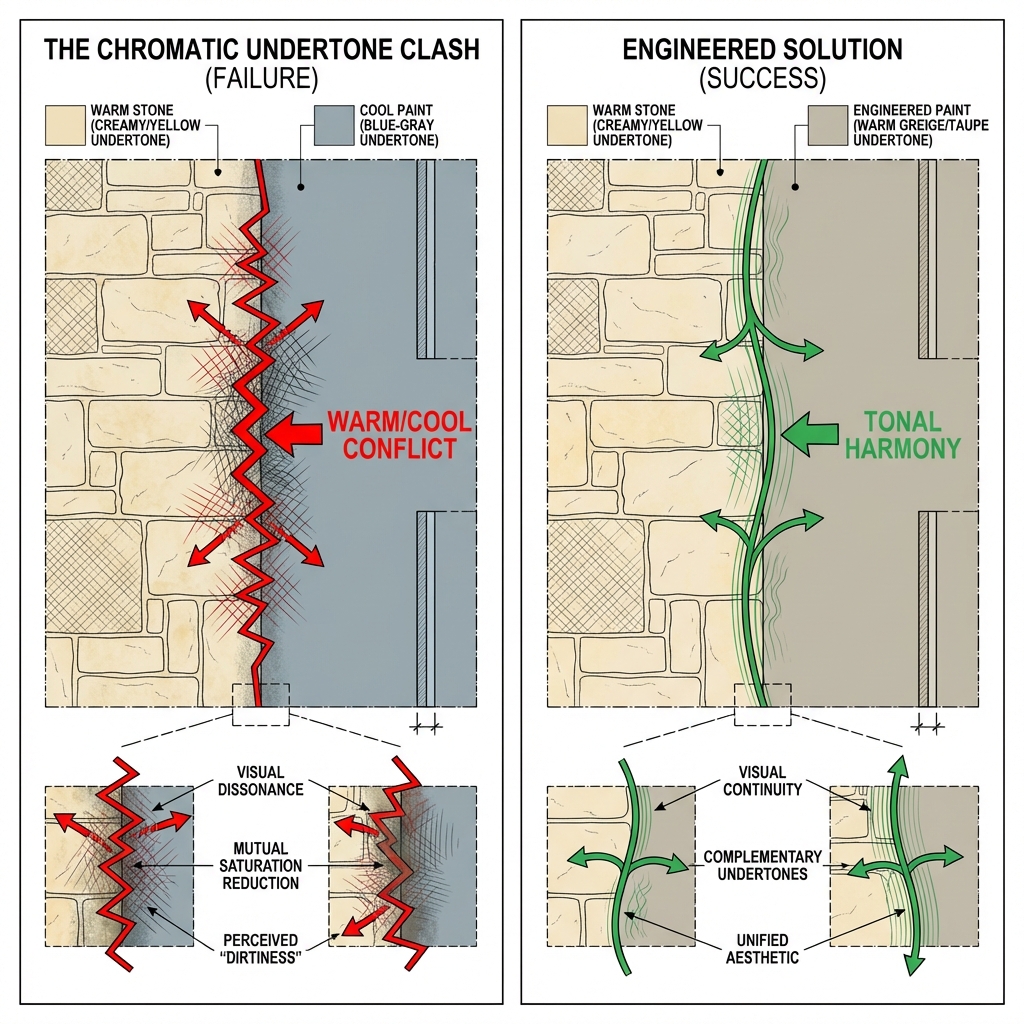
The Chromatic Undertone Clash
A visual failure where modern, high-contrast trim colors (such as black, charcoal, or cool whites) are applied to masonry that possesses strong, dated undertones like pink, peach, or yellow.
- Why it fails: High-contrast modern finishes act as a chromatic foil that amplifies the subtle, often undesirable pigments in older masonry; instead of creating a clean look, the interaction makes the primary facade appear 'dirty' or 'clashing' rather than intentionally designed.
- The Diagnostic Test: IF your brick appears significantly more "pink" or "muddy" after you painted the trim black or gray, THEN you have clashed with the masonry's undertone.
- See the Case Study: Killing the 'Pink Beige'
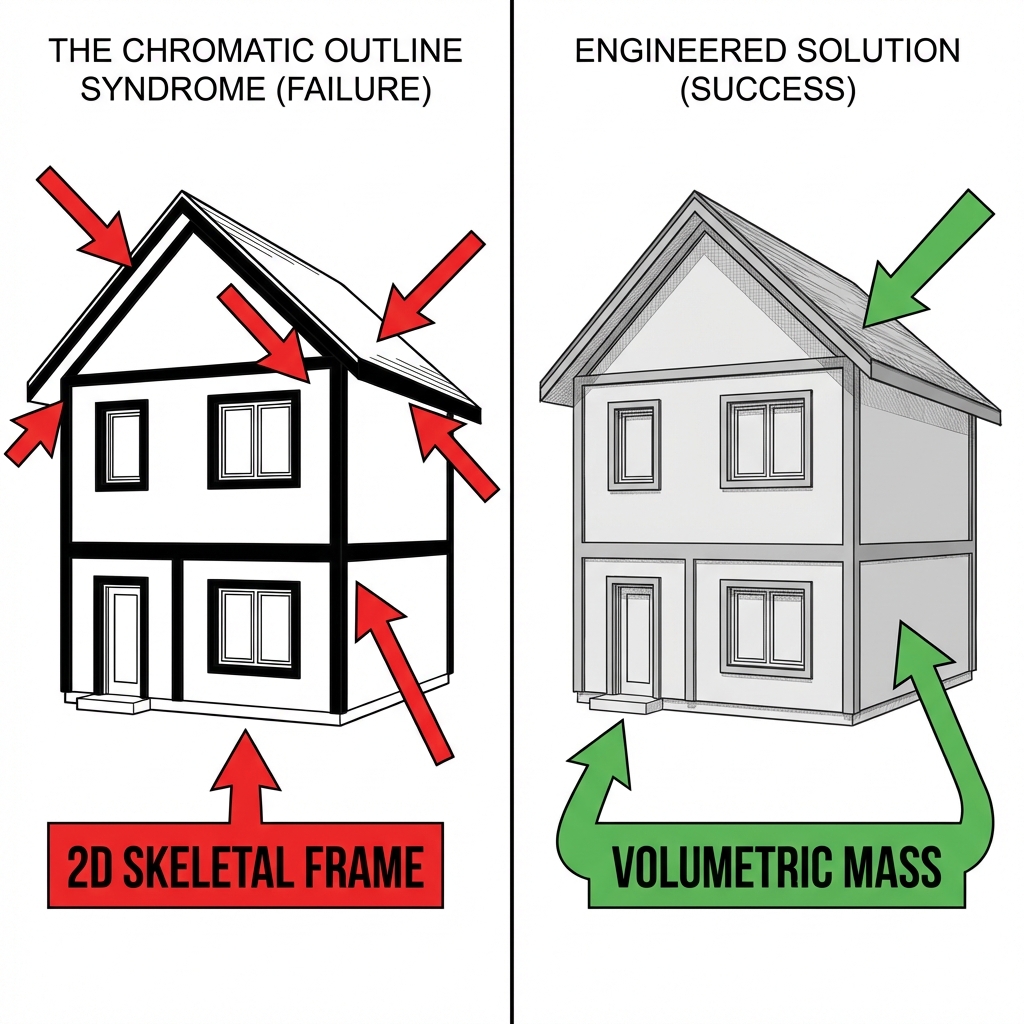
The Chromatic Outline Syndrome
A visual failure where high-contrast trim colors are used to trace the geometric perimeter of a structure, creating a two-dimensional 'cartoon' effect that highlights utilitarian boundaries.
- Why it fails: By emphasizing the edges of the fascia and eaves rather than the architectural massing, the home loses its three-dimensional depth and forces the eye to track the outline of the roofline rather than the entrance or the intentional facade features.
- The Diagnostic Test: IF your dark fascia makes the house look like a cartoon drawing outlined in Sharpie, THEN you are highlighting boundaries instead of massing.
- See the Case Study: Turning a Dated Stucco Box Into a Modern Home
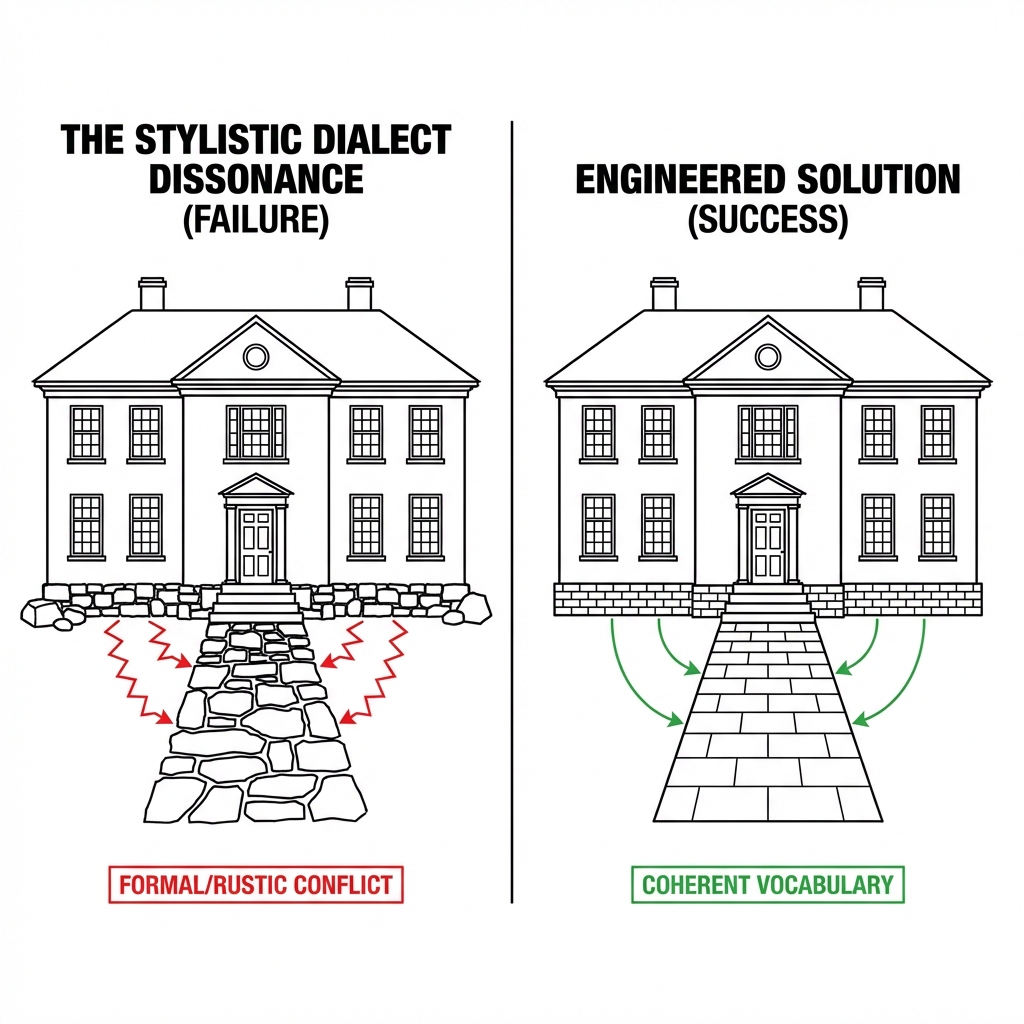
The Stylistic Dialect Dissonance
A visual failure where the historical or textural 'language' of a material finish (e.g., rustic fieldstone) contradicts the formal geometric language of the structure's architecture.
- Why it fails: Materials communicate specific environmental and social contexts; by applying a casual, 'rural' material to a formal, 'stately' architectural chassis, the design creates a psychological conflict that makes the home appear like an unintentional hybrid rather than a curated estate.
- The Diagnostic Test: Compare your architecture to your stones. IF the house is formal/symmetrical but the paving is irregular/jagged river rock, THEN the styles are fighting.
- See the Case Study: The "Lodge" Trap
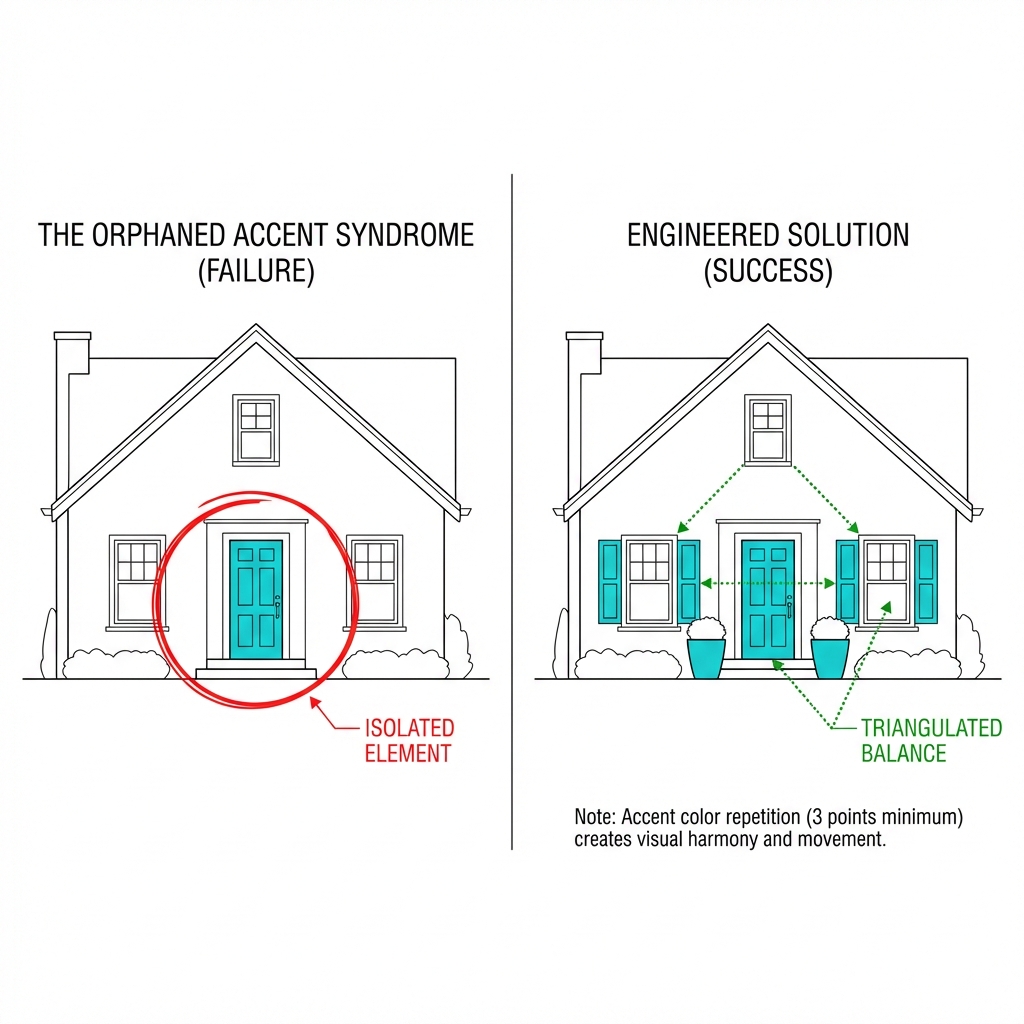
The Orphaned Accent Syndrome
A design failure where a distinct color or material (like a window sash) is introduced to a facade but appears only once, causing it to look accidental or mismatched.
- Why it fails: The human eye seeks patterns. Without repetition (The Rule of Three), a unique color lacks visual weight and is overpowered by dominant existing elements (like a white garage).
- The Diagnostic Test: IF a window sash or door color appears nowhere else on the facade, THEN it is "orphaned."
- See the Case Study: New Windows Don't Match the Door?
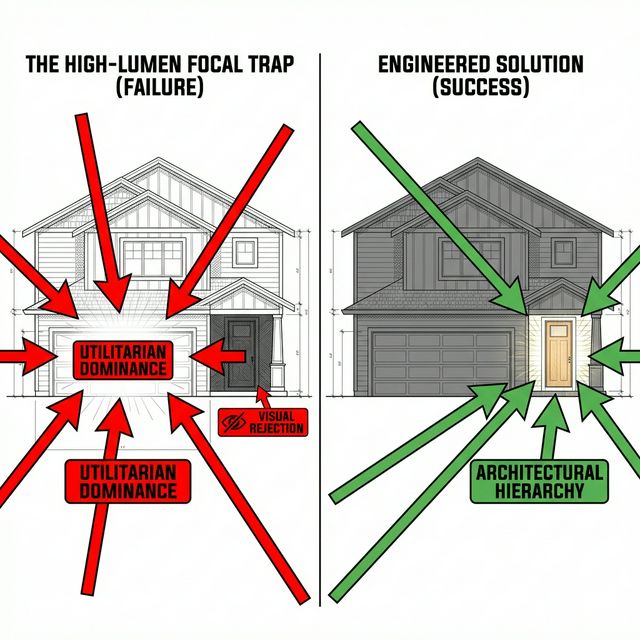
The High-Lumen Focal Trap
A visual failure where the highest-brightness value (usually white) is applied to large-scale utilitarian elements (like garage doors), forcing the eye to prioritize secondary storage zones over the architectural entry.
- Why it fails: Human vision is phototropic (attracted to light). When a large surface area like a garage door is significantly brighter than the home's facade, it hijacks the visual hierarchy, making the house appear unbalanced and utilitarian.
- The Diagnostic Test: If your eye hits the garage door before it finds the front door, you have a High-Lumen Focal Trap.
- See the Case Study: Why White Garage Doors Kill Curb Appeal (And the "Headlight" Fix)
The Photonic Outline Syndrome
A visual failure where continuous linear lighting is used to trace the geometric perimeter of a structure's roofline or fascia, flattening the architecture into a two-dimensional aesthetic.
- Why it fails: By highlighting the extreme utilitarian boundaries of a structure with a continuous light source, it eliminates all architectural shadow and depth, drawing the eye to the fixture itself rather than the mass and texture of the home.
- The Diagnostic Test: If you see a continuous glowing border tracing the eaves rather than soft pools of light highlighting the wall's texture, Then you have The Photonic Outline Syndrome.
- See the Case Study: Stop Outlining Your Roof: How to Design Exterior Lighting That Looks Expensive
Category IV: Landscape & Hardscape Integration
Failures related to how the house meets the ground, paving physics, and plant selection.
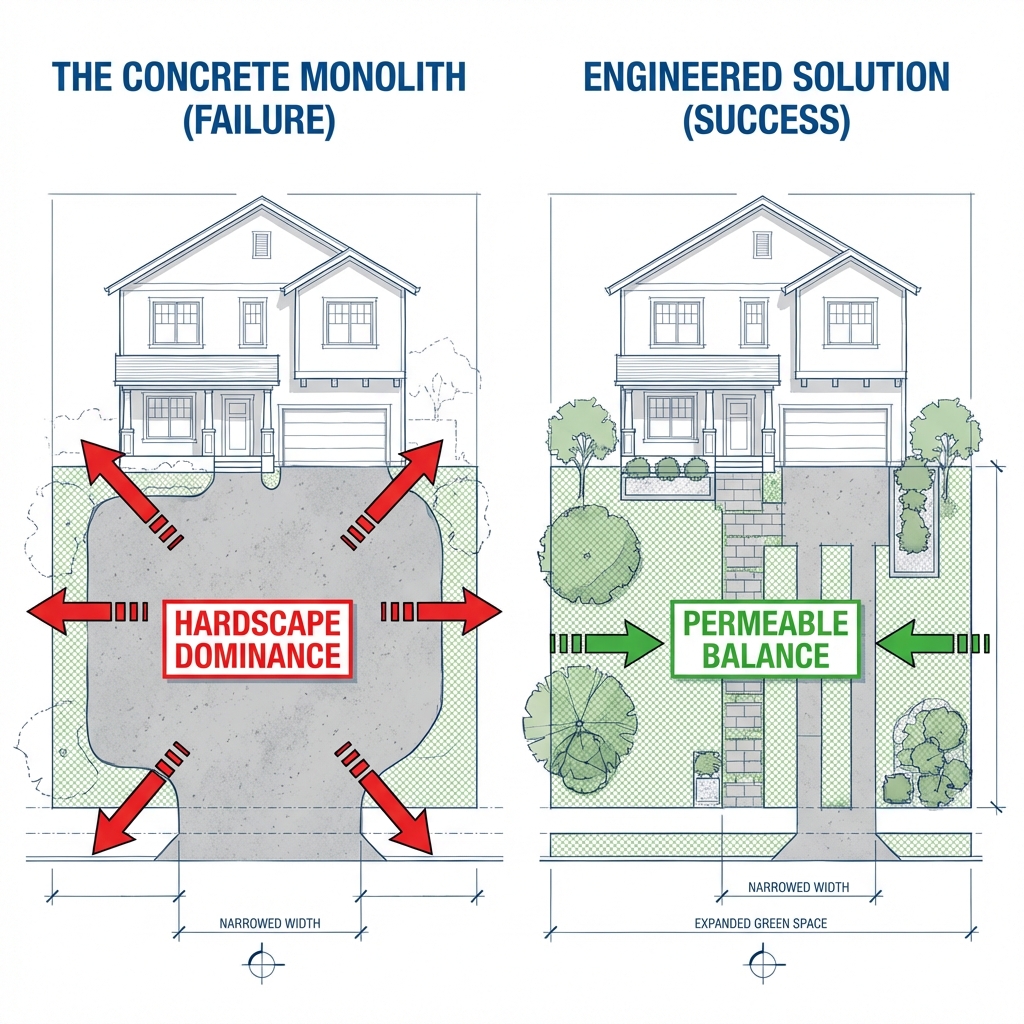
The Concrete Monolith
When the surface area of the driveway and hardscape exceeds 50% of the visible frontage.
- Why it fails: It creates a "heat island" effect and directs visual attention to the utility infrastructure (the car storage) rather than the human entry point.
- The Diagnostic Test: Stand at the curb. IF the driveway dominates your field of vision more than the front door or garden, THEN you have created a utility yard, not an entrance.
- See the Case Study: Drowning in Concrete: How to Give a Brick Box Serious Street Appeal
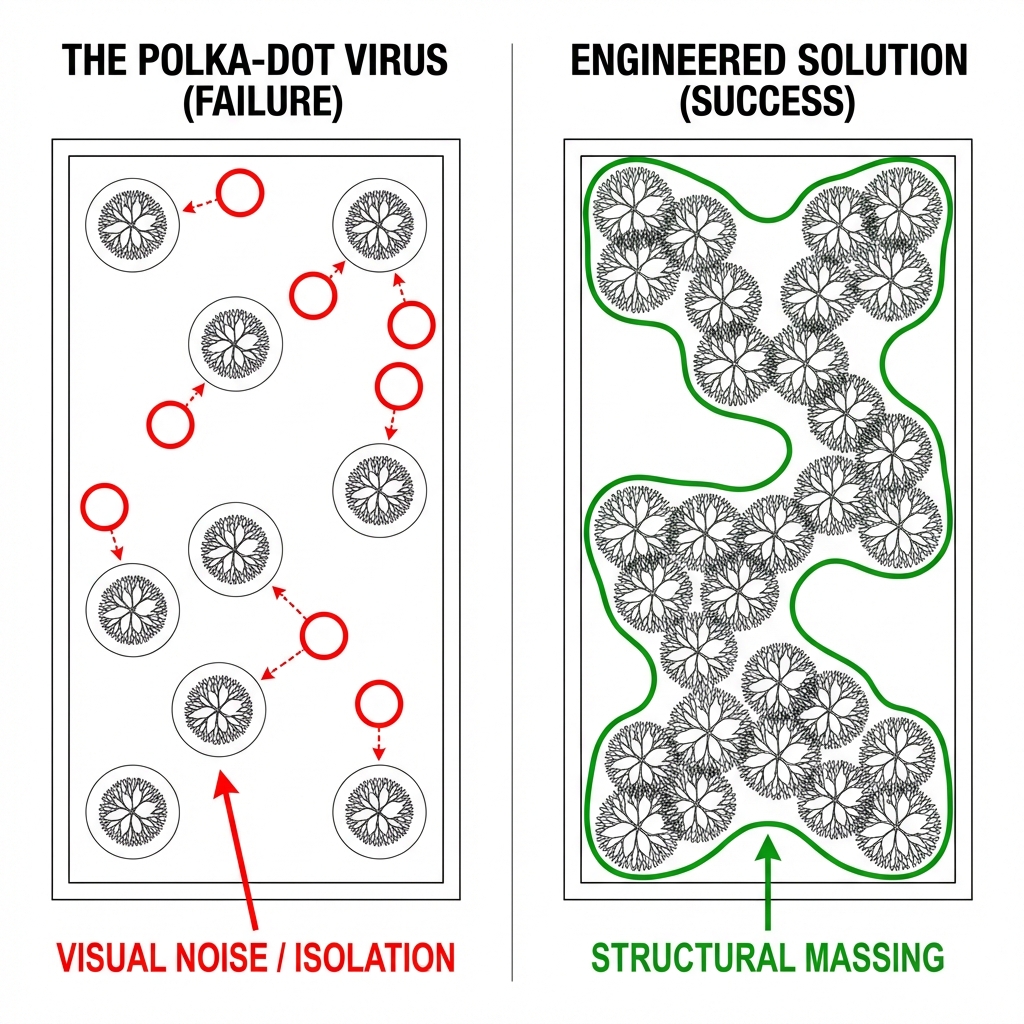
The Polka-Dot Virus
Spacing shrubs individually with gaps of mulch between them, rather than planting in drifts or masses.
- Why it fails: It creates "visual noise" and distracts the eye, failing to provide the heavy visual base required to anchor a multi-ton structure to the ground.
- The Diagnostic Test: Look at your garden beds. IF you can see individual circles of mulch around every separate plant, THEN your landscape lacks structural massing.
- See the Case Study: Fixing the 'Awkward Vibes' of a Cape Cod: From Polka-Dot Shrubs to Layered Curb Appeal
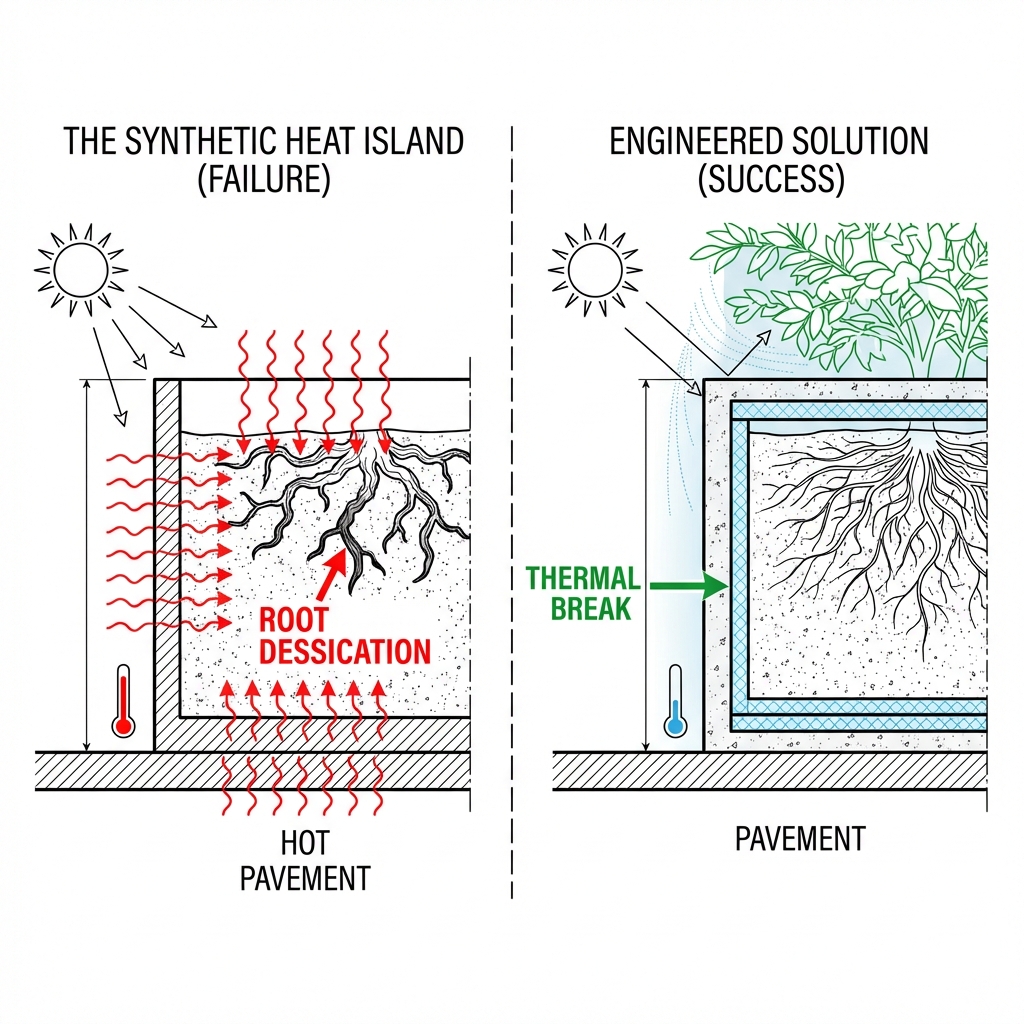
The Synthetic Heat Island
A thermal failure where uninsulated hardscape elements—such as rendered masonry planters or extensive stone surfaces—act as capacitors, radiating trapped solar energy and desiccating adjacent biological systems.
- Why it fails: Masonry absorbs and holds thermal energy; when used as a container without thermal breaks or proper soil volume, it creates a 'concrete oven' effect that reaches temperatures lethal to most ornamental plants.
- The Diagnostic Test: Touch your planters on a hot afternoon. IF the planter walls are hot to the touch and surrounded by pavement, THEN you are cooking the root systems.
- See the Case Study: Empty Concrete Planters: Why They Kill Plants
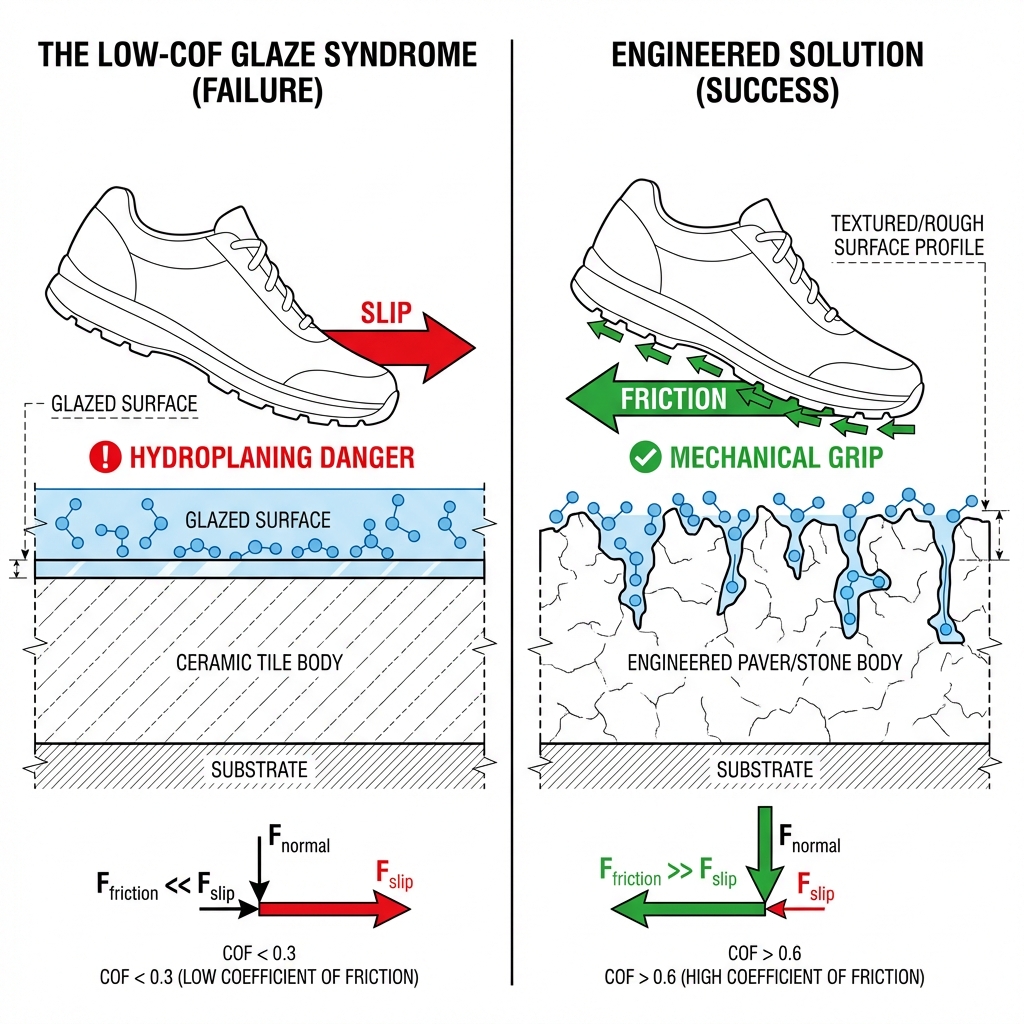
The Low-COF Glaze Syndrome
The application of non-porous, glazed, or polished ceramic finishes to outdoor pedestrian traffic surfaces.
- Why it fails: Glazed surfaces lack a sufficient Coefficient of Friction (COF) when wet and do not possess the surface profile necessary for mechanical shoe-sole grip; furthermore, the non-porous glaze prevents the adhesion of topical coatings, which inevitably delaminate as moisture wicks through grout lines and pops the paint from beneath.
- The Diagnostic Test: Wet the surface. IF the step becomes as slippery as a wet windshield, THEN the material lacks the correct Coefficient of Friction (COF).
- See the Case Study: Slippery Outdoor Tiles? Don't Paint Them
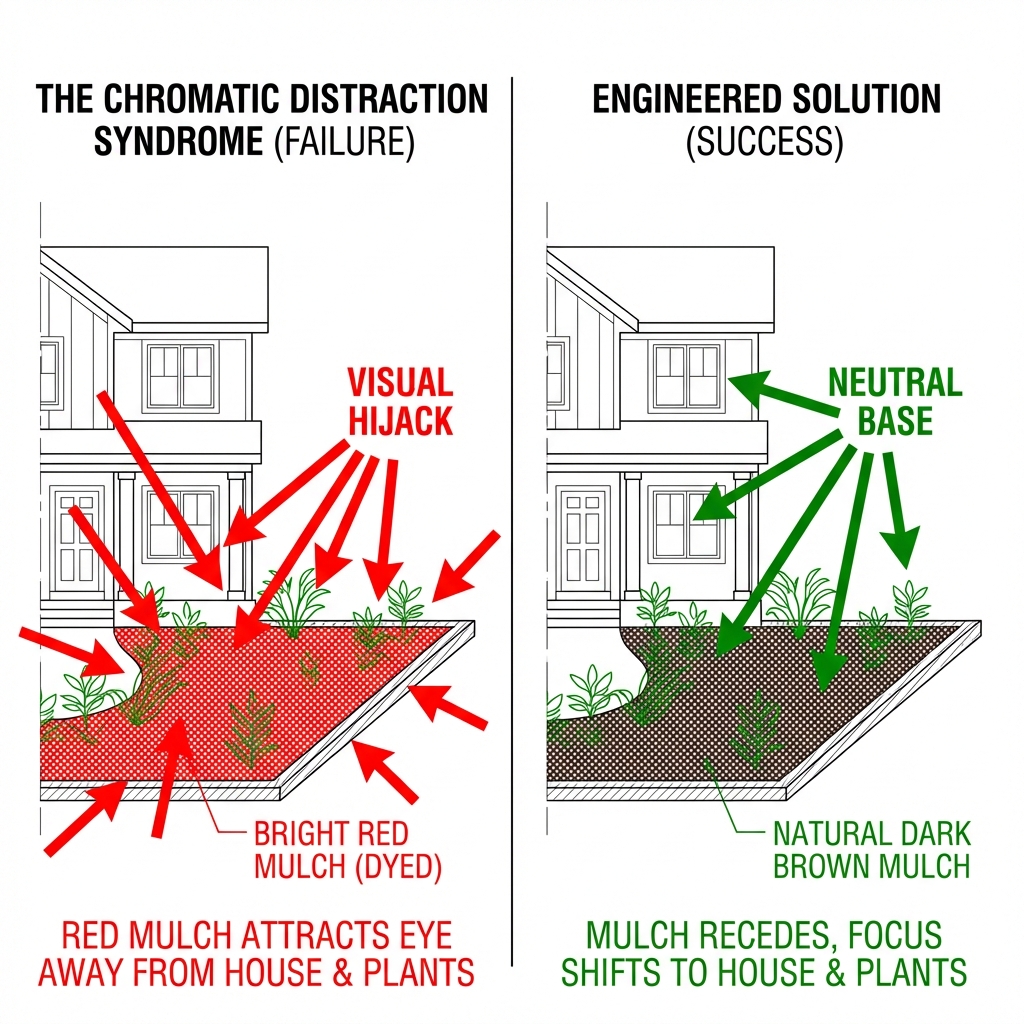
The Chromatic Distraction Syndrome
A visual failure where high-saturation, artificial material finishes—such as dyed red mulch—are used as a cosmetic cover-up for unmaintained soil or structural debris.
- Why it fails: Aggressive colors create an intense focal point on the ground, drawing the eye away from architectural features and signaling a 'quick-fix' approach that decreases the home's perceived value and professional polish.
- The Diagnostic Test: Squint at your yard. IF the red mulch or ground cover is brighter than the front door, THEN the ground is stealing focus from the architecture.
- See the Case Study: The 'Red Mulch' Trap
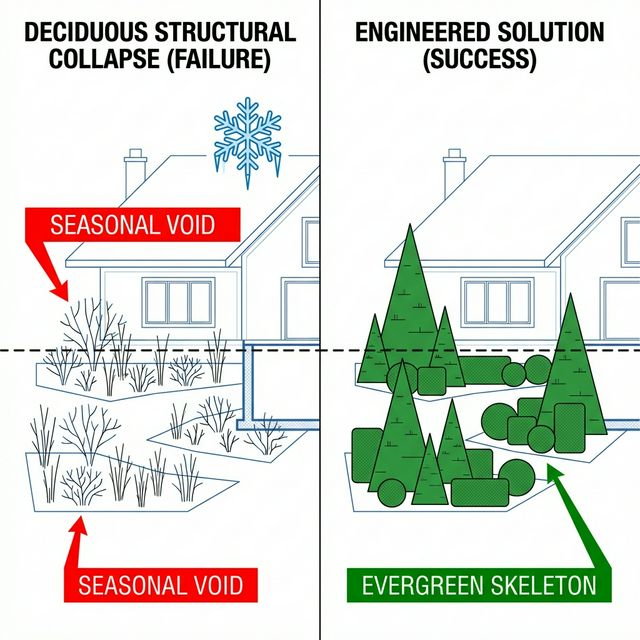
The Deciduous Structural Collapse
A seasonal failure where the architectural definition of a high-visibility corridor relies exclusively on soft-tissue or deciduous species that lose their form during dormancy.
- Why it fails: Primary entrance points require year-round visual mass to anchor the property's scale; without evergreen 'bones' to act as a structural substrate, the landscape undergoes a total collapse after the first frost, leaving the home's frontage appearing neglected or unfinished.
- The Diagnostic Test: Look at your yard in January. IF the "walls" of your garden disappear entirely in winter, THEN you lack evergreen structure.
- See the Case Study: Tropical Driveway Design in Zone 8a
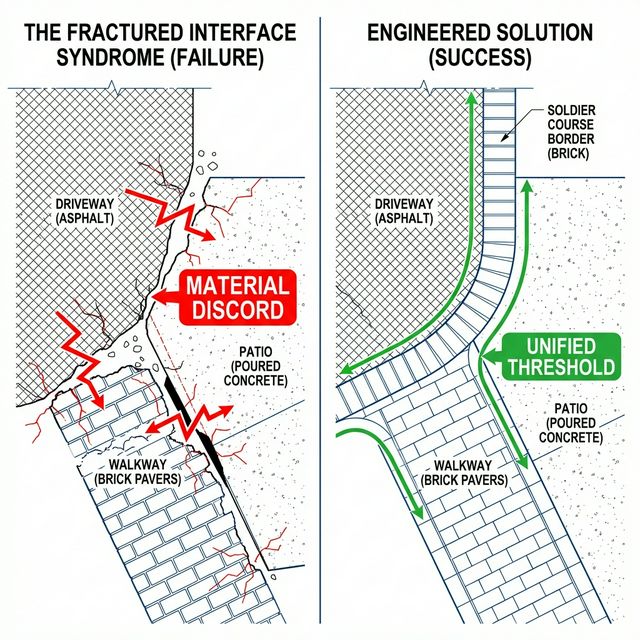
The Fractured Interface Syndrome
The attempt to repair or extend hardscaping by filling an irregular, broken void without establishing a clean, geometric saw-cut transition line.
- Why it fails: Jagged lines are perceived as accidental damage or 'pothole repairs' rather than deliberate design; without a straight-line anchor to define the new material zone, the repair fails to restore the property's architectural intentionality.
- The Diagnostic Test: IF the line between your old patio and new extension is jagged or follows a crack, THEN it looks like a pothole repair.
- See the Case Study: Don't Demo That Broken Patio
The "Curb Appeal" Bridge
"Curb Appeal" is not a mystical quality produced by flowers or wreaths. It is the absence of error. It is the result of architectural DNA and landscape envelope working in unison. A home with high curb appeal is simply a home where the geometry, drainage, and materials are mathematically coherent. If the eye catches on a detail—a narrow porch, a cracked stair, a stark color clash—the system has failed.
Initiate Curb Appeal Optimization
You cannot fix what you cannot measure. The human eye often misses slight slope ratios and proportion errors that register subconsciously as "ugliness." Upload a photo of your property to run a full diagnostic scan against our engineering database to identify geometric and material failures.