The Landscape Pathology Hub
A Forensic Breakdown of Common Landscape Design Failures.
The Executive Summary
Most residential landscapes fail not due to a lack of funding, but due to a fundamental misunderstanding of biology and civil engineering. These are not "stylistic choices"; they are functional errors that accelerate material degradation, invite hydraulic failure, and lower property value. This hub categorizes systemic design defects, treating the landscape not as a canvas for decoration, but as a biological machine that is currently malfunctioning.
Taxonomy of Failure Patterns
We have analyzed thousands of residential sites to categorize the following recurring syndromes.
Category I: Biological & Metabolic Failures
Failures related to plant physiology, soil chemistry, and solar tracking.
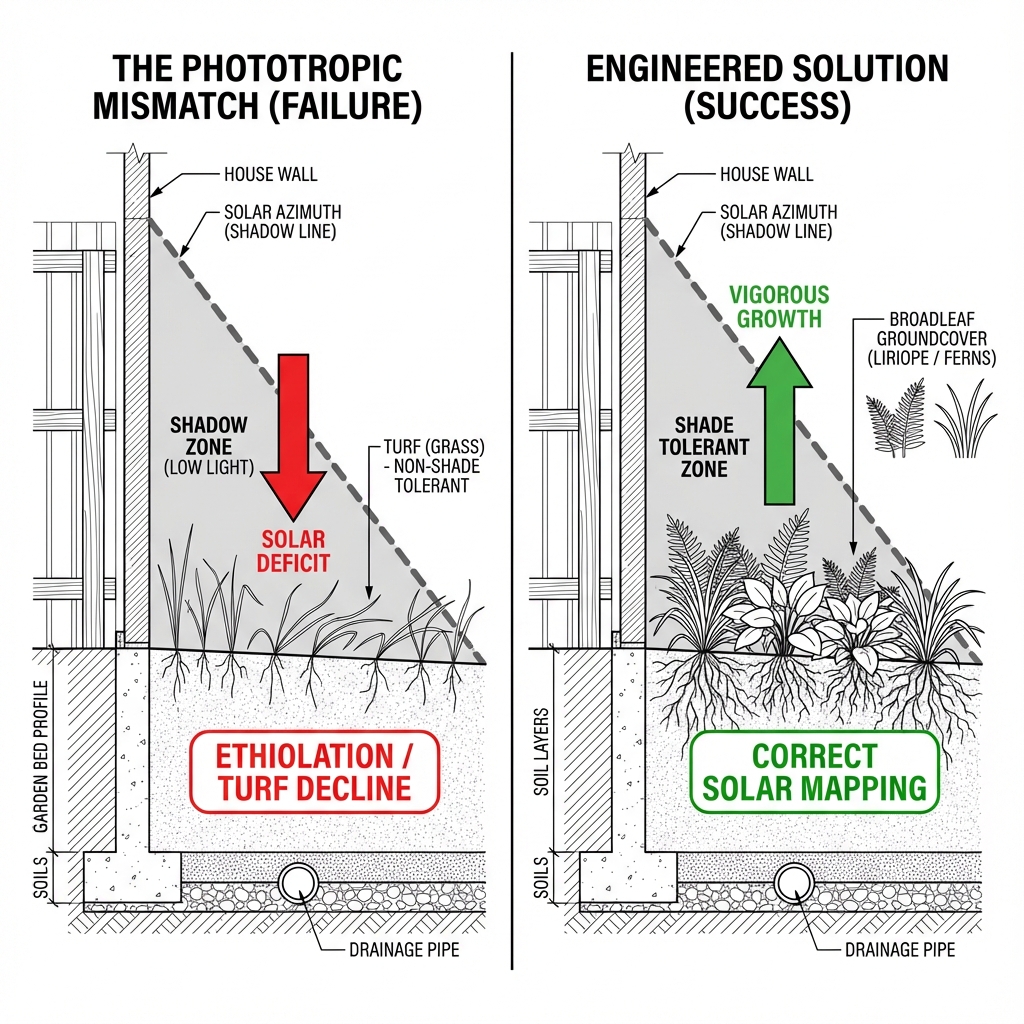
The Phototropic Mismatch
Forcing high-solar-requirement organisms (like Bermuda grass) into architectural shade zones (shadows cast by fences or the home).
- Why it fails: The plant depletes its carbohydrate reserves trying to photosynthesize in a deficit, leading to thinning turf and inevitable mud erosion.
- The Diagnostic Test: IF turf is thinning specifically on the north side of a structure or fence, THEN you have Solar Mapping Error.
- See the Case Study: Bermuda Grass vs. House Shadow: Why It’s Failing and How to Fix It
The Physiological Chlorosis Failure
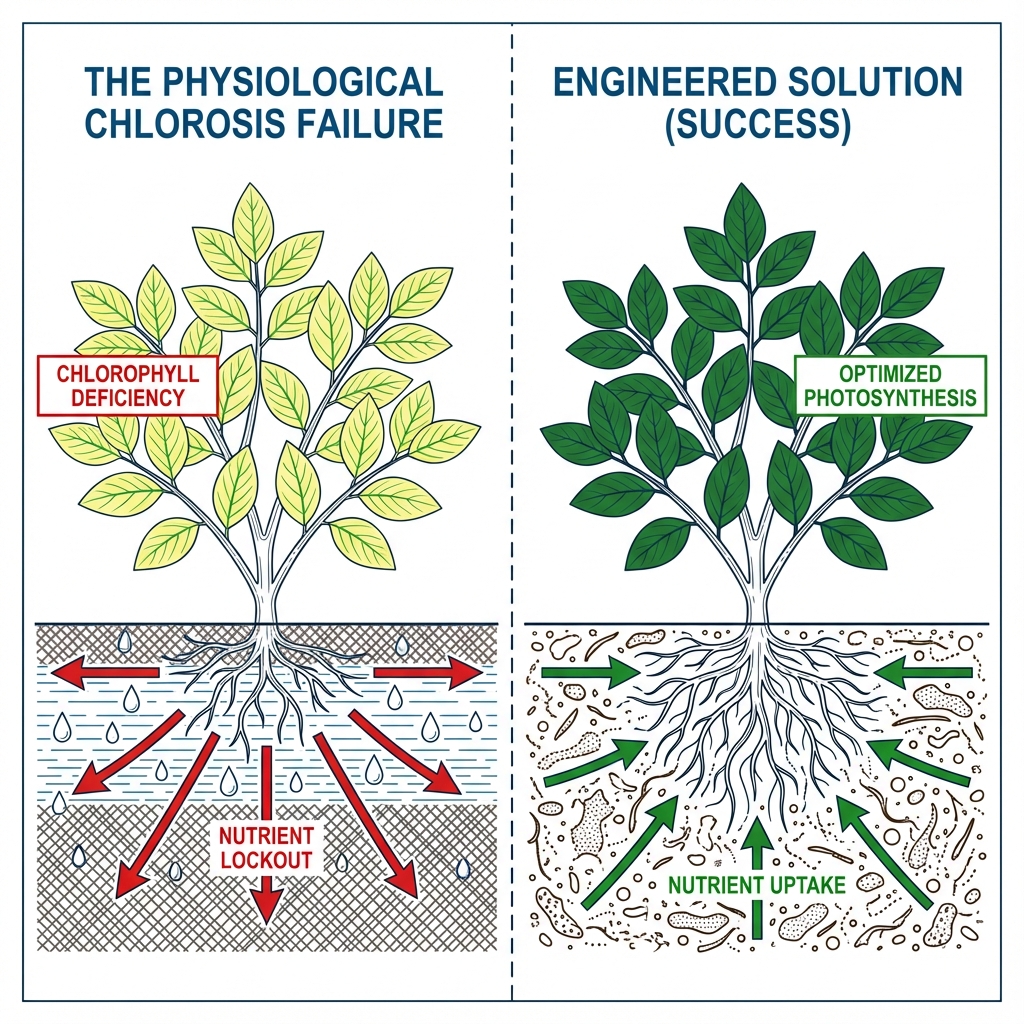
The structural inability of certain plants to uptake iron or manganese due to alkaline soil pH lock-out.
- Why it fails: High pH soils bind metallic ions, making them unavailable to roots; the plant starves in the midst of plenty, leading to yellowing foliage and slow decline.
- The Diagnostic Test: IF foliage displays uniform yellowing or interveinal chlorosis, then the plant is suffering from a metabolic mismatch with its current soil or lighting conditions., THEN you have The Physiological Chlorosis Failure.
- See the Case Study: Why Tree Leaves Turn Yellow and How to Fix It: A Comprehensive Guide
The Hydraulic Competition Syndrome
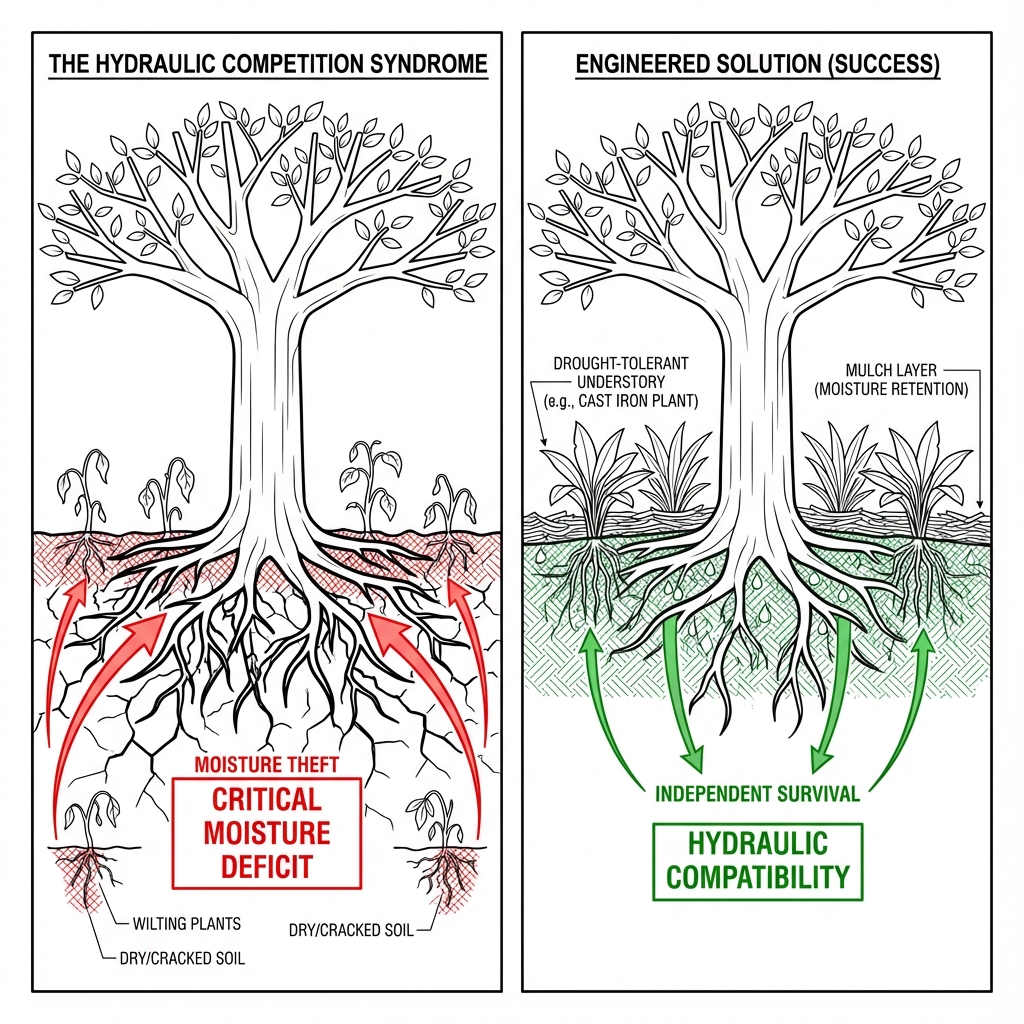
A systemic failure where understory plantings are outcompeted for moisture and light by the dominant root system and rain-shadow canopy of a mature tree.
- Why it fails: The mature tree acts as a superior hydraulic pump, extracting available groundwater from the upper soil profile while its canopy simultaneously blocks rainfall and solar energy, ensuring understory plants remain in a state of terminal resource deficit.
- The Diagnostic Test: IF soil beneath a mature canopy remains bone-dry and hydrophobic even after significant rainfall or irrigation, you have diagnosed The Hydraulic Competition Syndrome., THEN you have The Hydraulic Competition Syndrome.
- See the Case Study: The "Dry Shade" Death Trap: Turning a Barren Corner Into a Brutalist Refuge
The Root Zone Burial Syndrome
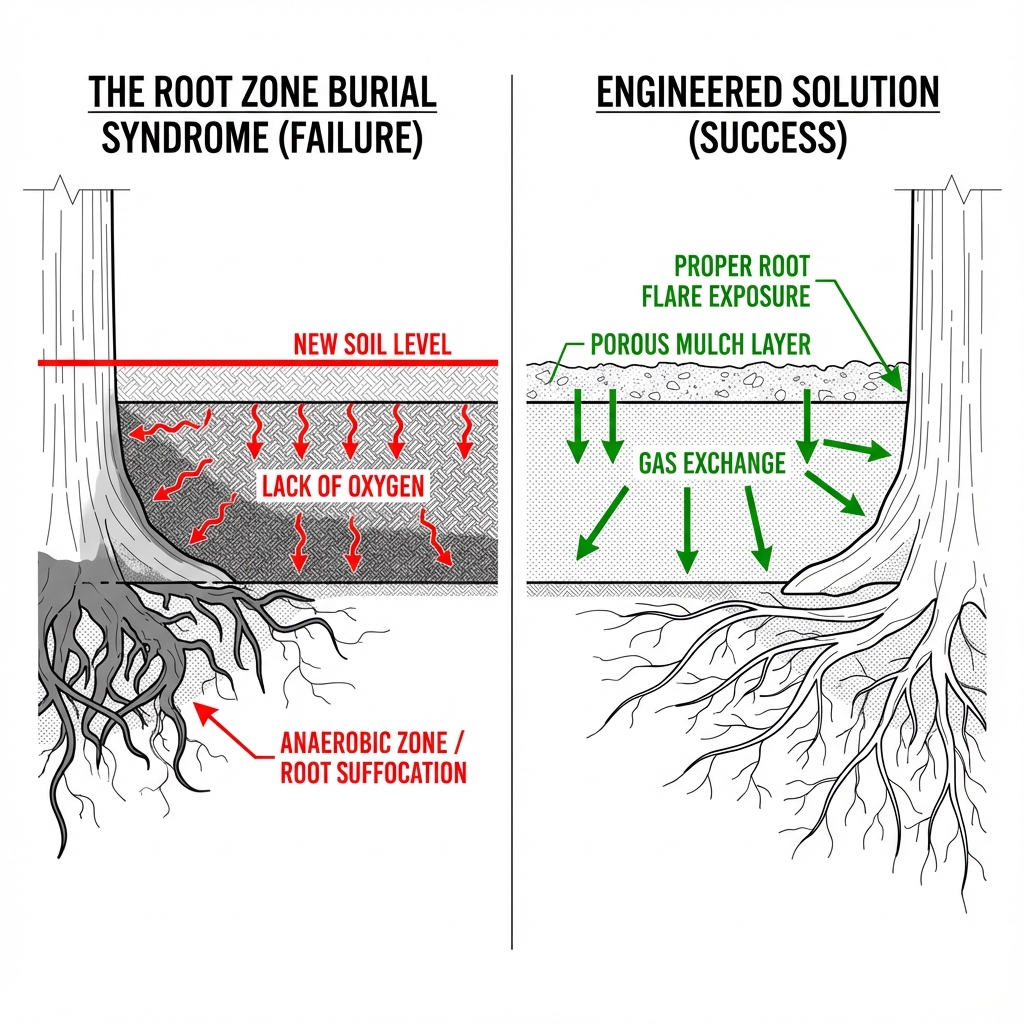
The practice of raising the soil grade or mechanically tilling within a tree's critical root zone to establish new landscaping.
- Why it fails: Trees rely on shallow feeder roots for gas exchange; burying these roots in heavy soil creates an anaerobic environment that suffocates the organism, while tilling acts as a systemic amputation of the nutrient delivery network.
- The Diagnostic Test: IF the tree's natural root flare is buried or if new flower beds are installed directly over existing surface roots, then the tree is at high risk of respiratory and structural failure., THEN you have The Root Zone Burial Syndrome.
- See the Case Study: Planting Under Large Trees: Why Tilling Is a Death Sentence (And What to Do Instead)
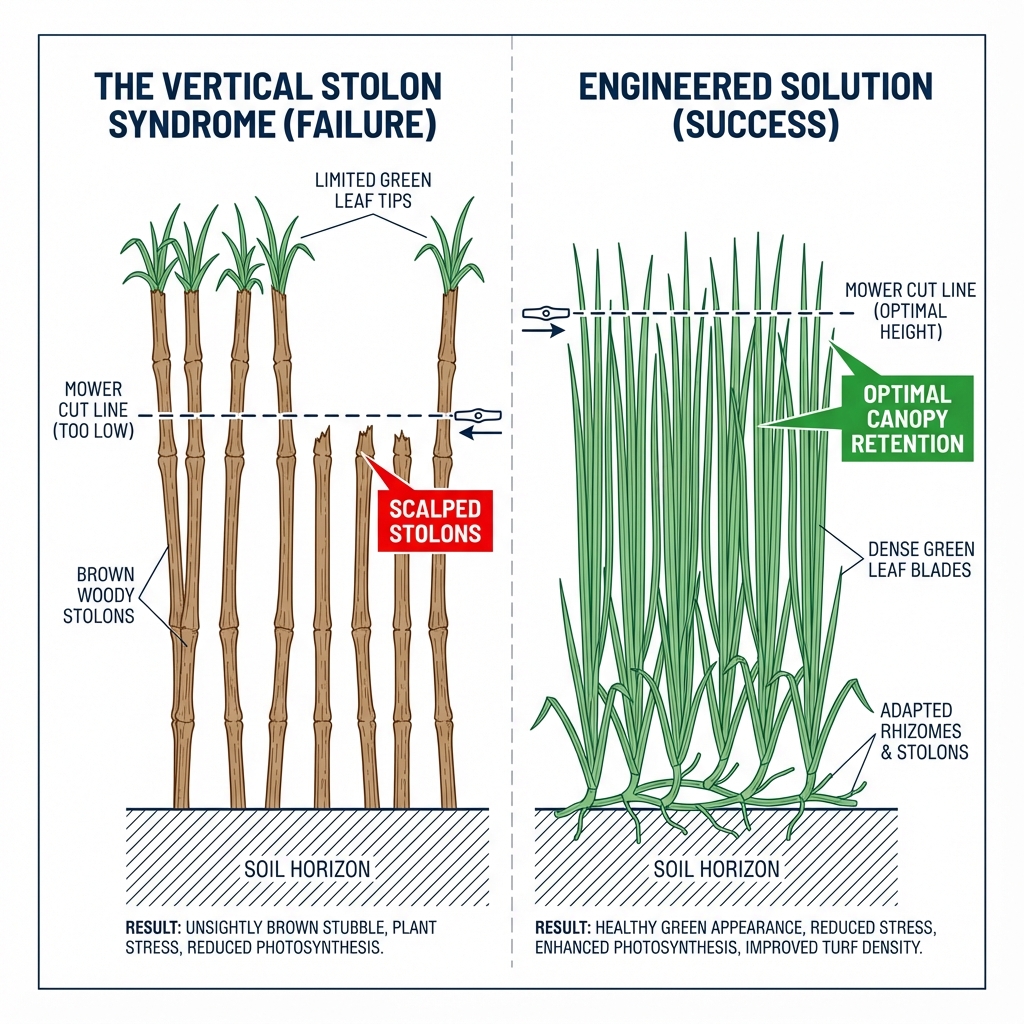
The Vertical Stolon Syndrome
The accumulation of woody stems (stolons) in warm-season grasses caused by infrequent mowing or excessive cutting height.
- Why it fails: Warm-season creepers (Couch, Bermuda, Zoysia) are designed to run horizontally. When forced to grow vertically due to shade or high mowing, the lower canopy turns to wood. Cutting it reveals this brown, stiff layer.
- The Diagnostic Test: IF the lawn looks green before mowing but turns brown/yellow and feels stiff immediately after a cut, THEN you have The Vertical Stolon Syndrome.
- See the Case Study: Why Your Green Lawn Turned Brown After Mowing (It’s Not Dead, It’s Legs)
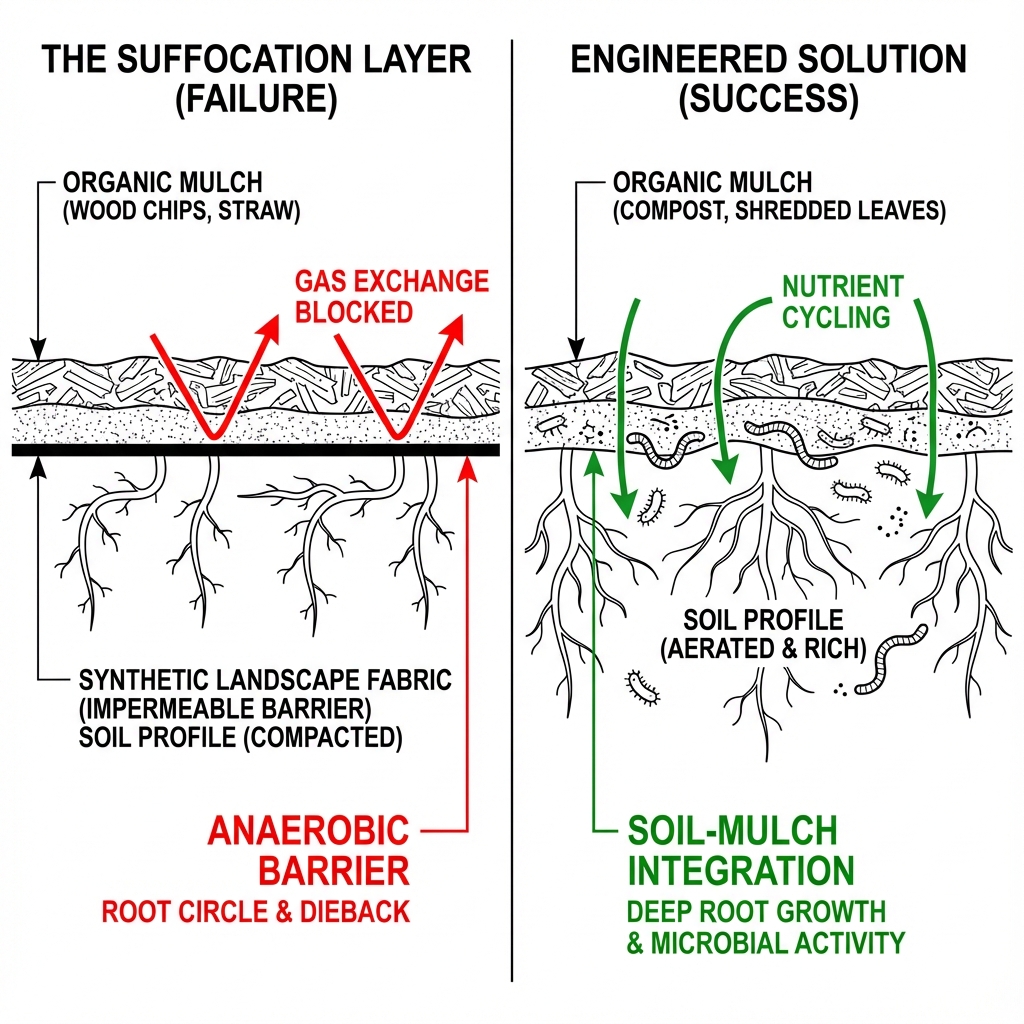
The Suffocation Layer
The use of weed fabric (geotextile) or cardboard under organic mulch in permanent planting beds.
- Why it fails: It interrupts the gas exchange and nutrient cycling between the mulch and the soil microbiome, leading to anaerobic soil conditions and surface rooting.
- The Diagnostic Test: Lift a corner of the cardboard or fabric. IF you find thick, white, fleshy roots running horizontally just beneath the surface, THEN you have not killed the weeds; you have built them a protected highway.
- See the Case Study: The "Cardboard & Pray" Trap: Why You Can't Just Cover Weeds in a New Allotment
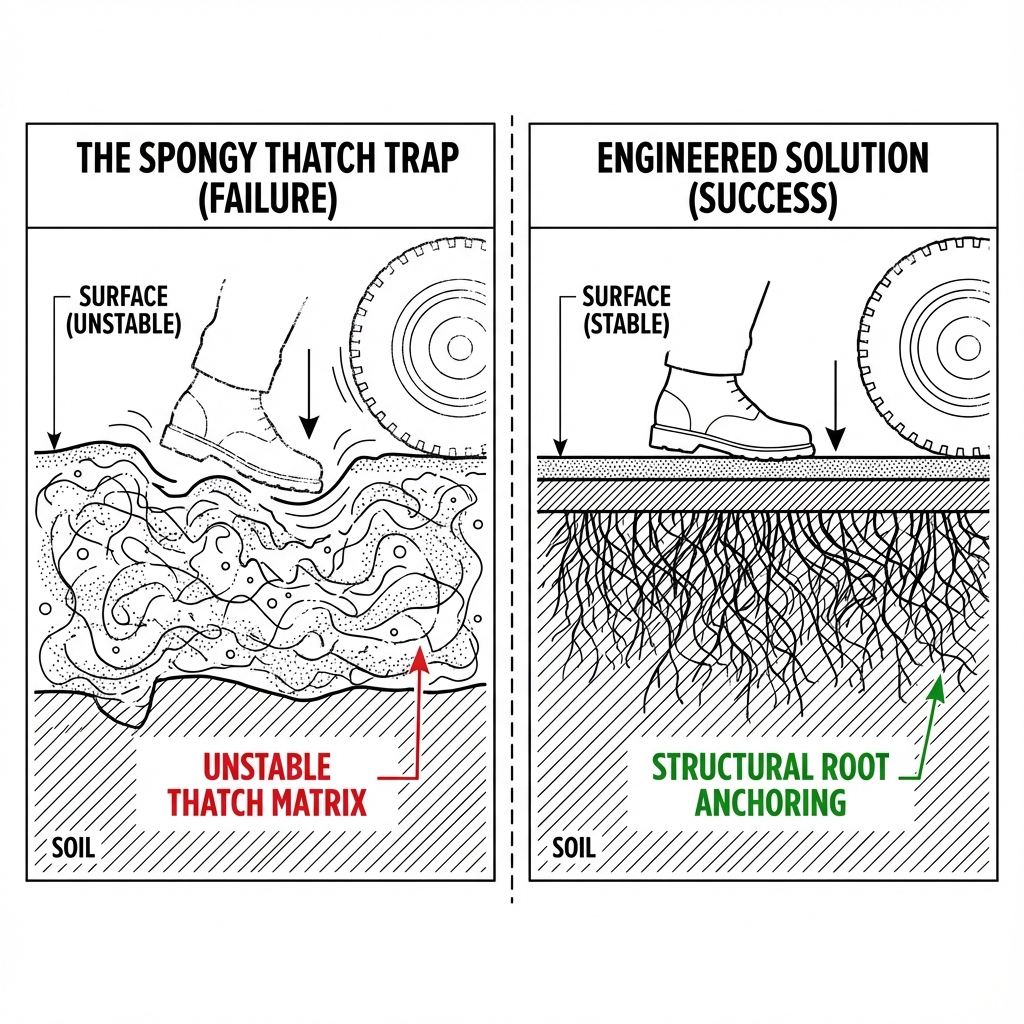
The Spongy Thatch Trap
A mechanical failure occurring when dense, rhizomatous groundcovers or thick organic mats are used as a substitute for traffic-bearing turf.
- Why it fails: Unlike professional sod which provides shear resistance and a flat grade, these species create a multi-inch spongy layer that hides terrain irregularities and creates a lubricated 'slip-plane,' leading to orthopedic injuries and a failure to manage underlying soil mud.
- The Diagnostic Test: IF a dog or human corners at speed and the vegetation slides laterally or feels 'disconnected' from the underlying soil, then the site has fallen into a Spongy Thatch Trap., THEN you have The Spongy Thatch Trap.
- See the Case Study: Why a Liriope Lawn Is a Disaster for Dogs (And What to Use Instead)
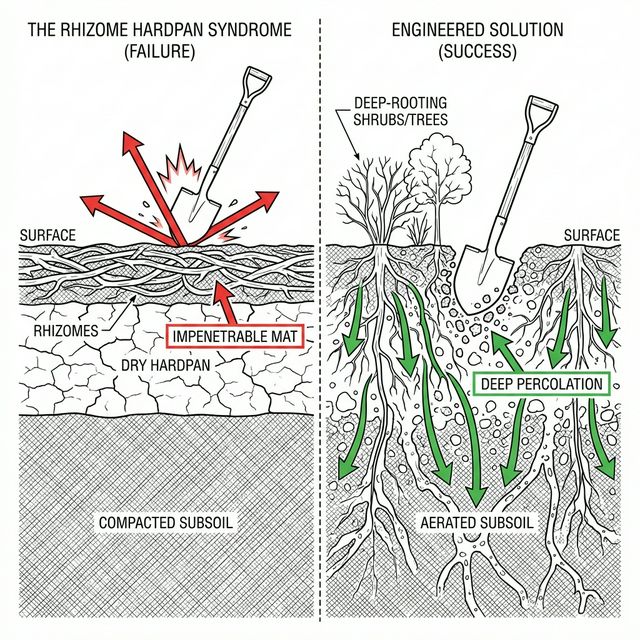
The Rhizome Hardpan Syndrome
A structural failure where vigorous, clumping perennials are allowed to grow unchecked without woody competition, fusing their crowns into an impenetrable, concrete-like mat.
- Why it fails: The lack of deep-rooted shrubs allows surface rhizomes to monopolize the soil structure, creating a monoculture that resists standard excavation tools.
- The Diagnostic Test: If your spade bounces off the soil surface and you need a pickaxe to plant a bulb, Then you have The Rhizome Hardpan Syndrome.
- See the Case Study: Why Your Lady's Mantle Became Concrete: Fixing the Rhizome Hardpan
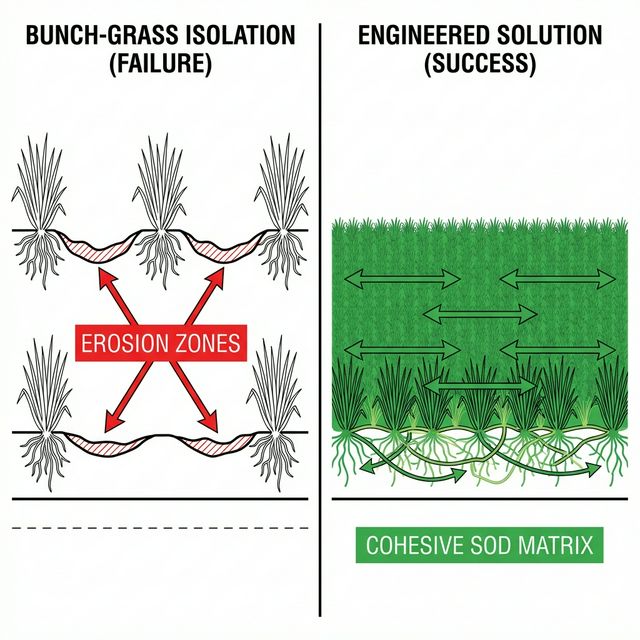
The Bunch-Grass Isolation Syndrome
The failure of a non-rhizomatous turf species to knit into a cohesive carpet, resulting in isolated 'islands' of vegetation separated by eroding soil.
- Why it fails: Homeowners mistakenly expect bunch-type grasses (Fescue/Rye) to spread via runners like creeping grasses (Bermuda/Bluegrass), leading to a lack of overseeding and eventual soil erosion between crowns.
- The Diagnostic Test: If your lawn consists of distinct, raised green tufts separated by bare mud that never fills in, Then you have Bunch-Grass Isolation.
- See the Case Study: Why Your Lawn Looks Like Clumps (And Why Fertilizer Won't Fix It)
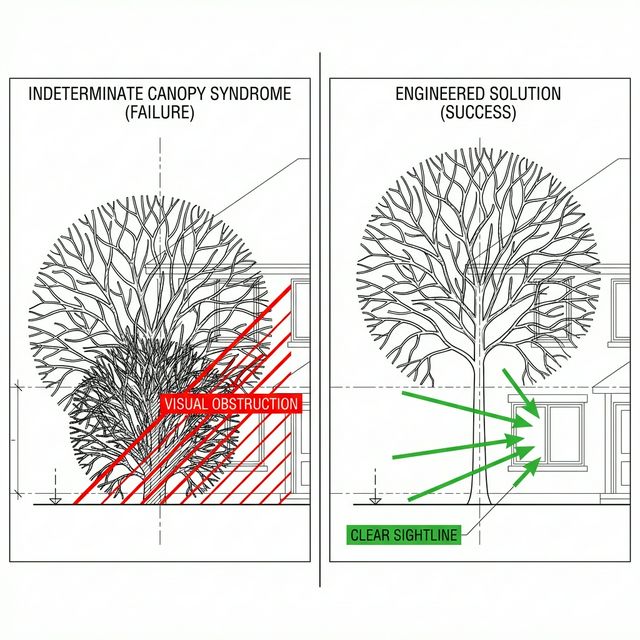
The Indeterminate Canopy Syndrome
The failure to establish a clear vertical trunk hierarchy, allowing lower epicormic growth or structural branches to obscure the tree's architectural form, resulting in a shrub-like visual mass.
- Why it fails: It creates a visual wall that blocks architectural sightlines and diverts metabolic energy from the upper canopy to low-value lower limbs.
- The Diagnostic Test: If the tree's foliage touches the ground or obscures the line of sight to the front door or windows, Then it is suffering from Indeterminate Canopy Syndrome.
- See the Case Study: The "Shrub-Tree" Mistake: Why Limbing Up Improves Curb Appeal
The Drip-Edge Incompatibility Syndrome
The attempt to install soft-tissue biological elements directly beneath an un-guttered roofline's primary hydraulic drip zone.
- Why it fails: The kinetic energy of falling sheet water from the roof physically pulverizes delicate foliage, while the necessary drainage aggregate bakes the root zone and lacks the organic matter required to sustain plant life.
- The Diagnostic Test: If you see a narrow strip of gravel directly under a massive, un-guttered roofline, Then it is a structural drainage zone and cannot support ornamental planting.
- See the Case Study: Why You Should Never Plant Flowers in Your Foundation Rock Strip
The Biological Traffic Shear Syndrome
The structural failure of biological groundcovers (turf) when subjected to concentrated, repetitive kinetic wear that exceeds the plant's metabolic recovery rate.
- Why it fails: Turf grass cannot survive constant, heavy mechanical compaction and shear force from repetitive foot traffic (especially canine patrol routes), leading to soil compaction, root death, and ultimately a muddy trench.
- The Diagnostic Test: If you see a bare, muddy trench tracing a fence line or perimeter while the rest of the lawn is intact, Then you have a Biological Traffic Shear failure.
- See the Case Study: How to Fix a Muddy Dog Run: Stop Fighting the Patrol Route
The Subterranean Rhizome Breach
The structural and hydraulic threat posed by aggressive running rhizomes penetrating foundation envelopes, masonry joints, or utility conduits.
- Why it fails: This is a systemic failure occurring when highly vigorous, running biological elements are planted without subterranean containment near rigid architectural structures. The roots actively seek the condensation and moisture gradients surrounding foundations, eventually applying immense hydraulic and mechanical pressure that fractures mortar and occludes ventilation.
- The Diagnostic Test: If you see thick, segmented roots running laterally from a boundary line directly toward a foundation wall or air vent, Then you have a Subterranean Rhizome Breach.
- See the Case Study: How to Stop a Neighbor's Bamboo from Destroying Your Foundation
The Structural Asphyxiation Syndrome
The unchecked vertical growth of aggressive climbing vines that completely engulfs and obscures utilitarian or architectural structures, rendering them inaccessible and prone to moisture damage.
- Why it fails: Climbing vines like English Ivy utilize aerial rootlets that aggressively bond to surfaces, trapping moisture against the structure, hiding mechanical faults, and increasing wind load resistance to the point of structural failure.
- The Diagnostic Test: If you cannot see the underlying architectural or utilitarian structure because it is entirely encapsulated by a thick woody vine canopy, Then you have Structural Asphyxiation.
- See the Case Study: The Window Cut Method: How to Kill Mature English Ivy Without Ruining Your Tools
The Riparian Denial Syndrome
The attempt to maintain shallow-rooted, upland biological finishes (like turf grass) in a natural, low-lying topographic sink that functions hydraulically as an ephemeral wetland.
- Why it fails: Turf grass lacks the root structure and metabolic capacity to survive extended inundation, resulting in biological death, soil compaction, and persistent standing water.
- The Diagnostic Test: If you have a persistent strip of muddy, dying turf in a natural depression at the edge of your property, Then you have The Riparian Denial Syndrome.
- See the Case Study: Stop Mowing the Swamp: How to Turn a Flooded Backyard Edge into a Biological Sponge
The Biofilm Eradication Syndrome
The catastrophic collapse of an aquatic ecosystem caused by the mechanical or chemical sterilization of beneficial biological filters during routine maintenance.
- Why it fails: Ponds rely on nitrifying bacteria living on surfaces like rocks and liners to process organic waste. Power washing or scrubbing removes this necessary biological infrastructure, causing ammonia spikes and severe algae blooms.
- The Diagnostic Test: If a naturalistic pond surface is scrubbed to bare liner or raw stone, Then the biological filtration system has been fatally compromised.
- See the Case Study: Don't Drain the Swamp: How to Resurrect an Inherited Pond (Without Killing It)
Category II: Structural Hardscape & Material Physics
Failures in paving, sub-base engineering, and material selection.
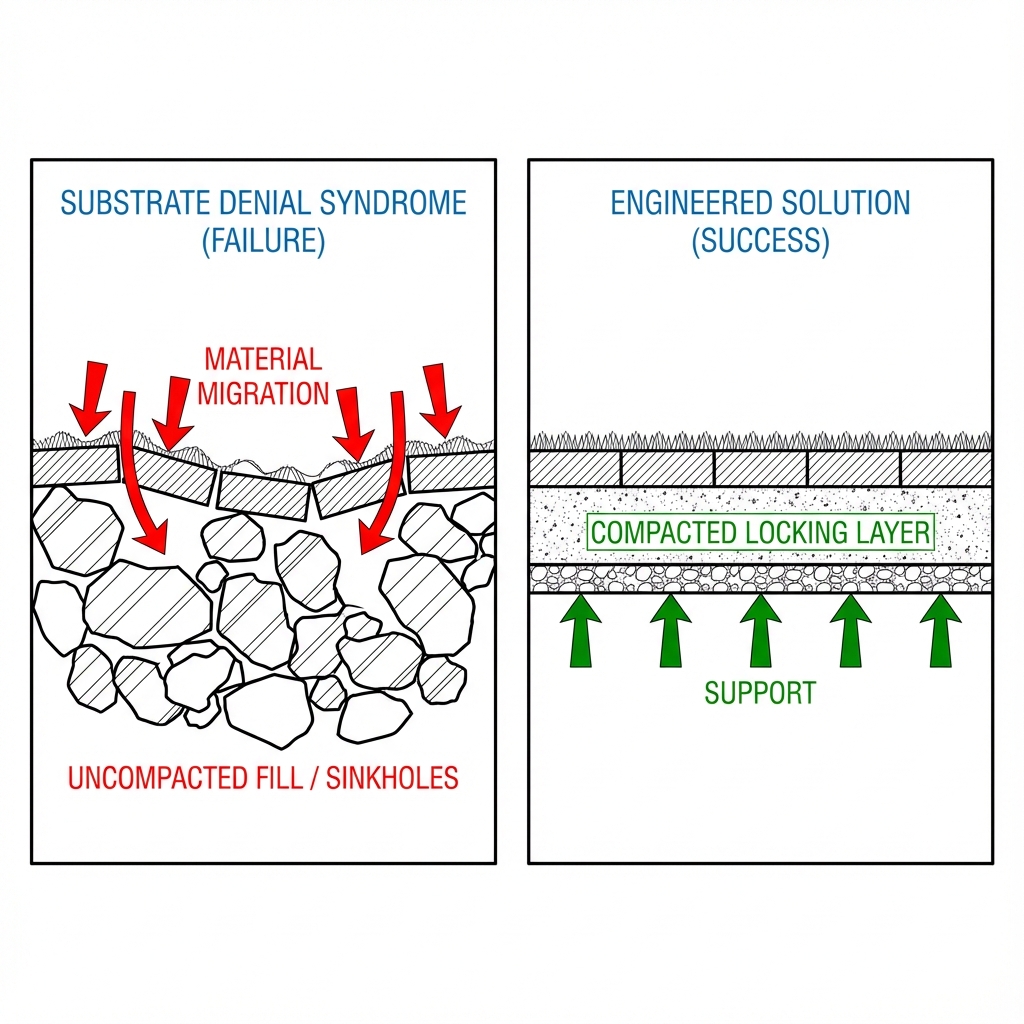
Substrate Denial Syndrome
The attempt to install surface finishes (turf, pavers, planting) over unstable or incompatible sub-bases (loose rocks, rubble, or uncompacted fill).
- Why it fails: Without a "locking layer" or proper compaction, the sub-base remains fluid; gravity inevitably pulls the surface finish into the voids, resulting in sinkholes and lumpy topography.
- The Diagnostic Test: IF walking on a paved or turf surface feels "spongy" or uneven, THEN you have Substrate Denial Syndrome.
- See the Case Study: Can I Lay Artificial Turf Over Rocks? (Stop Digging and Do This Instead)
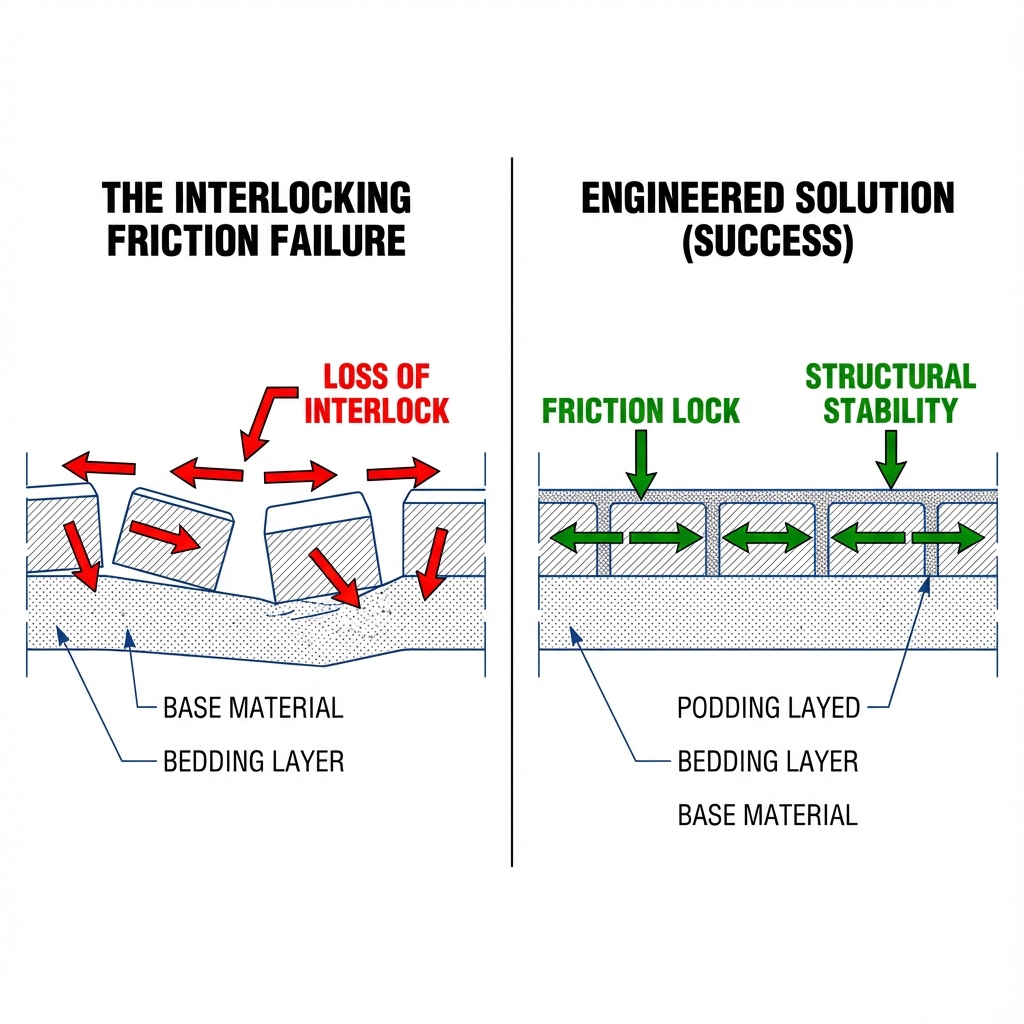
The Interlocking Friction Failure
A structural failure in segmental pavement systems where the perimeter jointing material (sand) is missing or depleted, compromising the mechanical interlock of the units.
- Why it fails: Paver systems rely on lateral friction provided by full-depth joint sand to distribute loads and resist movement; without this lock at the edges, the units become susceptible to shifting, water infiltration, and base erosion, which leads to total perimeter collapse.
- The Diagnostic Test: IF the joint sand at the edge of a patio is recessed more than 1/2 inch below the paver surface, creating a visible dark void at the perimeter, then the system is in a state of friction failure., THEN you have The Interlocking Friction Failure.
- See the Case Study: Missing Sand at Your Paver Edges? Why Your Contractor Is Wrong and How to Fix It
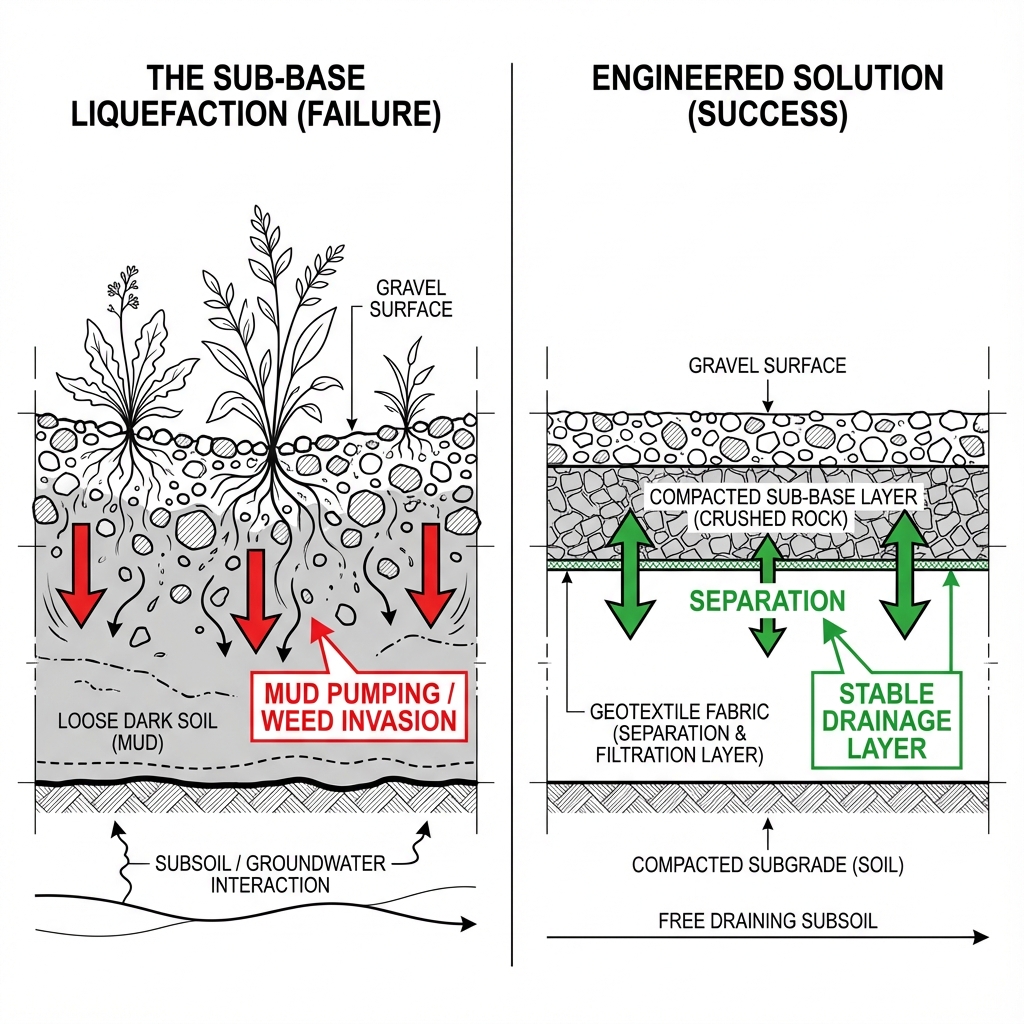
The Sub-Base Liquefaction
The installation of decorative aggregate surface finishes (gravel, stone, or granite) directly onto native topsoil without a separating, sterile, and compacted foundation layer.
- Why it fails: Native soil acts as a nutrient-rich seed bed; without a compacted, inorganic sub-base to provide structural separation and moisture control, organic fines and wind-blown dust migrate into the aggregate gaps, creating a 'weed sandwich' that facilitates rapid colonization.
- The Diagnostic Test: IF the decorative rock layer is thinning, showing bare earth, and supporting significant weed growth despite the presence of landscape fabric or topical herbicides, then you have a sub-base failure., THEN you have The Sub-Base Liquefaction.
- See the Case Study: Weeds in Your Gravel Walk: Why They Keep Coming Back and How to Fix It for Good
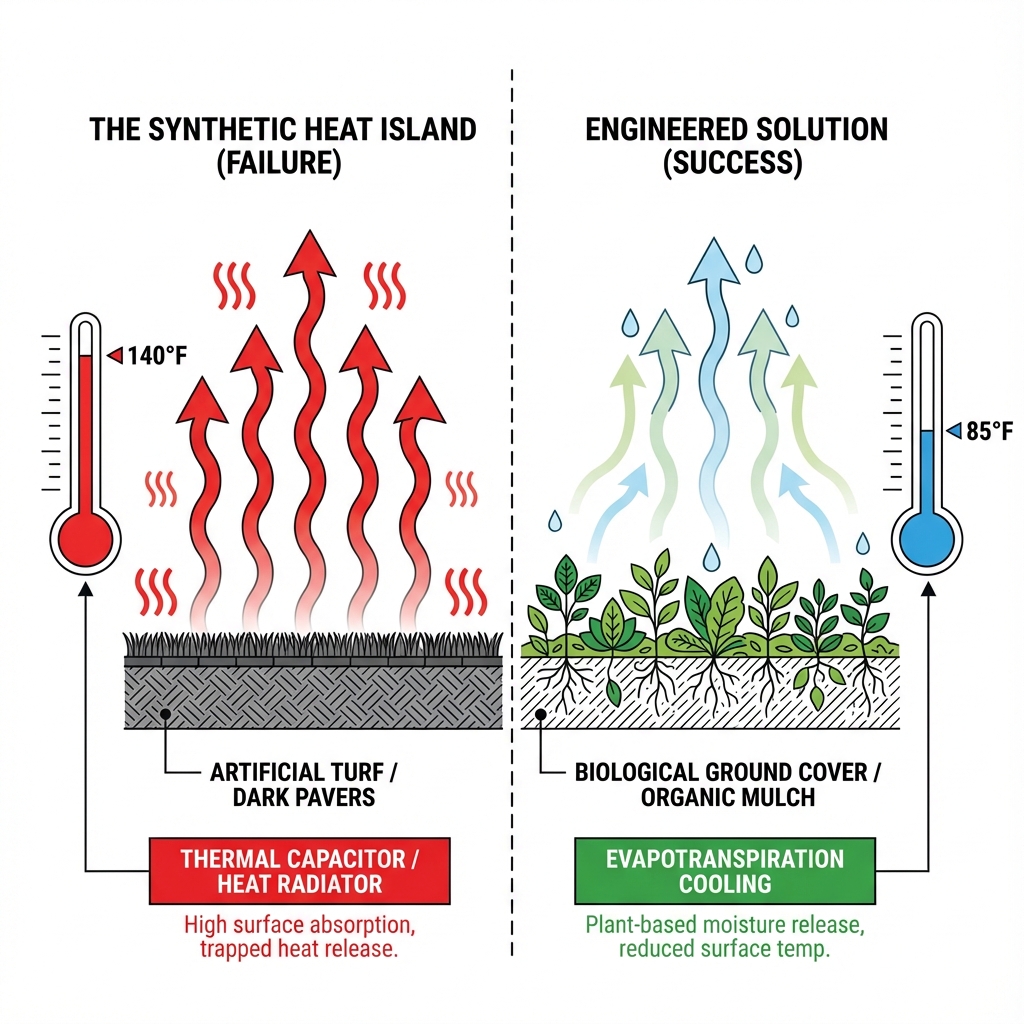
The Synthetic Heat Island
The installation of artificial turf, dark pavers, or extensive gravel in high-exposure zones without organic mitigation.
- Why it fails: These materials act as thermal capacitors, radiating heat upwards of 140°F (60°C), rendering the space biologically sterile and physically uninhabitable for humans or pets.
- See the Case Study: Ditching the Fake Grass: How to Build a Cool, Edible Garden in a Hot West-Facing Yard
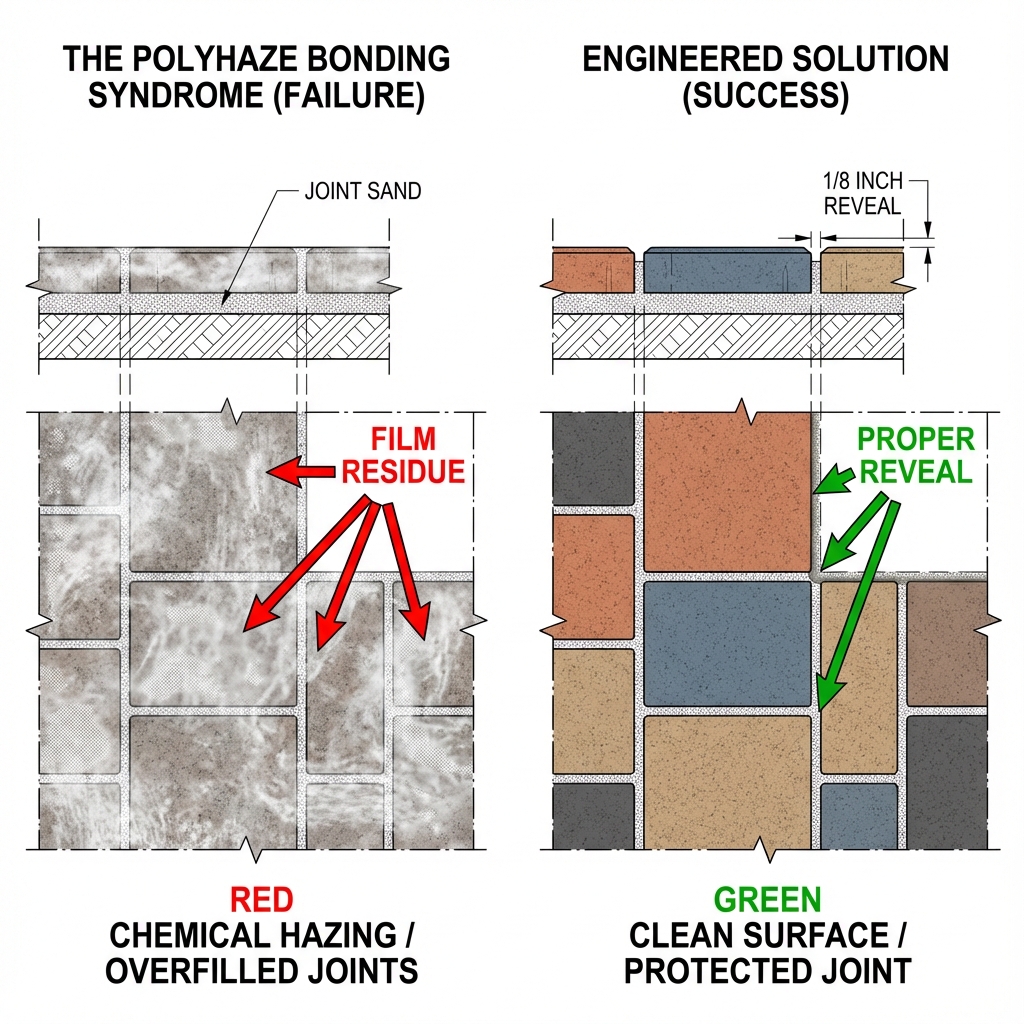
The Polyhaze Bonding Syndrome
A chemical and mechanical failure where polymer-modified jointing sand is activated while still present on the paver surface or overfilled within the joints without a proper reveal.
- Why it fails: Polymer residue bonds to the face of the masonry creating an indelible 'ghosting' film, while the lack of a recessed joint (reveal) exposes the sand to mechanical friction from foot traffic, which grinds the binder away and reverts the joint to loose, erodible sand.
- The Diagnostic Test: IF there is visible dust on the paver surface before wetting, or if the sand level is flush with the top of the chamfered edge, then the installation will suffer from permanent surface staining and premature joint failure., THEN you have The Polyhaze Bonding Syndrome.
- See the Case Study: Put the Hose Down: How to Avoid the 'Polyhaze' Disaster on Your New Patio
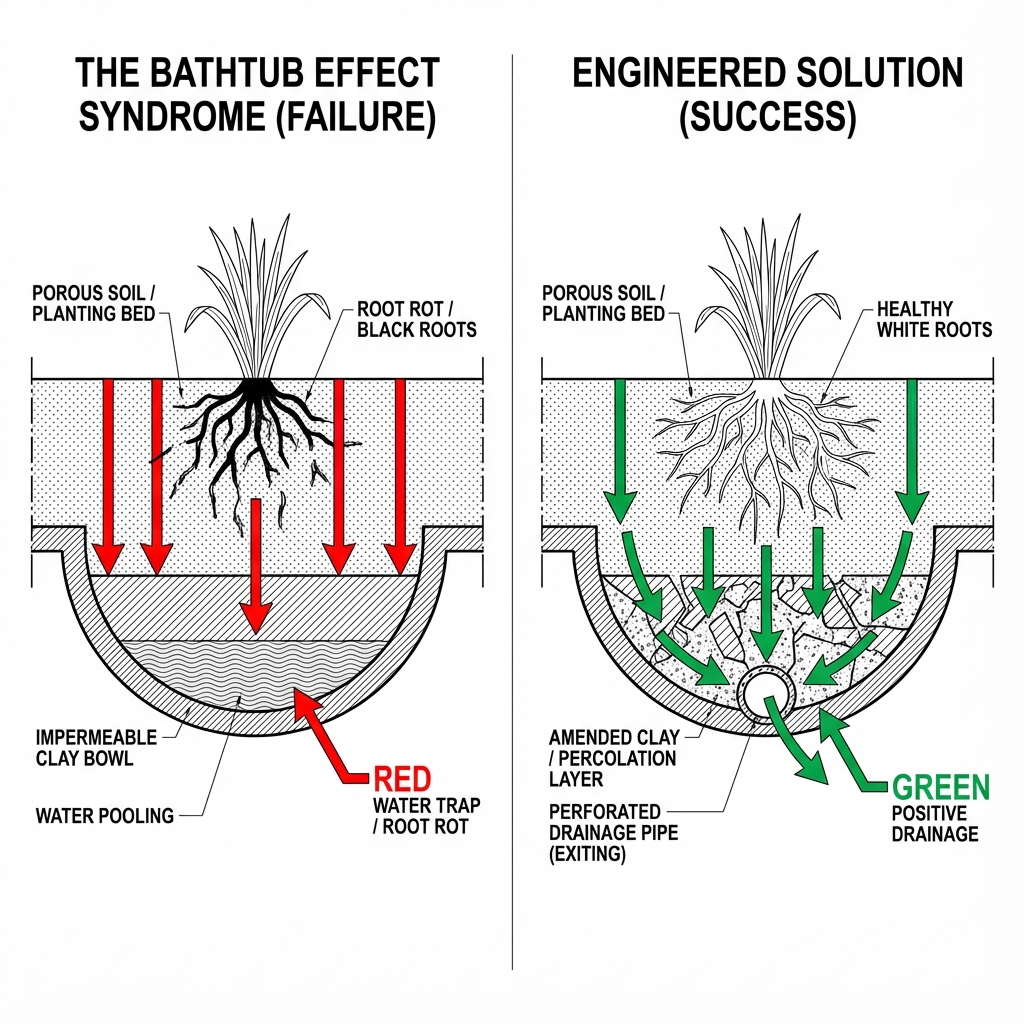
The Bathtub Effect Syndrome
A hydraulic failure where a porous medium, such as garden soil or mulch, is placed over or inside an impermeable substrate like compacted clay.
- Why it fails: Because clay lacks vertical percolation, the planting zone acts as a vessel that captures and holds water; this saturates the root zone, creates anaerobic conditions, and leads to the rapid decay of biological material or root rot.
- The Diagnostic Test: IF planting beds remain saturated for days after rain while the surrounding surface is dry, then the system is experiencing the Bathtub Effect., THEN you have The Bathtub Effect Syndrome.
- See the Case Study: Turning a Muddy Clay "Bowling Alley" Into a Grass-Free Family Oasis
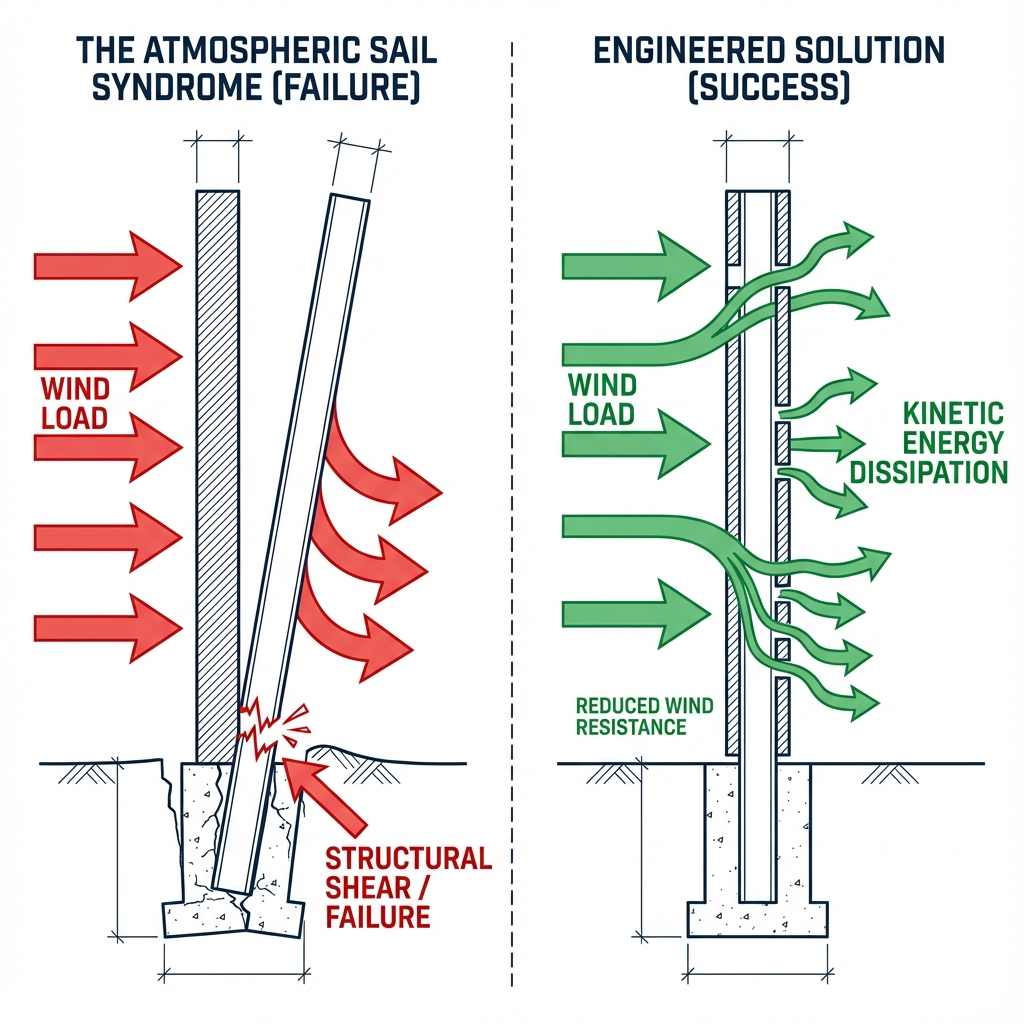
The Atmospheric Sail Syndrome
The conversion of a permeable boundary, such as a picket fence or slatted screen, into an impermeable barrier that captures kinetic wind energy.
- Why it fails: By blocking airflow in high-exposure zones like lakefronts, the lateral wind load is transferred directly to structural posts and footings, leading to mechanical shear or foundation failure during storm events.
- The Diagnostic Test: IF you are adding solid infill to an existing slatted fence near a large body of water, then you are creating a wind-sail that will likely exceed the original post's shear strength., THEN you have The Atmospheric Sail Syndrome.
- See the Case Study: Hiding Pool Equipment and Handling Lake Winds: A Side Yard Strategy
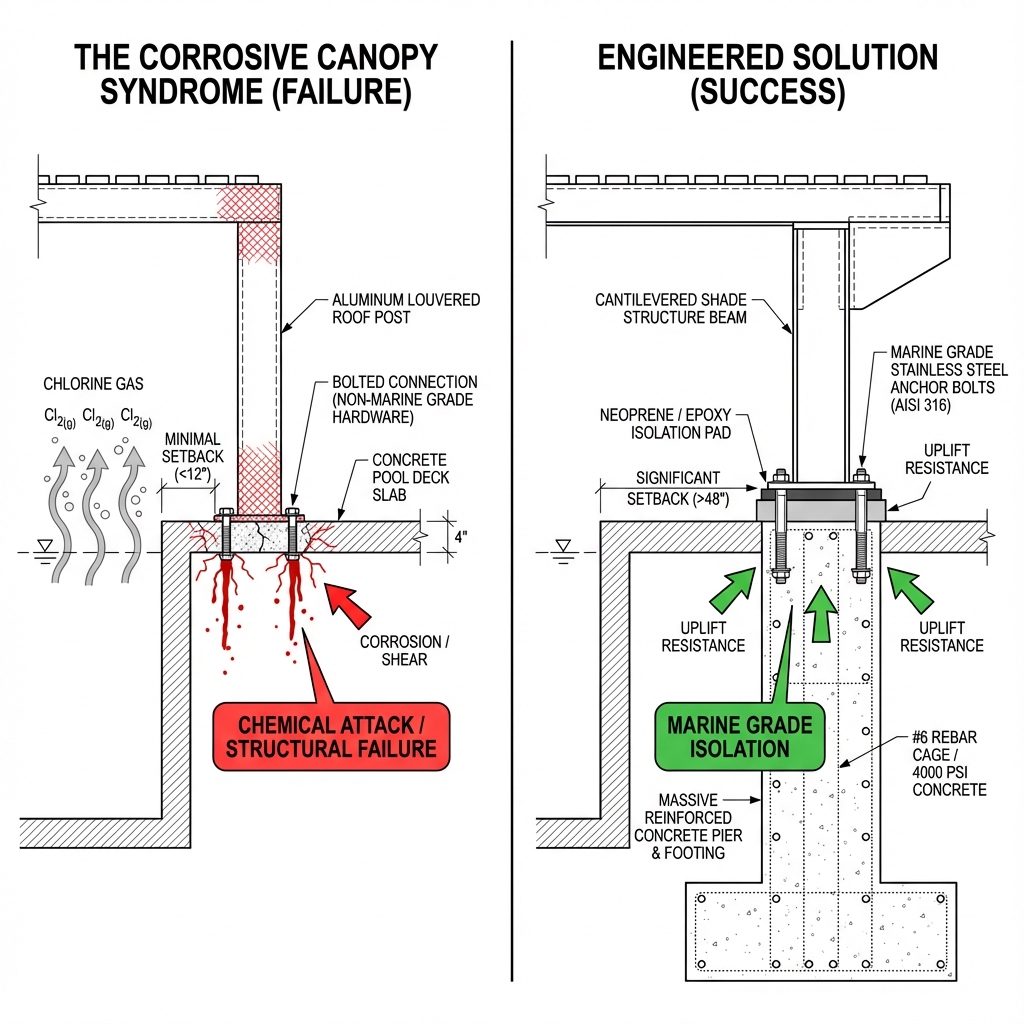
The Corrosive Canopy Syndrome
The installation of mechanical or motorized shading systems over chemically active aquatic environments (chlorine or salt pools) without marine-grade protection or structural isolation.
- Why it fails: Pools emit corrosive chlorine or salt vapors that cause standard aluminum and mechanical components to pit and seize; additionally, mounting these systems to standard thin pool decks fails to provide the mass needed to resist uplift wind loads.
- The Diagnostic Test: IF a motorized louvered roof is bolted directly to a standard pool deck rather than cantilevered from reinforced concrete piers, then the system is predisposed to both mechanical corrosion and wind-induced shear., THEN you have The Corrosive Canopy Syndrome.
- See the Case Study: The Pool Shade Trap: Why Louvered Roofs Rust and How to Build Them Right
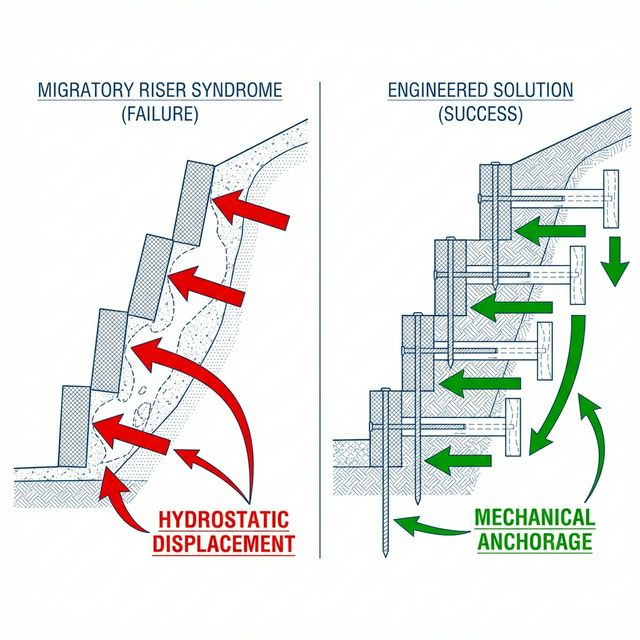
The Migratory Riser Syndrome
A mechanical failure in hillside hardscaping where unanchored retainment elements (timbers or stones) slide downslope due to gravity, vibration, and hydraulic pressure.
- Why it fails: Without a mechanical connection to the stable subgrade (like rebar pins or a keyway trench), the friction between the timber and the soil is insufficient to resist the lateral load of foot traffic and erosion.
- The Diagnostic Test: IF your timber steps are bowing forward, twisting, or have gaps appearing between the timber and the tread material behind it, THEN you have The Migratory Riser Syndrome.
- See the Case Study: How to Build Hillside Steps That Won't Rot or Slide (DIY Guide)
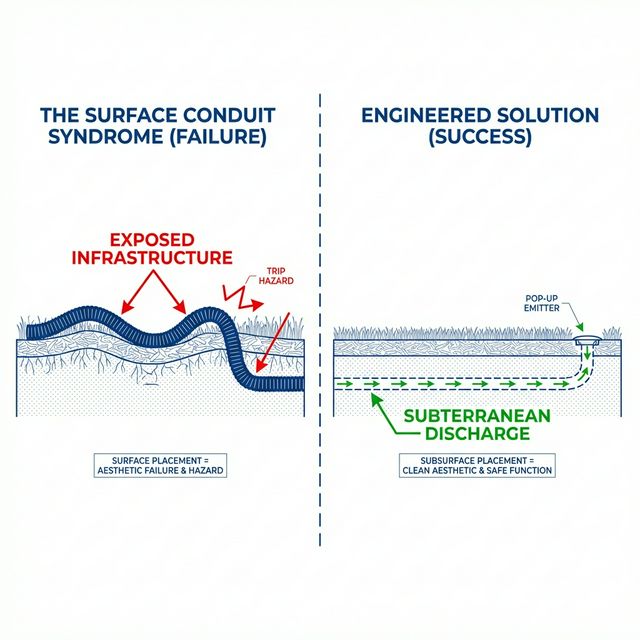
The Surface Conduit Syndrome
The permanent reliance on temporary, above-ground drainage extensions (like corrugated flex-pipe) that visually sever the landscape and create tripping hazards.
- Why it fails: It treats a subterranean hydraulic necessity as a surface-level accessory, prioritizing short-term water movement over long-term site integration and safety.
- The Diagnostic Test: If you have to step over a pipe to mow your lawn, you have The Surface Conduit Syndrome.
- See the Case Study: The "Surface Conduit" Trap: Why Wildflowers Can't Fix Bad Drainage
The Linear Shear Plane Failure
A structural failure in multi-size segmental pavement where continuous, unbroken joint lines are created, eliminating the mechanical interlock required to distribute kinetic loads.
- Why it fails: Without staggered joints (such as a proper Ashlar pattern), kinetic force and thermal expansion travel along the path of least resistance—the straight seam—causing the pavers to separate and drift.
- The Diagnostic Test: If a straight joint line runs uninterrupted past three or more paver junctions in a multi-size layout, Then you have a Linear Shear Plane Failure.
- See the Case Study: Why Your Patio Pavers Are Drifting Apart (And How to Fix the Pattern)
The Biodegradable Retainment Syndrome
The structural failure of a slope caused by relying exclusively on decomposing organic materials, such as landscape timbers, for long-term soil retainment without an integrated biological root matrix.
- Why it fails: Wood in ground contact inevitably decays. If a living root system is not established behind the timber to assume the hydrostatic and gravitational load, the slope will catastrophically fail once the wood's structural integrity is compromised.
- The Diagnostic Test: If you see crumbling, moss-covered landscape timbers holding back a slope with only shallow-rooted groundcover behind them, Then you have a ticking time bomb of erosion.
- See the Case Study: Don't Rip Out That Rotting Retaining Wall (Do This Instead)
The Unretained Cut Syndrome
A structural failure where a vertical excavation is made into a graded slope without the installation of a mechanical retaining structure, guaranteeing soil collapse.
- Why it fails: Native soil lacks the shear strength to maintain a vertical face when exposed to hydraulic weathering and kinetic foot traffic, leading to rapid erosion, grade failure, and localized flooding.
- The Diagnostic Test: If you see a raw, vertical dirt wall carved into a sloped yard, Then you have an Unretained Cut Syndrome.
- See the Case Study: The Trampoline Pit Trap: Why You Can't Just Dig a Hole in a Hill
The Capillary Heave Trap
A mechanical failure where moisture-retaining fines (like stone dust) are used as a setting bed in freeze-thaw climates, leading to hydraulic expansion and pavement displacement.
- Why it fails: Stone dust and fine particulate screenings act as a sponge, trapping water directly beneath the paving units. When temperatures drop, this trapped water freezes and expands, lifting the heavy stones and shattering rigid jointing materials.
- The Diagnostic Test: If your patio stones are heaving unevenly and the rigid jointing material is cracking into loose chunks, Then you likely have a moisture-trapping setting bed.
- See the Case Study: Don't Use Stone Dust: How to Reset an Old Flagstone Patio the Right Way
The Municipal Basin Syndrome
A visual and structural failure where a naturalistic, meandering watercourse terminates abruptly into a rigid, geometrically formal basin, shattering the organic illusion.
- Why it fails: It creates a stylistic dissonance that highlights the artificial nature of the feature, while rigid vertical edges often fail to hide the synthetic liner and prevent wildlife from safely accessing or exiting the water.
- The Diagnostic Test: If a meandering, boulder lined stream empties into a pond with perfectly straight, flat capped coping stones, Then you have The Municipal Basin Syndrome.
- See the Case Study: How to Rebuild a Leaking Backyard Stream (And Fix the Bathtub Pond)
The Organic Subsidence Trap
The structural failure of a leveled surface caused by using decomposing organic matter as a permanent volumetric fill.
- Why it fails: Organic matter is biologically active and breaks down over time. As soil microbes consume the compost, the volume shrinks, causing the repaired low spots to sink back to their original grade.
- The Diagnostic Test: If you fill a rut with pure compost and it looks level today, Then it will become a sunken rut again by next season.
- See the Case Study: Why Leveling Your Lawn With Compost Is a Trap (And How to Fix It)
The Dissimilar Retainment Syndrome
A structural and visual failure where rigid masonry units and dynamic, biodegradable materials (like wood timbers) are integrated into the same retaining structure, destroying mechanical continuity.
- Why it fails: Wood expands, contracts, and eventually decays, while concrete remains static. This differential movement breaks the structural interlock required to hold back hydrostatic and earth pressures, leading to inevitable shear failure and wall collapse.
- The Diagnostic Test: If you see alternating layers, patched sections, or direct stacking of wood timbers and concrete blocks in a single soil-retaining wall, Then you have The Dissimilar Retainment Syndrome.
- See the Case Study: Are Old Landscape Timbers Safe for Raised Beds? Fixing the 'Frankenstein' Retaining Wall
The Capillary Siphon Syndrome
A hydraulic and biological failure where encroaching turf or porous soil bridges the physical gap of a water feature's edging, actively wicking water out of the basin while depositing nutrient-rich organic matter directly into the aquatic system.
- Why it fails: It creates a continuous moisture bridge that drains the pond's volume while simultaneously feeding aggressive algae blooms with nitrogen-rich runoff and clippings.
- The Diagnostic Test: If you see grass or soil touching the water directly over the edge of a pond liner, Then you have a Capillary Siphon.
- See the Case Study: The "Capillary Siphon" Trap: Why Your Backyard Pond is Green, Mucky, and Losing Water (And How to Fix the Edging)
Category III: Spatial & Geometric Configuration
Failures in layout, scale, boundaries, and visual perception.
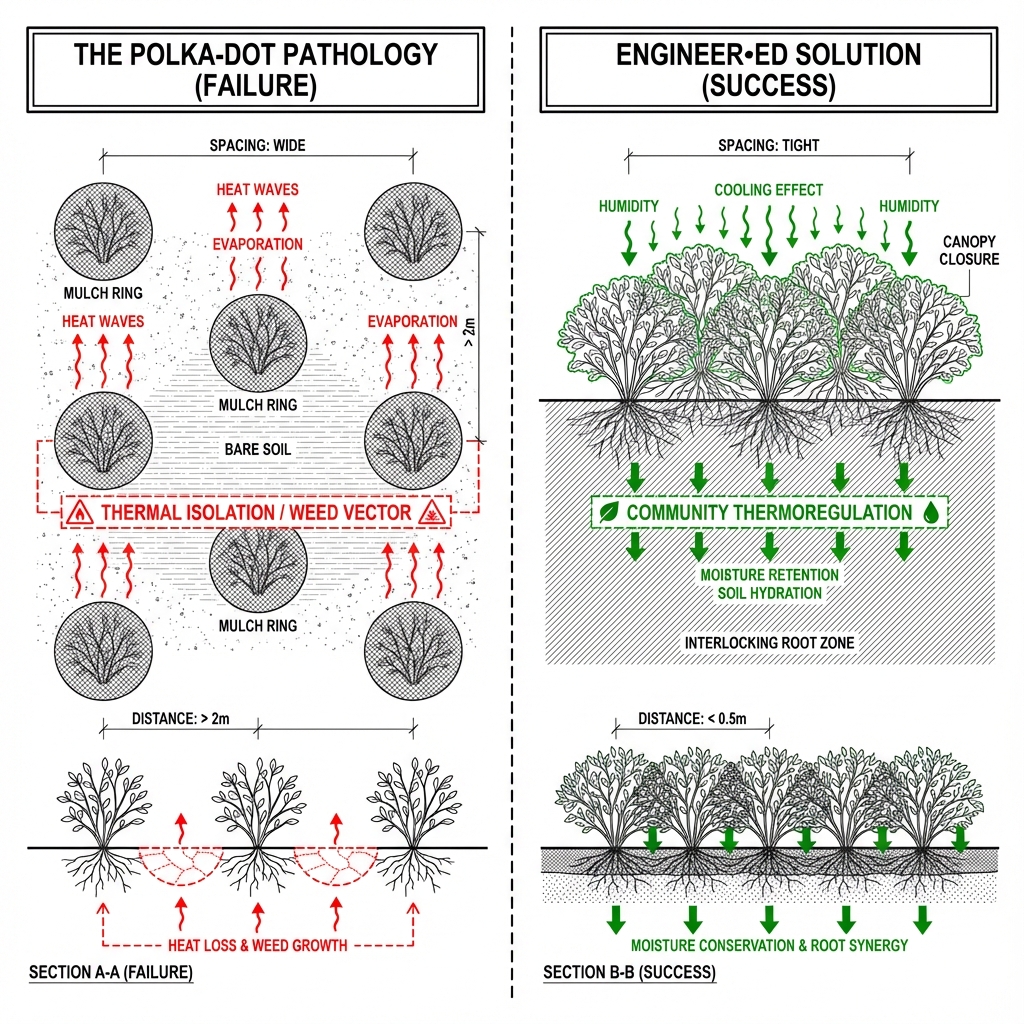
The Polka-Dot Pathology
The spacing of plant material as isolated individuals rather than cohesive drifts, usually surrounded by excessive negative space (mulch).
- Why it fails: It destroys visual weight balance and increases soil temperature; plants rely on community density for thermal regulation and weed suppression.
- The Diagnostic Test: IF you can see individual pieces of mulch between shrubs that have been planted for more than two years, THEN you have Density Failure.
- See the Case Study: Fixing the 'Empty Bed' Syndrome: How to Balance a Lopsided Garden Plot
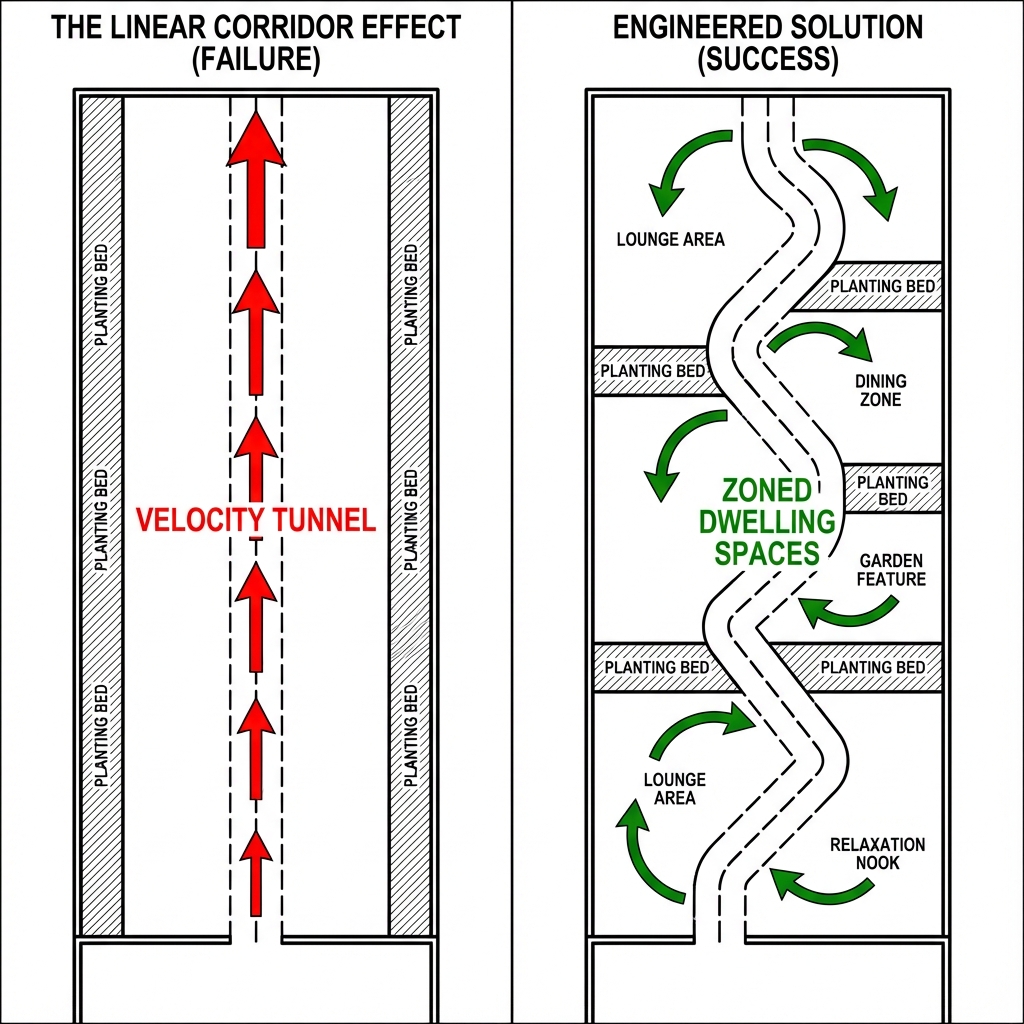
The Linear Corridor Effect (The Bowling Alley)
Installing straight, parallel bed lines in a narrow rectangular yard.
- Why it fails: It accentuates the constriction of the space, creating a "pass-through" psychological effect rather than a destination, reducing the usability of the square footage.
- The Diagnostic Test: Stand at the entrance of the space. IF you cannot place a table and chairs without blocking the only walking path, OR if your eye travels instantly to the back fence without stopping on a feature, THEN you are standing in a hallway, not a yard.
- See the Case Study: The 'Bowling Alley' Backyard: How to Turn a Narrow Mud Pit Into a Fire Pit Lounge
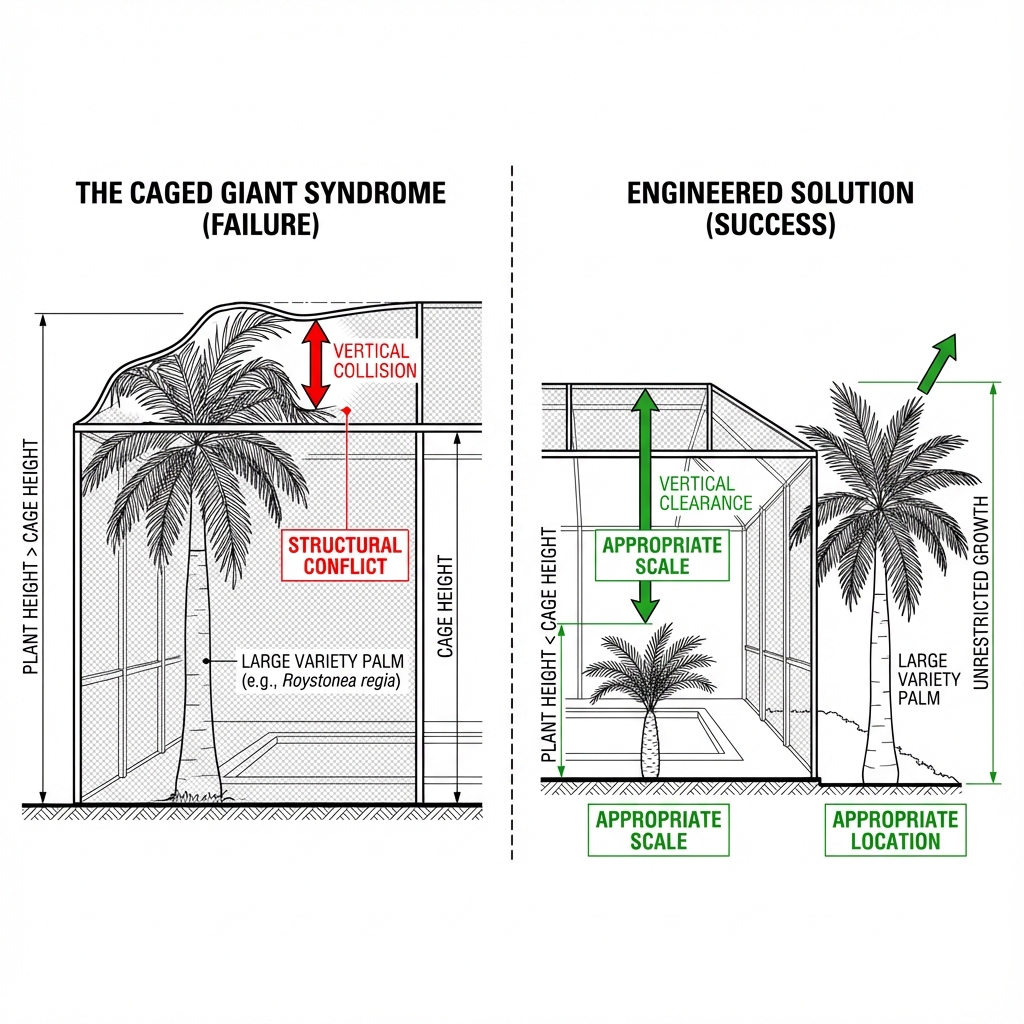
The Caged Giant Syndrome
The installation of macro-scale flora (like Strelitzia nicolai) within height-restricted architectural enclosures.
- Why it fails: The plant's genetic vertical drive physically collides with the static enclosure, resulting in structural damage to screens and a distorted, cramped aesthetic.
- The Diagnostic Test: Look up at the ceiling of your enclosure. IF the plant's newest leaf spear is touching the screen, OR if the plant has to bend its neck to fit under the roof, THEN you have planted a tree inside a room.
- See the Case Study: Why Birds of Paradise Ruin Screened Pools (And What to Plant Instead)
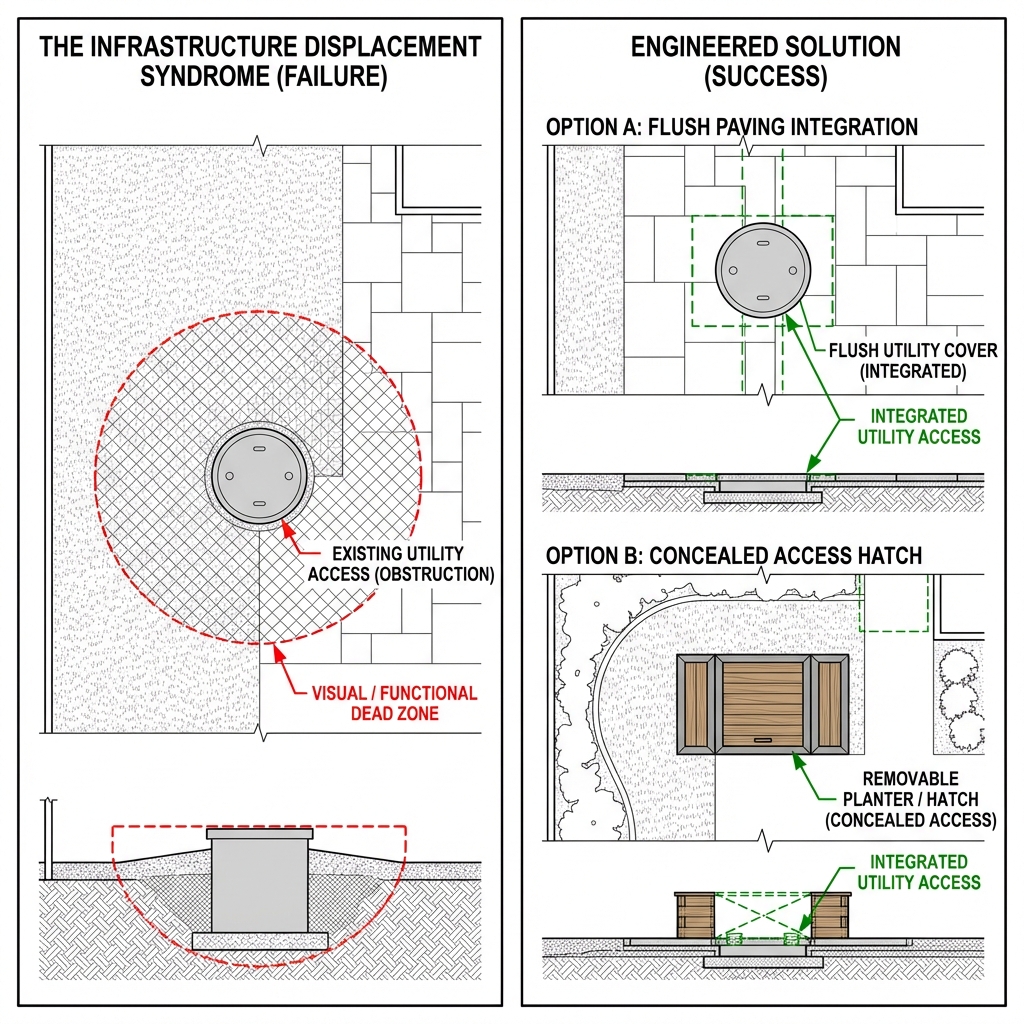
The Infrastructure Displacement Syndrome
A spatial failure where utilitarian easements or industrial access points (drains, meters, pits) create a permanent visual and functional 'dead zone' that disrupts the landscape's continuity.
- Why it fails: By treating utilities as static obstacles rather than integrated service layers, homeowners create fragmented designs and 'visually loud' service areas that diminish the perceived square footage and property value.
- The Diagnostic Test: IF a yard contains a below-grade depression or industrial lid that forces an awkward break in the paving or planting rhythm, then the property is suffering from Infrastructure Displacement., THEN you have The Infrastructure Displacement Syndrome.
- See the Case Study: How We Hid an Ugly Stormwater Drain and Gained a Usable Corner Patio
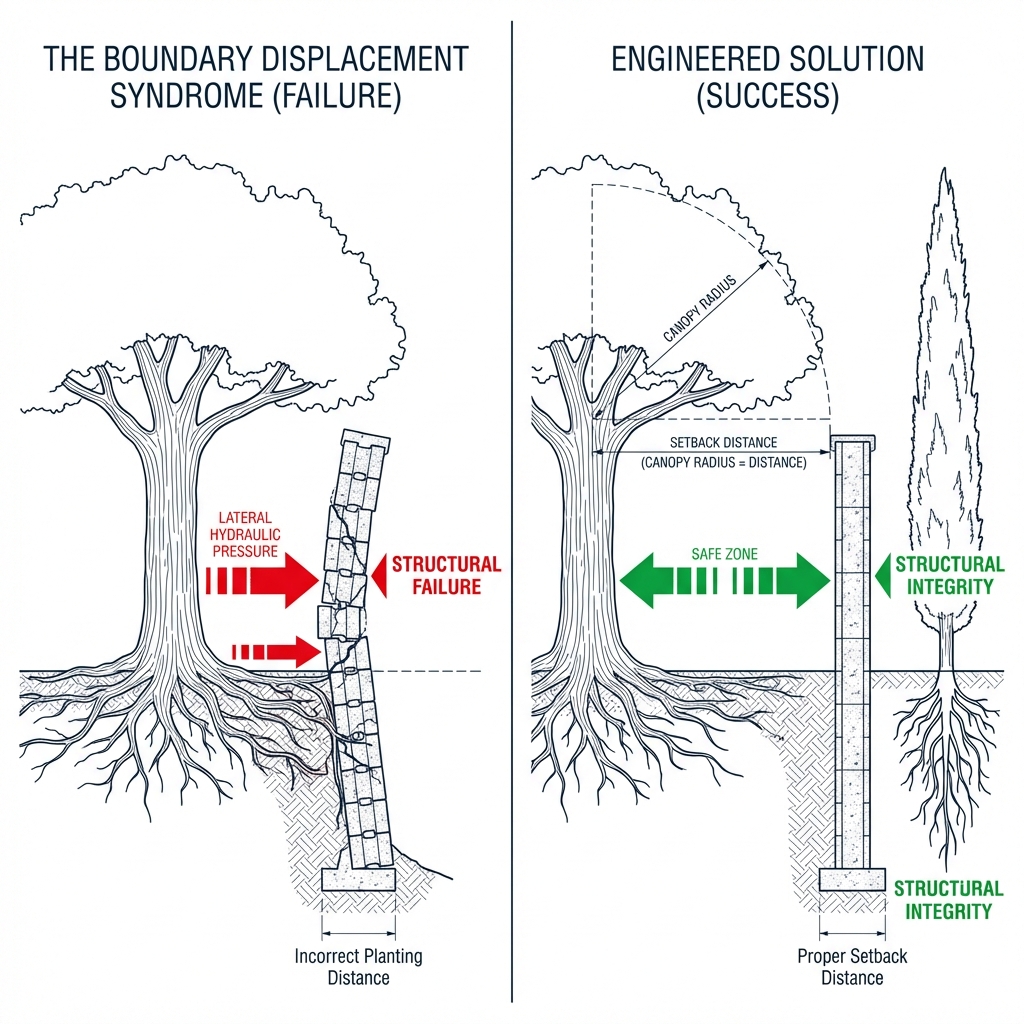
The Boundary Displacement Syndrome
The installation of macro-scale tree species within the narrow setback of a structural boundary or retaining wall.
- Why it fails: As the trunk and root flare expand, they exert immense lateral hydraulic pressure against footings and masonry, eventually cracking walls and tilting fences that were never designed to resist biological force.
- The Diagnostic Test: IF a tree’s ultimate trunk diameter is projected to exceed 50% of the distance between the wall and the lawn, then structural failure is a mechanical certainty., THEN you have The Boundary Displacement Syndrome.
- See the Case Study: Shade Along a West-Facing Fence: How to Get Afternoon Lawn Cover Without Cracking Your Retaining Wall
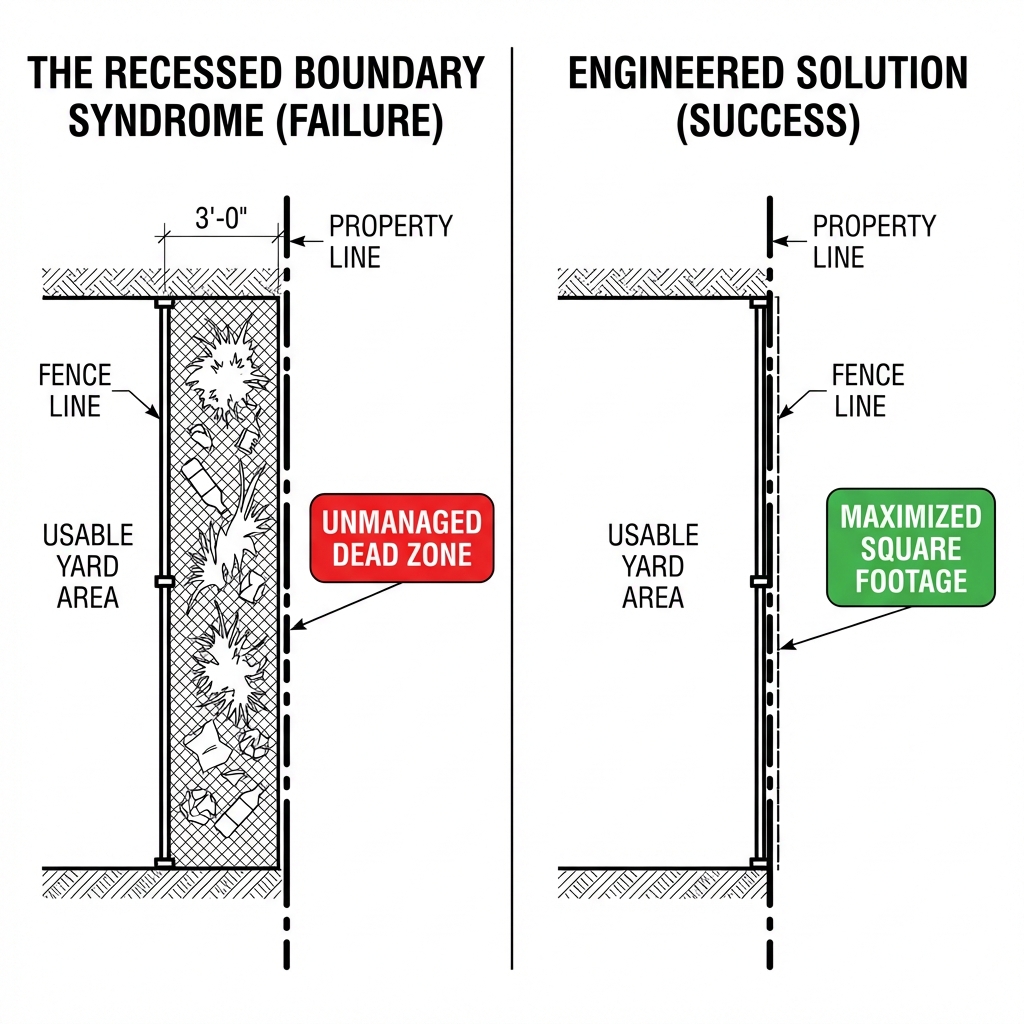
The Recessed Boundary Syndrome
The installation of a secondary barrier or fence offset inside the legal property line, creating an unmanaged and inaccessible 'dead zone.'
- Why it fails: It artificially reduces usable square footage and creates a maintenance liability that traps debris and weeds, leading to a claustrophobic psychological effect in the primary yard.
- The Diagnostic Test: IF the physical fence line is offset from the legal property boundary, then the resulting interstitial space becomes a functional dead zone., THEN you have The Recessed Boundary Syndrome.
- See the Case Study: Small Yard, Big Dreams: How to Reclaim Dead Space and Fit It All In
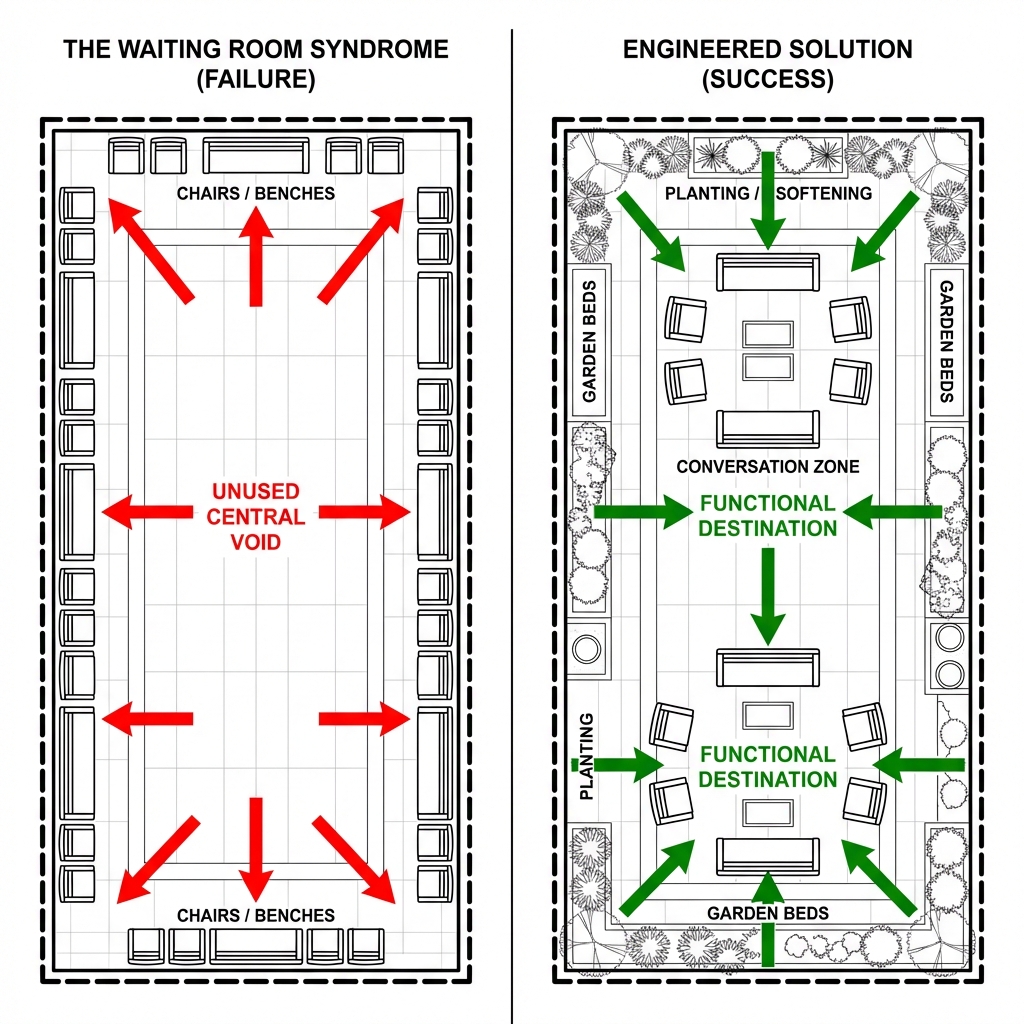
The Waiting Room Syndrome
A spatial planning failure in enclosed courtyards where furniture and functional elements are pushed against the perimeter, creating an unused central void.
- Why it fails: This layout highlights the architectural 'boxiness' of the enclosure and creates a 'dance floor' effect—a sterile, transactional space that feels like a pass-through rather than a functional destination.
- The Diagnostic Test: IF the center of a courtyard remains a 'dead zone' of empty hardscape while all seating is pinned against the walls or fences, then the site is suffering from the Waiting Room Syndrome., THEN you have The Waiting Room Syndrome.
- See the Case Study: The "Waiting Room" Effect: How to Fix a Sterile Box Backyard
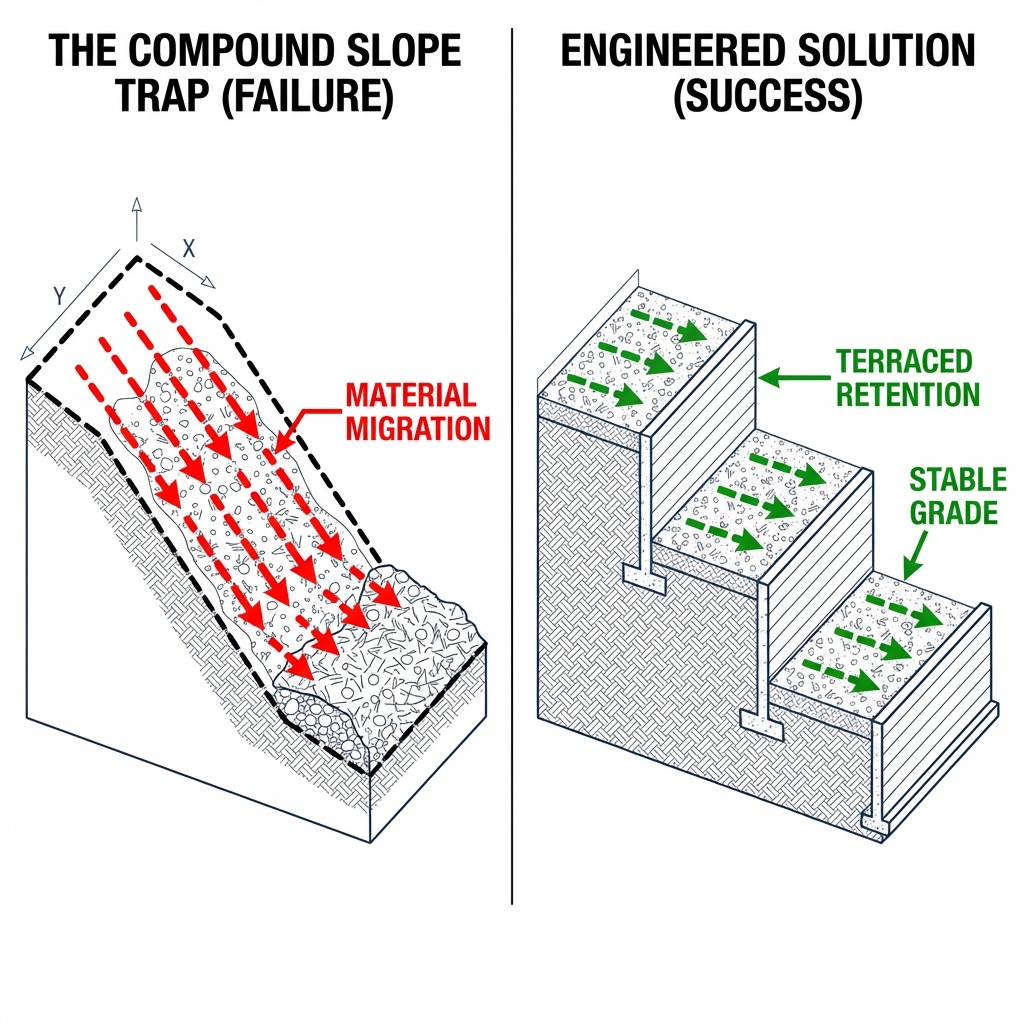
The Compound Slope Trap
A landscape failure where a terrain featuring simultaneous vertical and lateral gradients (twisting along X and Y axes) is treated as a simple slope, leading to material migration and unmanaged dead zones.
- Why it fails: Gravity exerts multi-directional force on surface runoff and loose materials; without an engineered 'cut and fill' approach, topical additions like gravel or soil will migrate toward the lowest point, destabilizing the grade and allowing opportunistic weeds to dominate the transition zones.
- The Diagnostic Test: IF the ground drops away in two directions simultaneously and surface materials (mulch, gravel, or topsoil) are visibly migrating toward the lowest corner of the property, then you are caught in a Compound Slope Trap., THEN you have The Compound Slope Trap.
- See the Case Study: The "Double-Slope" Trap: Fixing a Weedy Hillside for Caravan Storage
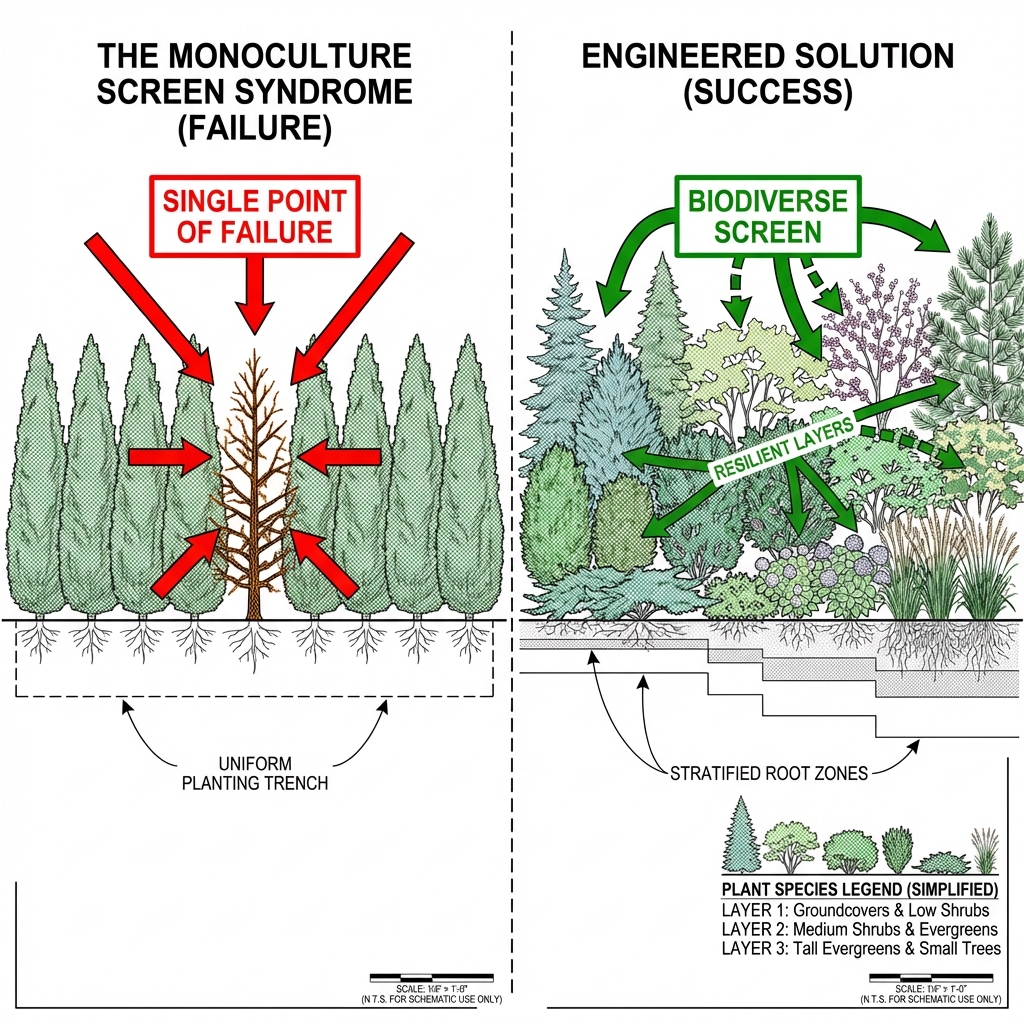
The Monoculture Screen Syndrome
The practice of planting a single species in a tight, linear, and equidistant row to create a privacy barrier.
- Why it fails: This configuration creates a high-risk aesthetic where a single plant failure (the 'missing tooth' effect) ruins the entire composition; furthermore, the lack of species diversity and vertical layering results in a rigid, artificial boundary that makes the yard feel smaller and lacks seasonal depth.
- The Diagnostic Test: IF a privacy hedge consists of only one species planted in a perfectly straight line with no secondary layering, then it is a Monoculture Screen susceptible to total aesthetic and structural collapse., THEN you have The Monoculture Screen Syndrome.
- See the Case Study: Stop Planting "Green Giant" Walls: How to Layer a Privacy Screen That Actually Looks Good
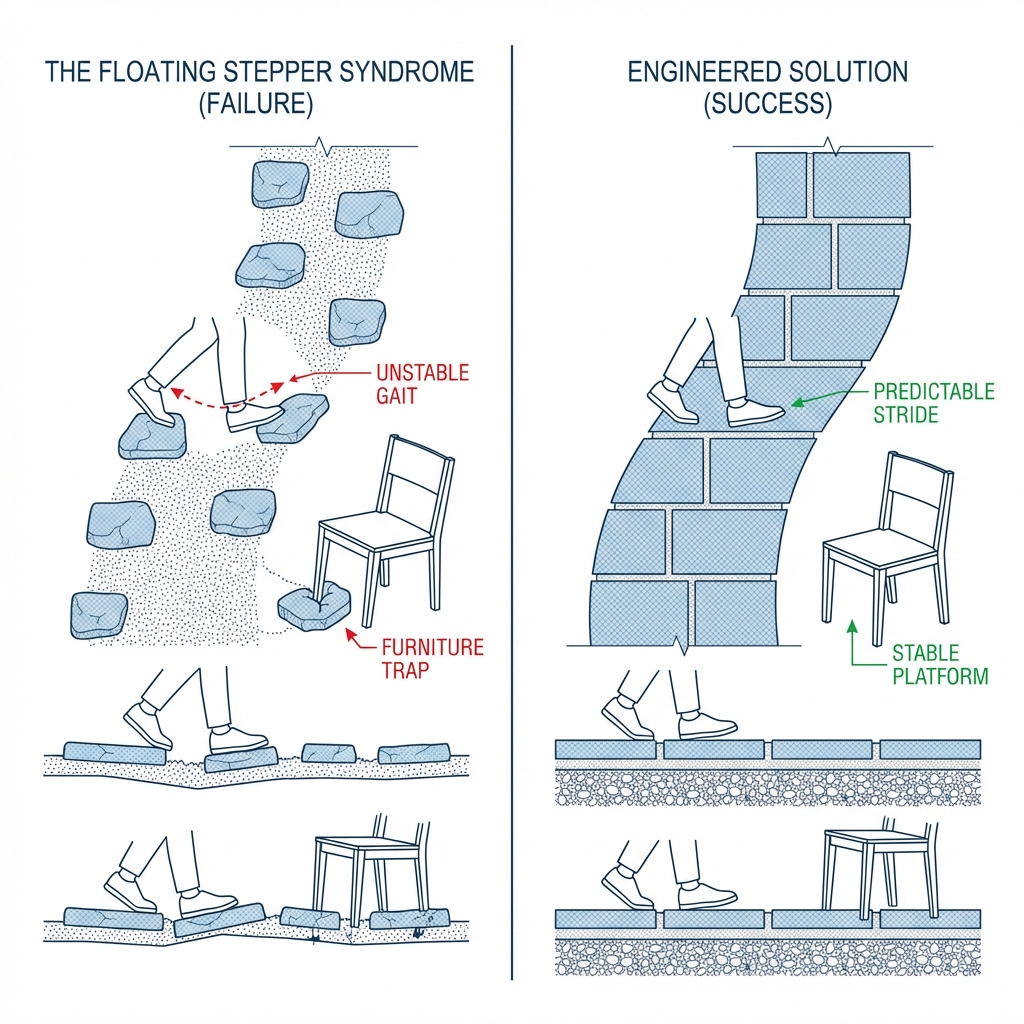
The Floating Stepper Syndrome
The installation of isolated paving units with wide gaps in a high-traffic zone, forcing a specific stride length and preventing furniture placement.
- Why it fails: By prioritizing coverage over density, the hardscape fails to provide a stable platform for living (furniture) or walking (gait variance), effectively rendering the space useless.
- The Diagnostic Test: If you have to look at your feet to walk across your yard without tripping, you have Floating Stepper Syndrome.
- See the Case Study: Budget Rental Rescue: Fixing the 'Floating Stepper' Trap
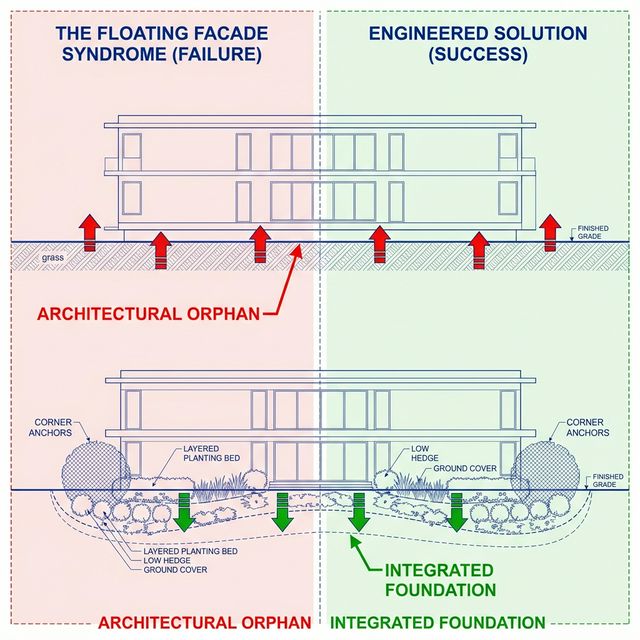
The Floating Facade Syndrome
A visual failure where a large architectural mass lacks vertical landscape anchors, causing it to appear ungrounded and disproportionately long relative to the horizontal grade.
- Why it fails: Without mid-ground vertical elements (trees) to break the viewing plane, the human eye travels the full length of the structure uninterrupted, emphasizing its bulk and creating a commercial or institutional appearance.
- The Diagnostic Test: If the house appears to sit 'on top' of the landscape rather than 'in' it, and the facade length exceeds 60 feet without vertical vegetation, then it is a Floating Facade.
- See the Case Study: Fixing the 'Motel' Look: How to Anchor a Floating House Without Remodeling
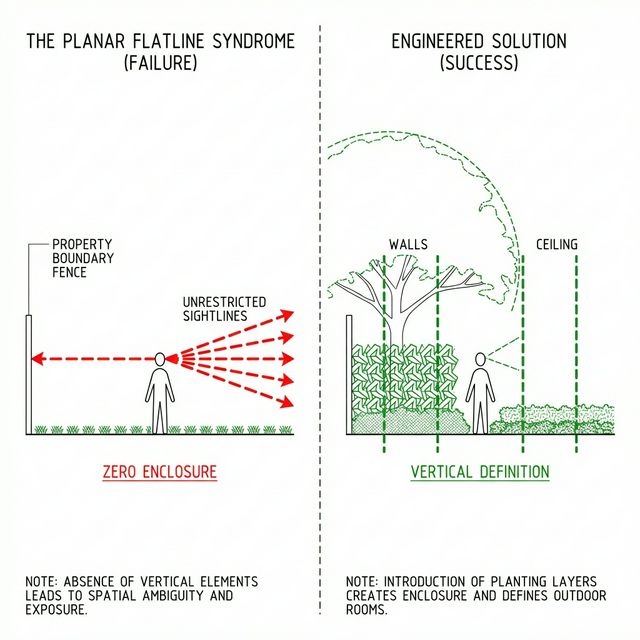
The Planar Flatline Syndrome
A spatial failure where a landscape lacks vertical definition or enclosure, resulting in a 2D 'factory floor' aesthetic that offers no psychological shelter or privacy.
- Why it fails: Humans have an innate psychological need for 'prospect and refuge.' A completely flat landscape offers prospect (you can see everything) but zero refuge (you are exposed), creating subconscious anxiety and preventing relaxation.
- The Diagnostic Test: If you can see from one end of the property to the other at eye level without a single vertical obstruction breaking your line of sight, you have The Planar Flatline Syndrome.
- See the Case Study: From Mud Pit to Beer Garden: Fixing the 'Flatline' Allotment
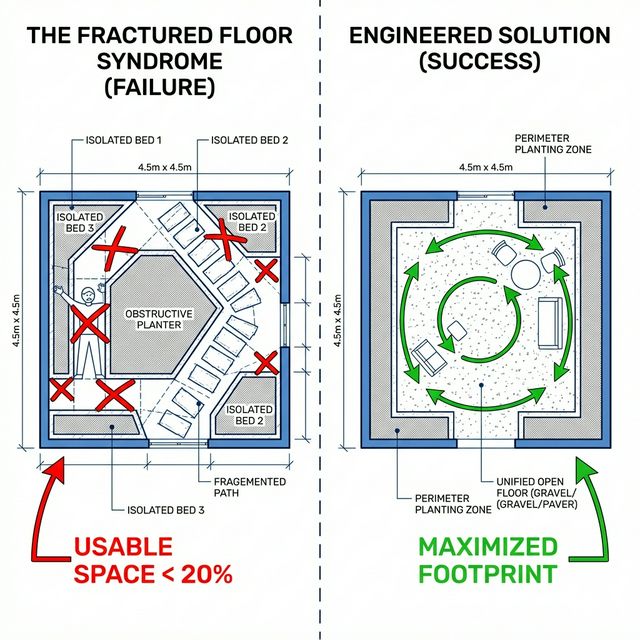
The Fractured Floor Syndrome
The subdivision of a small, confined courtyard into unusable geometric slivers by rigid, angular hardscaping.
- Why it fails: Breaking a small ground plane with central obstacles (planters, paths) destroys the sense of scale and prevents functional use (play, furniture placement).
- The Diagnostic Test: If a path or planter forces you to walk single-file in a yard smaller than 400 sq ft, you have a Fractured Floor.
- See the Case Study: Why Your Shady Dog Yard is a Mud Pit (And How to Fix It)
The Inverted Privacy Screen Syndrome
The attempt to create visual privacy from a public right-of-way by planting macro-scale screening flora directly against the architectural foundation rather than at the property boundary.
- Why it fails: It traps the architecture behind a wall of vegetation, shrinking the perceived depth of the yard, blocking natural light from windows, and failing to actually block sightlines from the street to the yard.
- The Diagnostic Test: If your privacy planting requires pruning just so you can see out of your own front window, Then you have The Inverted Privacy Screen Syndrome.
- See the Case Study: How to Fix Front Yard Privacy When Your Shrubs Are Eating the House
Category IV: Maintenance & Mechanical Conflict
Failures related to pruning, access logistics, electrical integration, and sequencing.
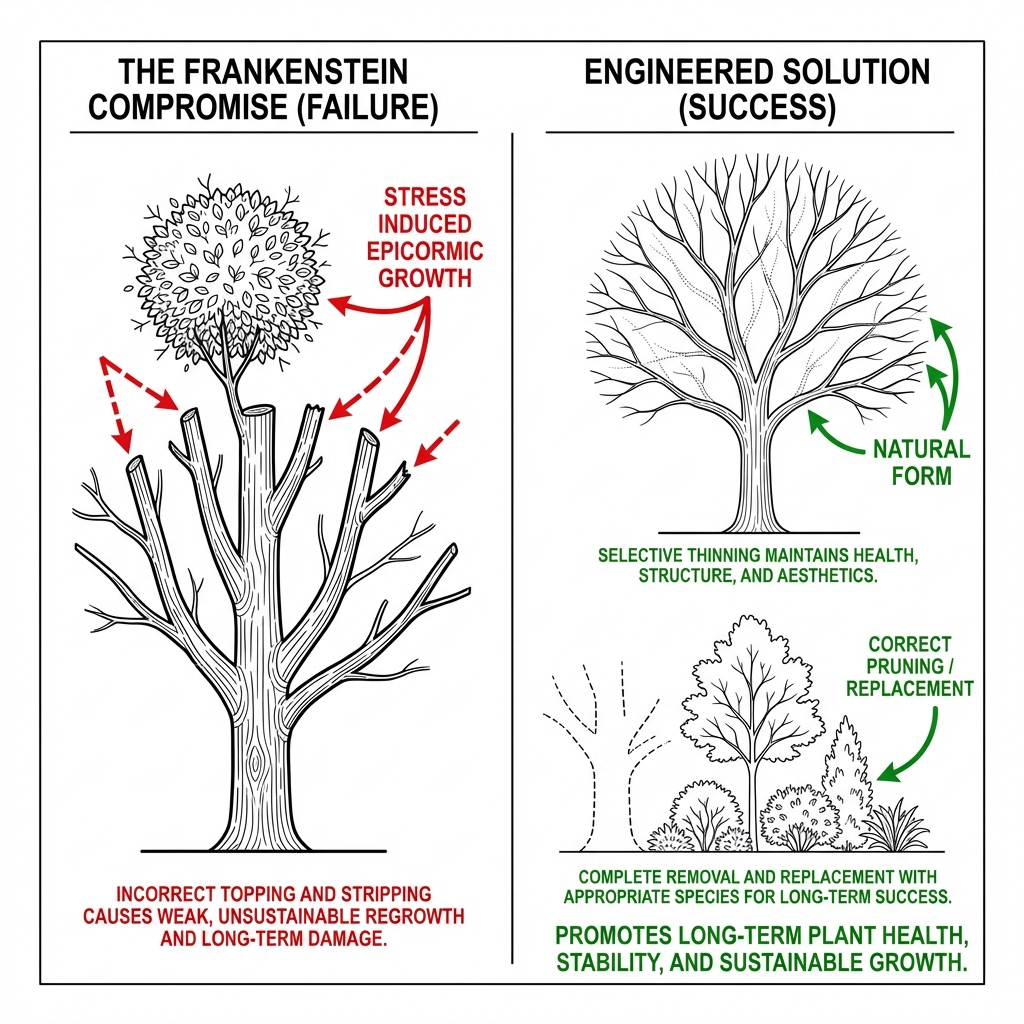
The Frankenstein Compromise
A maintenance failure where a large-scale screening element is aggressively topped and stripped of lateral growth rather than being fully removed or properly rejuvenated.
- Why it fails: By removing terminal leaders and lower canopy foliage, the plant is forced into a state of structural stress that produces weak epicormic growth; this results in a 'lollipop' aesthetic that fails to provide functional privacy while exposing an unsightly, woody interior.
- The Diagnostic Test: IF a formerly solid hedge has been reduced to bare vertical trunks with isolated 'pom-poms' of foliage on top, then it is a Frankenstein Compromise., THEN you have The Frankenstein Compromise.
- See the Case Study: My Neighbor Butchered the Shared Hedge: What Happened and How Do I Fix This View?
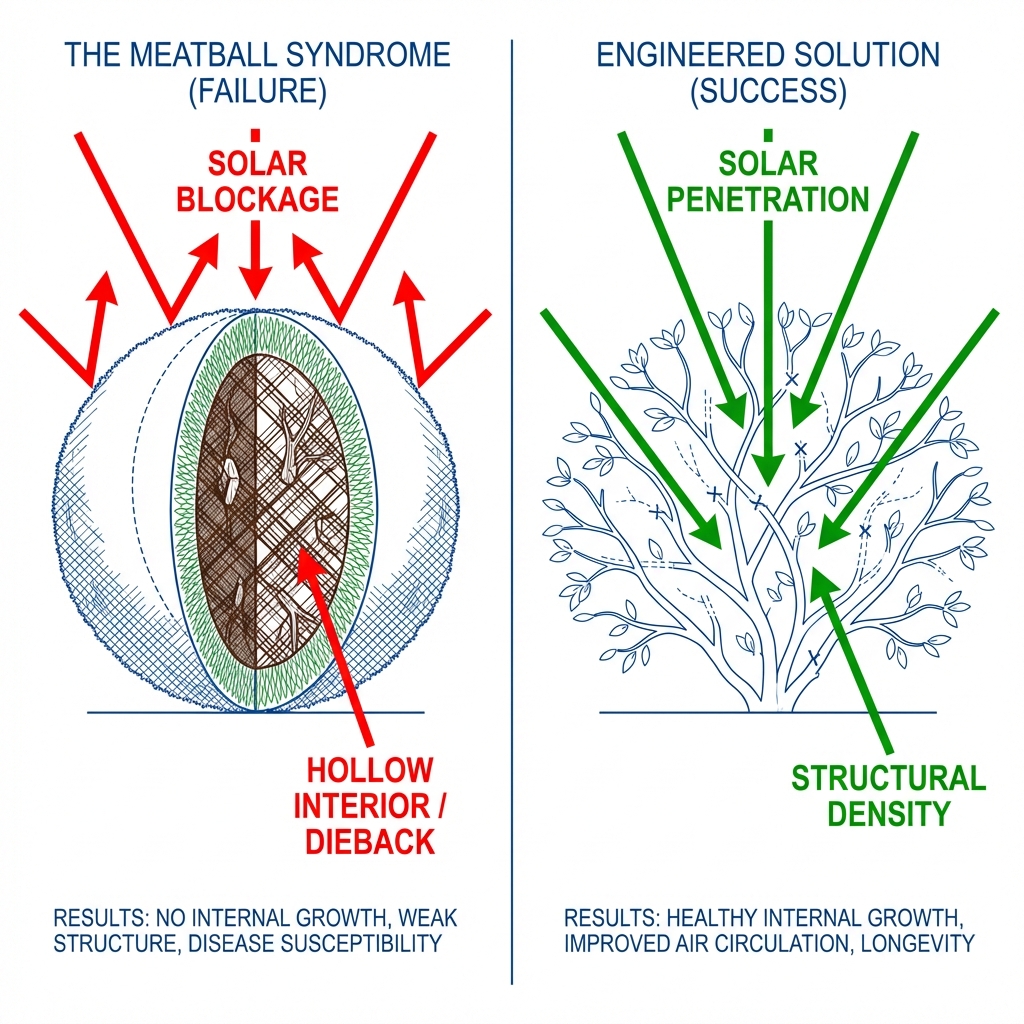
The Meatball Syndrome
A maintenance-induced failure where plants are repeatedly sheared into rigid geometric shapes, creating a thin outer shell of foliage with a hollow, woody interior.
- Why it fails: Frequent shearing prevents light from reaching the inner canopy, causing the plant to shed interior leaves; when this green 'skin' is breached by over-pruning, the plant exposes a non-photosynthetic 'dead zone' that lacks the latent buds required for regeneration.
- The Diagnostic Test: IF a shrub is green only on the outer 2 inches and contains a bare, skeletal interior, then pruning beyond that green shell will result in a permanent 'dead zone' failure., THEN you have The Meatball Syndrome.
- See the Case Study: The 'Dead Zone': Why Your Hedge Turned Brown After Pruning and How to Save It
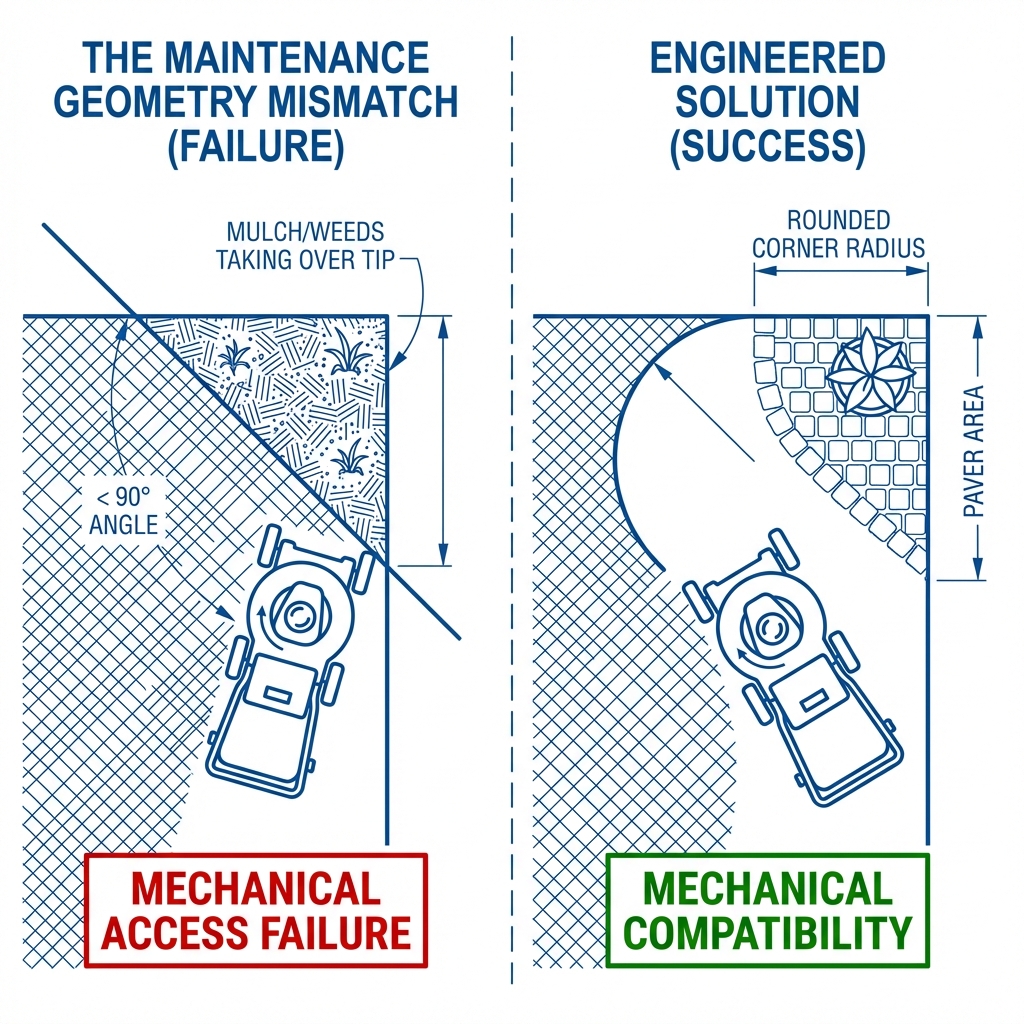
The Maintenance Geometry Mismatch
A spatial planning failure where the dimensions of a confined area or the spacing of structures prevents the use of standard mechanical maintenance equipment.
- Why it fails: By ignoring the 'mower geometry' of the site, homeowners are forced into high-labor manual trimming that results in 'green sludge' clippings on crops and mechanical 'shrapnel' damage to the wooden or metal structures.
- The Diagnostic Test: IF the clearance between fixed vertical elements is narrower than the turning radius and width of the site's primary mower, then turf should be rejected in favor of inert or self-limiting ground covers., THEN you have The Maintenance Geometry Mismatch.
- See the Case Study: The Raised Bed Floor Trap: Why Grass Is a Nightmare (And What to Use Instead)
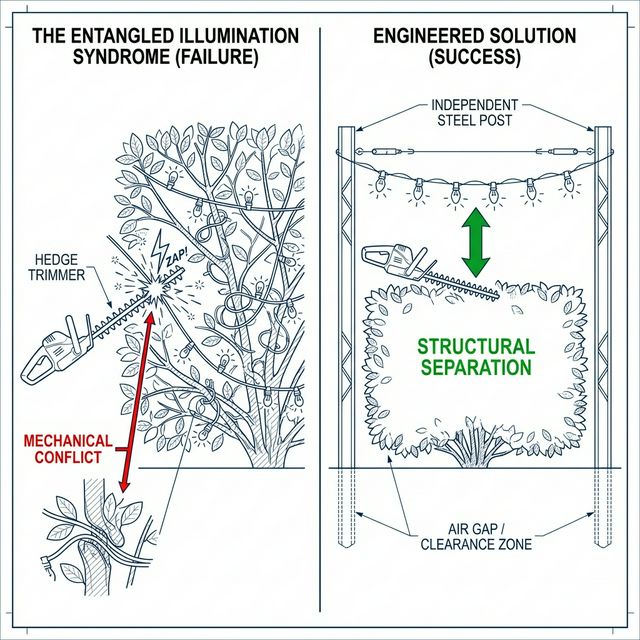
The Entangled Illumination Syndrome
The practice of integrating static electrical infrastructure directly into a dynamic biological canopy that requires regular mechanical maintenance.
- Why it fails: Biological growth inevitably occludes the light source, while the lack of mechanical separation creates a significant hazard during pruning, leading to severed cords or electrical shorts.
- The Diagnostic Test: IF the illumination source relies on living foliage for structural support rather than independent posts or architectural mounts, then the system is destined for maintenance-induced failure., THEN you have The Entangled Illumination Syndrome.
- See the Case Study: Stop! Don't Weave String Lights Into Your Hedges (And What to Do Instead)
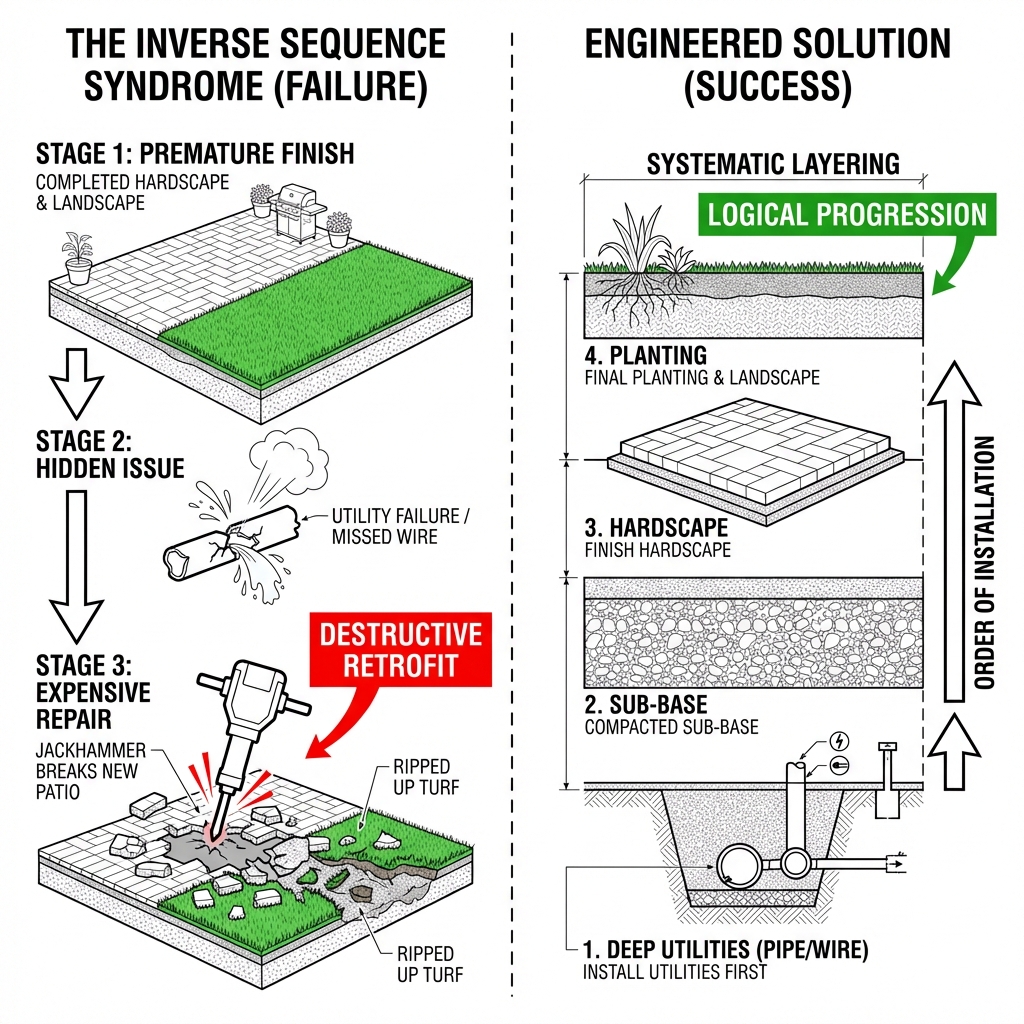
The Inverse Sequence Syndrome
The installation of delicate biological material (softscape) before the completion of structural site work (hardscape) and final grading.
- Why it fails: Subsequent construction activity—including heavy machinery, material staging, and concrete dust—inevitably damages new plantings, while the lack of established hardscape elevations leads to 'trapped' drainage zones and incorrect plant heights that are difficult to rectify post-planting.
- The Diagnostic Test: IF plants are being installed in a yard where the final footprint of patios, decks, or walkways has not been physically established and the finished floor levels are unknown, then the site is suffering from The Inverse Sequence Syndrome., THEN you have The Inverse Sequence Syndrome.
- See the Case Study: The "Plants First" Trap: Why Your New Fence Needs Hardscape Before Greenery
The Inverted Canopy Syndrome
A structural and biological failure in formal hedging where the upper canopy is allowed to grow wider than the base, permanently shading out the lower foliage and resulting in bare, woody scaffolding.
- Why it fails: Plants are phototropic. If the top of a formal hedge is allowed to block the sun, the plant abandons its lower leaves to push all metabolic energy upward, creating a top-heavy, hollow structure that offers no low-level privacy.
- The Diagnostic Test: If a formal hedge has a thick green top but bare, woody stems for the bottom 3 to 4 feet, Then you have The Inverted Canopy Syndrome.
- See the Case Study: The Skeleton Hedge Trap: Why Your Privacy Screen is Bare at the Bottom
The Granular Canopy Trap
The installation of loose, unbound jointing materials like sand directly beneath a high-litter shedding canopy, creating a surface that cannot be mechanically cleared without destroying the joint matrix.
- Why it fails: It creates a permanent maintenance conflict where the kinetic force required to remove biological debris (via raking or blowing) exceeds the structural weight of the hardscape jointing material, resulting in inevitable matrix blowout.
- The Diagnostic Test: If you see loose sand or gravel joints buried under constant leaf litter that cannot be swept clean, Then you have a Granular Canopy Trap.
- See the Case Study: Why Sand Between Pavers is a Trap (And How to Fix a Dirty Flagstone Path)
The Flush Border Trap
The application of loose decorative material alongside a flush pedestrian path embedded in turf, creating an unmaintainable boundary that invites turf invasion and mower damage.
- Why it fails: Turf runners easily bridge flush edging to root in loose media, while the proximity to the lawn guarantees kinetic displacement of the material by mower blades.
- The Diagnostic Test: If you see a narrow strip of decorative gravel separating a flush path from a lawn, Then you have a guaranteed future weed trap and mower hazard.
- See the Case Study: Why Your Flush Stone Path is Disappearing (And Why a Gravel Border is a Mistake)
The Foundation Shear Zone
The practice of running high-maintenance biological groundcovers (turf) directly against vertical architectural envelopes, guaranteeing chronic mechanical damage from string trimmers and mowers.
- Why it fails: Mowers and string trimmers cannot cut flush to a vertical plane without the blade or string striking the masonry or siding, leading to cumulative structural damage, scuffed bricks, and severed utility lines.
- The Diagnostic Test: If your lawn meets your house foundation at a 90-degree angle with no intervening buffer bed, Then you have a Foundation Shear Zone.
- See the Case Study: Why Your Lawn Shouldn't Touch Your House (And How to Hide Exposed Wires)
The Synthetic Boundary Trap
The installation of flimsy, surface-mounted plastic or rigid linear edging between turf and softscape, resulting in frost heave, mechanical mower conflict, and visual degradation.
- Why it fails: It introduces a rigid, non-biodegradable, and thermally unstable element into a dynamic biological transition zone, creating a tripping hazard and a permanent obstacle for mechanical maintenance.
- The Diagnostic Test: If you see a wavy, heaving black plastic lip or rotting timber separating grass from a planting bed, Then you have The Synthetic Boundary Trap.
- See the Case Study: Why Plastic Landscape Edging is a Mistake (And What to Do Instead)
The Curb Appeal Bridge
"Curb appeal" is a marketing term for spatial discipline. A property is not attractive because of decoration; it is attractive because the geometry, drainage, and biological constraints are mathematically coherent. When a landscape looks "wrong," it is because the eye detects a violation of scale or a failure in material logic. Fix the engineering, and the aesthetic corrects itself.
Initiate Curb Appeal Optimization
You cannot fix what you cannot measure. The human eye creates blind spots regarding slope ratios and proportion errors. Upload a photo of your property to run a full diagnostic scan against our engineering database.
The Micro-Basin Inundation Syndrome
A hydraulic and biological failure where concentrated, uncontrolled roof runoff is channeled directly into a restricted-volume container, resulting in rapid soil saturation and root asphyxiation.
- Why it fails: Roof surface areas collect massive volumes of water during even minor rain events. Funneling this catchment into a small pot overwhelms the container's drainage capacity, instantly flushing out nutrients, displacing soil, and drowning the root system in an anaerobic environment.
- The Diagnostic Test: If you see a downspout, rain chain, or makeshift gutter discharging directly into a potted plant or small hanging basket, Then you have a guaranteed root rot scenario.
- See the Case Study: Why You Should Never Funnel Roof Runoff Into Hanging Plants (And How to Actually Water Them)
The Shallow-Root Riparian Failure
The structural collapse of a waterway bank caused by relying on shallow-rooted turf grass to resist high-velocity hydraulic shear forces.
- Why it fails: Turf grass roots only penetrate two to three inches into the soil, creating a weak, superficial crust that easily shears off when the underlying, unprotected earth is undercut by moving water.
- The Diagnostic Test: If you see a sheer, vertical dirt cliff alongside a creek topped with perfectly mowed lawn, Then you have The Shallow-Root Riparian Failure.
- See the Case Study: Why Your Creek Bank is Collapsing (And How to Fix It Without a Retaining Wall)
The High Angle Exposure Syndrome
A spatial failure where a ground level recreational zone lacks overhead canopy or architectural interruption, leaving it entirely exposed to steep sightlines from adjacent elevated structures.
- Why it fails: Relying on traditional perimeter fences or ground level screening cannot intercept downward sightlines, completely destroying the psychological shelter and privacy of the space.
- The Diagnostic Test: If you can make direct eye contact with a neighbor's second story window from your seating area, Then you have High Angle Exposure Syndrome.
- See the Case Study: Fixing the Fishbowl: How to Block Second Story Neighbors Without Crowding Your Pool