Sloped Backyard Ideas
A sloped backyard gets expensive when you try to flatten it before you understand it.
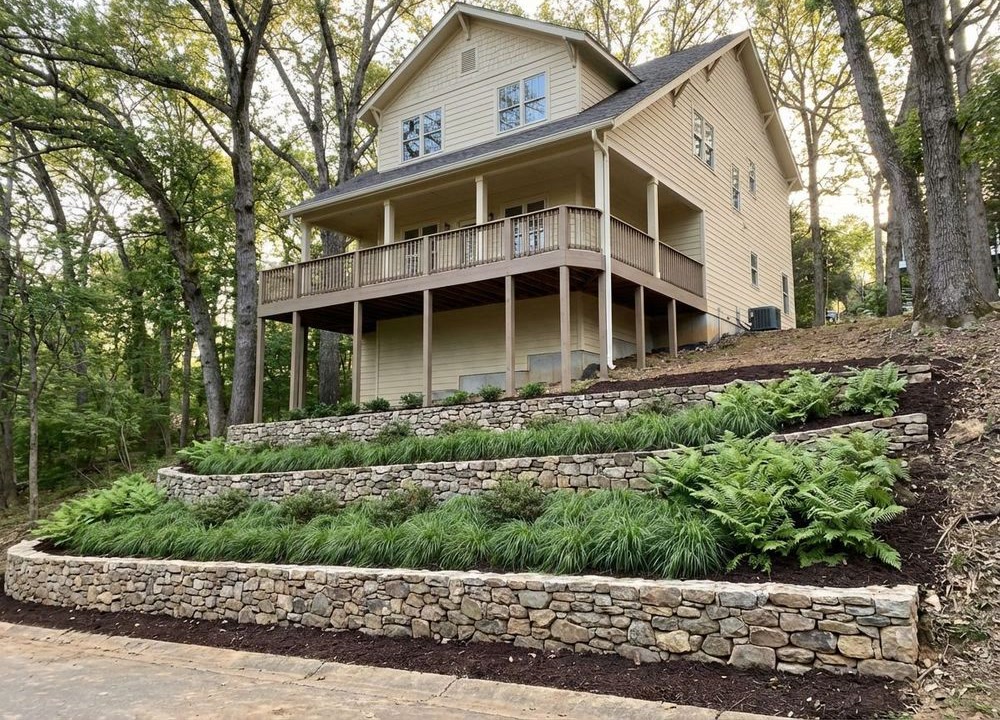
A sloped backyard gets expensive when you try to flatten it before you understand it.
Many slope projects go wrong because the first instinct is to fight the grade: force a lawn onto it, overbuild a retaining wall, or spread loose mulch and hope it stays put. Better slope design starts by deciding which parts of the grade should carry people, which parts should hold planting, and which parts should simply be stabilized and left alone.
What a Sloped Backyard Must Do Well
Every good sloped-yard plan needs answers to four questions:
- where people move
- where water goes
- what needs to be level
- what can stay sloped
If those are clear, the design gets simpler fast.
The Main Ways to Use a Slope
1. Create One Level Destination
Not every sloped yard needs full terracing. Often the best move is one useful level space:
- a sitting area near the house
- a small lawn shelf
- a fire pit terrace
Then the rest of the slope can become planting, stone, or a shaped transition instead of a fake flat yard that constantly fails.
2. Turn the Slope Into Planting
If a hill is dangerous to mow, hard to irrigate, or too rocky for turf, stop trying to make it behave like lawn. Slopes often work better as:
- rock garden planting
- low woodland planting
- drought-tolerant massing
- layered shrub zones that hold soil visually and physically
3. Use Steps and Paths as Structure
On a slope, access is design. A path that lands in the wrong spot or steps that feel bolted on will make the whole yard feel awkward.
The best sloped-backyard ideas use paths and steps to:
- connect the house to the main usable zone
- split a long slope into digestible sections
- make the grade feel intentional instead of hostile
4. Build Walls Only Where They Solve Something
Retaining walls can be useful, but they are not automatically the smartest answer. In many backyards, a wall is only justified when you need one of these:
- a true level pad
- edge support near a hardscape or pool
- safe grade transition where the slope is too abrupt
If the main problem is mowing difficulty or washout, planting and grading can sometimes solve it more elegantly.
Good Sloped Backyard Ideas by Problem
If the Hill Is Washing Out
- stabilize first, decorate second
- use rooted planting and surface control together
- stop using sliding mulch as the whole solution
If the Hill Is Impossible to Mow
- stop treating it as lawn
- choose a planted slope or rock garden approach
- make maintenance part of the design brief, not an afterthought
If the Slope Cuts the Yard in Half
- create one clear destination at the top or bottom
- connect it with direct access
- use planting masses to make the rest of the grade feel composed
If You Think You Need a Retaining Wall
Before building one, ask:
- do you need a level pad or just a better slope?
- can one short wall do the job instead of a full wall system?
- would steps, planting, or a path solve the real problem more cleanly?
What Usually Makes a Sloped Backyard Worse
- spreading loose material on a steep grade without real stabilization
- building a wall everywhere instead of where it matters
- forcing lawn onto a slope that should be planted
- creating access as an afterthought
More Yard Examples
- Slanted Garden Solutions: Taming the Compound Slope Trap
- The Denuded Grade: How to Stop Your Steep Backyard From Washing Away
- Stop Mowing That Rocky Slope: Turning a "Nightmare" Hill Into a Rock Garden
- Skip the Retaining Wall: A Smarter Fix for a Mild Slope and Tricky Mowing Strip
- Retaining Wall on a Steep Slope: Where You Can Dig (and What Will Break It)
See the Grade Before You Commit to the Build
Slope projects are hard to visualize because every move changes the whole yard. One path changes circulation. One wall changes drainage. One planted mass changes how steep the site feels.
Use the backyard design app when the slope plan also needs patio placement, privacy, seating, lawn shape, or planting beds tested as one full yard design.
Use AI Landscape Design to test planted slopes, steps, walls, terraces, and usable-level zones on your own yard photo before you commit to excavation.